With or without bike lanes, streetcar and light rail streets attract bicycle traffic. Making these streets safe for people using bikes is critical for preserving local destination access, and is often important for bike network connectivity.
If high-comfort bicycle facilities cannot be implemented on streetcar and light rail streets, parallel high-comfort bicycle routes should be provided in addition to basic destination-access bicycle accommodations on streetcar streets.
Dongho Chang
Discussion
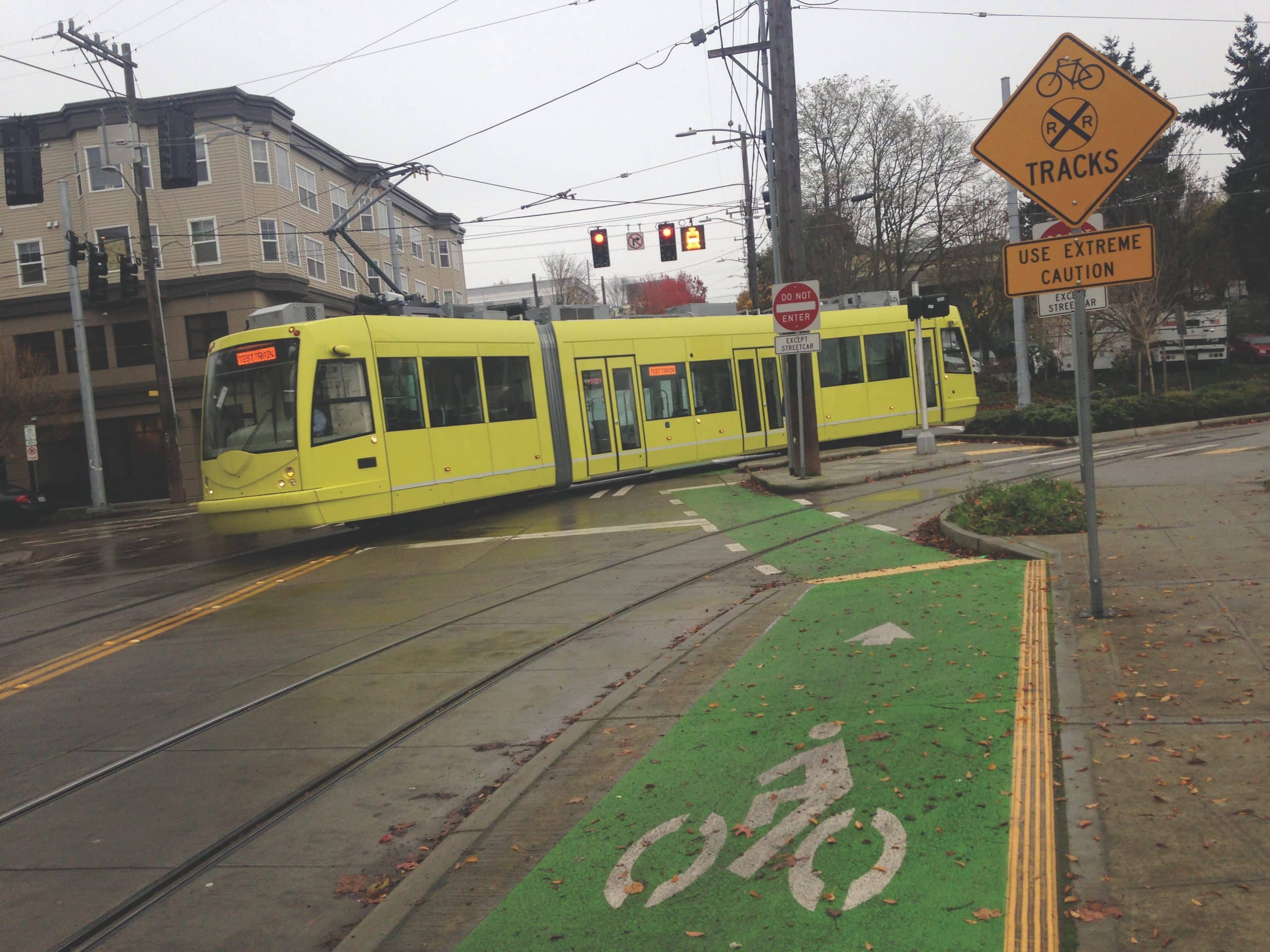
Bicycle tires can become stuck in rail flanges when in-street tracks are crossed at too low an angle, causing the bicycle rider to fall. Particular attention must be paid where streetcar tracks bend or turn, where light rail tracks cross a street, or where bicycle lanes or bicycle turning movements cross tracks.
Bicycling adjacent to tracks can also pose dangers, particularly pronounced when a bicyclist must be prepared to swerve to avoid unforeseen obstacles such as opening vehicle doors.
A variety of design techniques can prevent these injury-causing falls by directing bicyclists to cross tracks at higher angles, and by guiding people on bikes to ride a safe distance from rails while riding parallel to them.
Application
Bike-friendly track crossings are applicable wherever streetcar or light rail tracks turn across a bikeway (including any bike lane, bike boulevard, or cycle track), where a bikeway turns across tracks, and at any intersection where bike turns are accommodated, especially where two bike lanes intersect.
Bike-friendly trackway design is applicable to all mixed-traffic streetcar and light rail running ways.
Critical
Where bicycle paths of travel cross a street-surface rail track, bicyclists must be directed to cross tracks at a high angle. While 90-degree crossings are preferred, 60 degrees is the minimum design angle for bikeways to cross in-street rails.
Bicyclists must be able to cross tracks fully upright and not leaning, with perpendicular or high-angle approaches established in advance of tracks to allow riders to right themselves.
Recommended
Rail Turns Across Bikeways
- A bike sneak is a short section of bicycle lane, protected bicycle lane, or raised cycle track that is bent out (bent toward the sidewalk) to direct bicyclists at a safe angle across turning tracks. Provide bicycle lane markings to direct bicyclists to the right, establishing sufficient space for a safe crossing of rails. Provide intersection markings, at or near a 90-degree angle to the curving track that return bicyclists to the bicycle lane on the opposite side of the intersection without entering the motor vehicle lane. The bike sneak can be marked, raised, channelized, or otherwise protected using a variety of means of separation, depending on the volume of bicyclists and the role of the street in the bicycle network.
- Crossing tracks at an angle less than 45 degrees should be discouraged, both on streets with and without a bicycle facility.
- Warning signage or markings should be used ahead of an intersection or other rail crossing where the natural travel path of a bicyclist, generally parallel to the lane line or curbline, would cross the rail at a low angle.
Bicycle Turns Across Rail
- Two-stage turn queue boxes direct bicyclists to cross rails at a safe angle when turning left across tracks, or turning right across tracks from a left-side bikeway. (Refer to the Urban Bikeway Design Guide for guidance on two-stage turn queue box design).
Bicycle-Friendly Trackways
- Bicycle lanes should include a buffer at least 3 feet wide to account for these instances, and prohibitions of dangerous misuse of the bike lane, such as double-parking, must be strictly enforced. Where possible, physically separating bicycle lanes from streetcar lanes is preferred. In addition to cycle tracks, placing rails on raised beds or transitway design treatments, such as rails in raised beds, or vertical separation, prevent bicycles from entering tracks. Vertical separation may be especially desirable in tight spaces. If curbs are greater than 2 inches, roll curbs or mountable curbs should be considered.
For more on bicycle networks, see Bicycle Access & Networks.
Urban Bikeway Design Guide
Learn more about designing bike-friendly streets in NACTO’s Urban Bikeway Design Guide.