Contraflow transit streets are typically used to simplify transit routing in a complex one-way street network. The contraflow lane is typically configured to the left side of the street, and may operate for only a single block or for an entire corridor. Contraflow transit lanes can be a powerful tool for reducing travel times and improving route legibility, especially where suitable parallel routes do not exist, or where transit would be delayed making multiple or difficult turns.
Streets with left-side contraflow bus lanes operate like two-way streets but with general traffic prohibited in one direction. The use of color along the entire transit lane, optional vertical separation, and refuge islands all can alert people walking, biking and driving to the opposing travel direction of transit. With management or restrictions on left turns, these designs can be safer than two-way streets, and provide an opportunity for two-way protected bikeways along contraflow lanes.
Recommendations
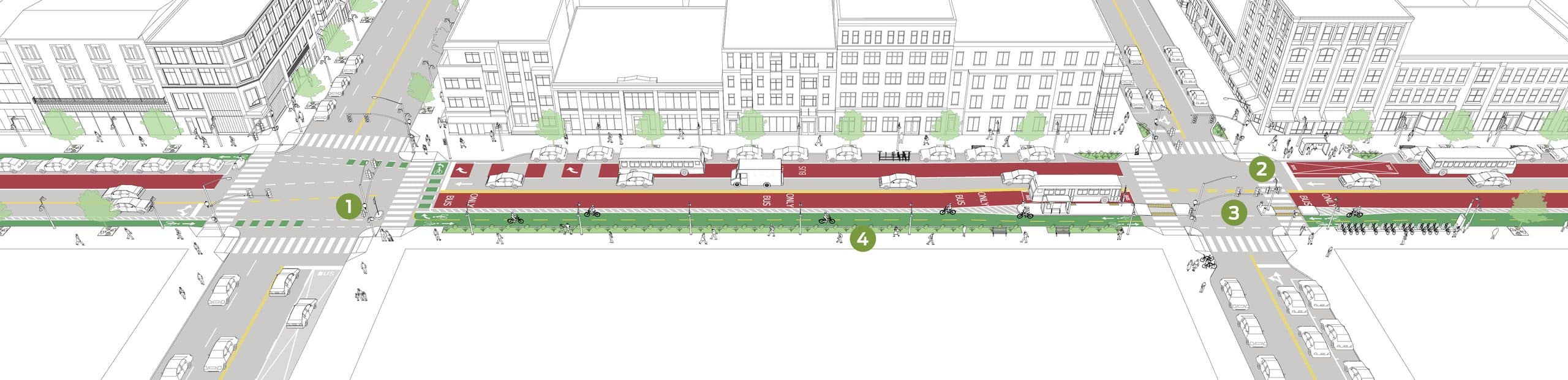
1Gateway treatments that clearly prohibit wrong-way or private vehicle entry at intersections—especially at the beginning of the contraflow segment—are essential to safe and functional operation of contraflow lanes. Forced turns may be marked through the intersection or guided with hard barriers. Wide cross streets provide smooth bus transitions.
Contraflow transit lanes are demarcated by solid double yellow lines (when hard barriers do not separate the lane from opposing traffic).
Multiple routes can be consolidated using a contraflow lane to move buses through congested corridors.
2Contraflow bus lanes can employ TSP to activate the signal when approaching (see Active Transit Signal Priority).
Contraflow lanes should be painted red to discourage vehicles from entering and to alert pedestrians to the presence of a transit lane with vehicles coming from an unexpected direction (see Contraflow Transit Lane).
Prohibit or separate left turn phases at intersections, depending on bus and vehicle turning volumes (see Turn Restrictions).
Give transit vehicles adequate space to operate safely: while curbside lanes can be as narrow as 11 feet, wider contraflow lanes may be desirable given widths of travel lanes in the opposing direction.
3“Hard” barriers (e.g. concrete curb, median strips, bollards, or safe hit posts), or “soft” barriers (e.g. rumble strip or striped buffers) can be used to make the contraflow lane more legible.1 Wider barriers can act as pedestrian refuge islands (see Transit Lane Separation Elements).
4When turning movements across contraflow lanes are restricted, an opportunity to provide a low-stress, bi-directional protected bike lane emerges. Refer to the Urban Bikeway Design Guide for additional design information.
Buses can be re-routed onto a contraflow lane to eliminate the need to make sharp turns, especially through busy crosswalks with poor sight lines—one of the most significant safety conflicts for buses.
Carefully consider pedestrian behavior, enacting measures to discourage pedestrians from entering the roadway without looking, since buses may be coming from an unexpected direction. Pavement markings, audible warnings, and fencing (in limited instances) may improve pedestrian safety.
Contraflow lanes preclude inclusion of street parking or bus bulbs at the curbside in the contraflow direction.
Contraflow lanes must be operated 24 hours, or may generate confusion and conflicts.
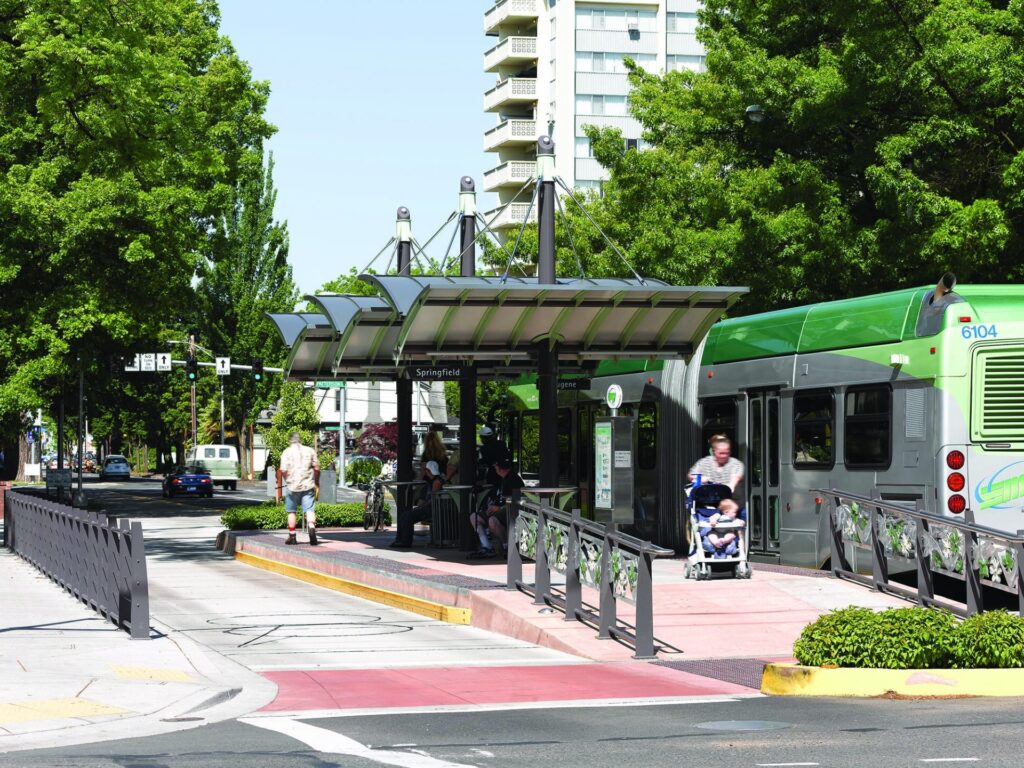
Dan Tutt
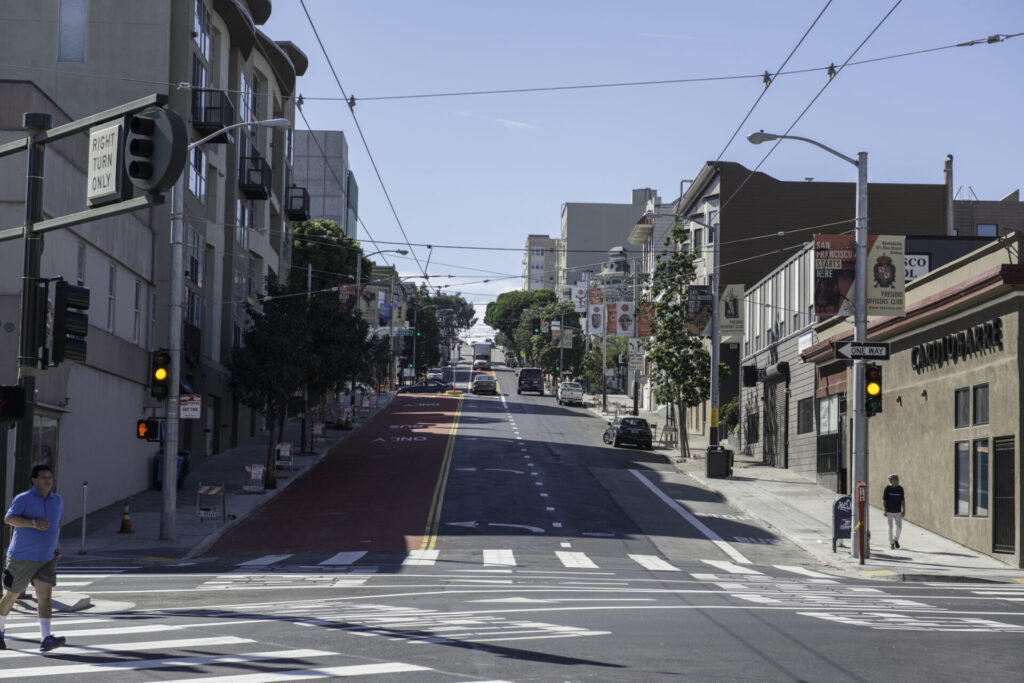
San Francisco Municipal Transportation Agency Photo Library
- If a bus becomes disabled in the contraflow lane, it may be helpful to provide additional space for other buses to pass, as entering the opposing traffic direction is not desired.
Ryus, Paul, Kelly Laustsen, Kelly Blume, Tom Urbanik, and Scott Beaird. Improving Transportation Network Efficiency Through Implementation of Transit-Supportive Roadway Strategies. TCRP A-39, Transportation Research Board, Washington, DC: 2015. ↩︎