Universal design features are critical throughout the transportation network, making it possible for any street user to comfortably and conveniently reach every transit stop.
Universal street design facilitates station access, system equity, and ease of movement for all users, especially people using wheelchairs or mobility devices, the elderly, people with children and strollers, and people carrying groceries or packages.
Employ tactile, visual, and audible design elements together to guide people of all abilities through the street environment. Consistently using detectable surfaces, color contrast, and audible warnings assists all users, enhancing safety and accessibility.

Tactile Cues
Detectable warning strips must be at least 24 inches deep, and must be applied at all curb ramps for their entire width, or at any location where pedestrians cross into another modal zone (i.e. bike lanes or vehicle lanes) along a flush transition (DOT 504 §406.8).1
Where the boarding platform is higher than a typical curb height, including near-level or level boarding platforms, 24-inch deep detectable warning strips must be applied the entire length of the platform edge (PROWAG §R208).2
Where passengers using wheelchairs are directed to specified doors, ensure the accessible doors are clearly communicated throughout the boarding platform using signs and markings.
At sidewalk-level stops, detectable warning strips may be used to indicate door locations.3
Color
Use color consistently to delineate modal zones and edges; for instance, transit lanes may be red/terra cotta, and bike zones or crossings may be green. Color repetition reinforces legibility, and should be employed at conflict zones, flush crossings, or likely sites for encroachment. Color-coded detectable warning strips can draw attention to conflict points.
Detectable warning strips should visually contrast with adjacent surfaces to alert pedestrians that they are crossing into a new modal zone (such as a transitway, bikeway, or vehicle traveled way).
Lighting
Pedestrian-scale lighting, typically including lamps less than 25 feet high, increases comfort and safety around stops.4
Higher illumination around transit stops should be gradual rather than sudden to avoid creation of virtual shadows as driver and bicyclist eyes adjust.
Audible Cues
Signalized crossings may include accessible pedestrian signals (APS), which utilize audible cues to inform pedestrians of signal phases, including announcements or rapid percussive tones. If audible cues rely upon push-button activation, the button should be located near the curb ramp for each crossing direction, and far enough apart to distinguish from other ramps.
Stops and stations with real-time arrival information should include audible announcement capabilities (refer to Passenger Information & Wayfinding).
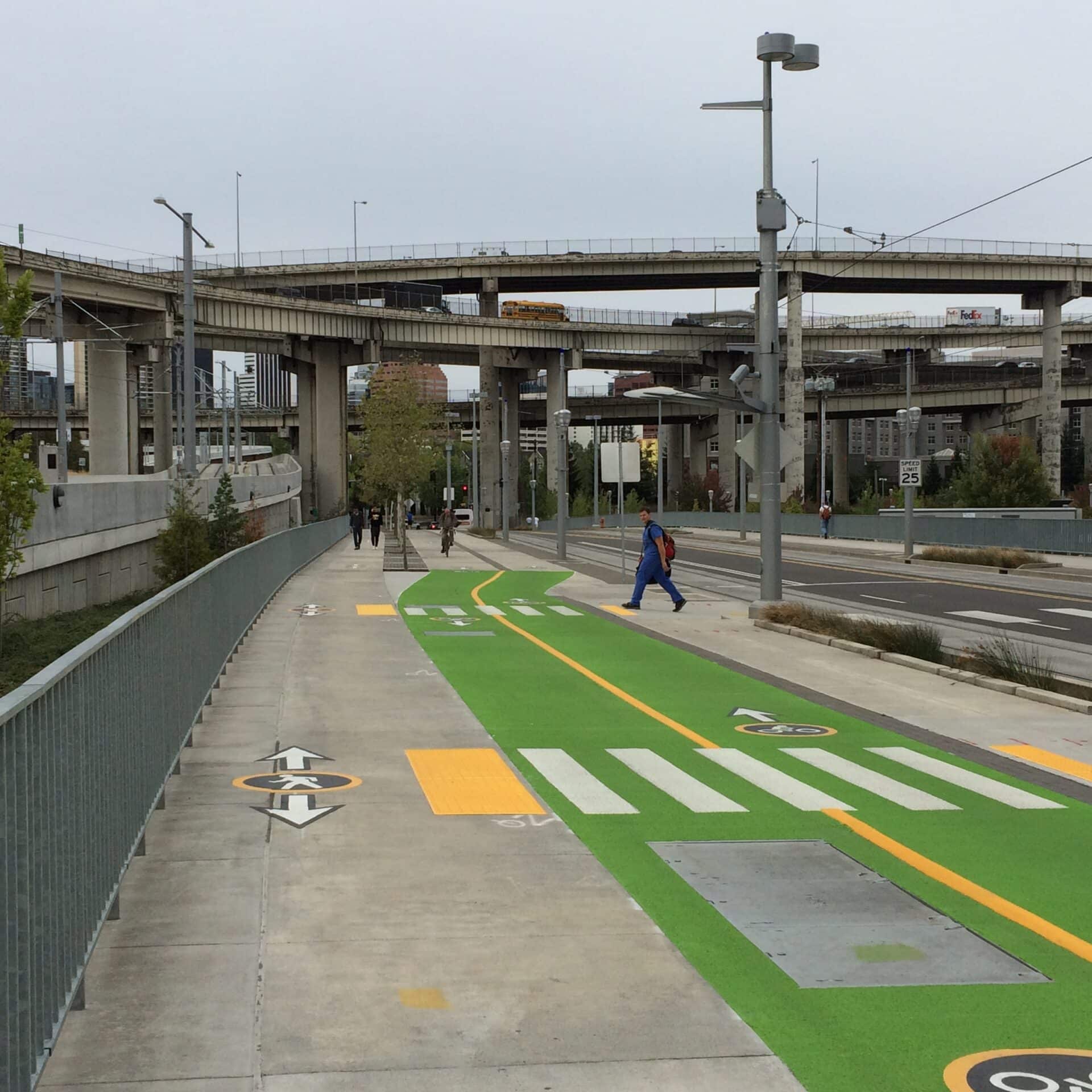
Portland Bureau of Transportation
- “Proposed guidelines require detectable warning surfaces to be installed on newly constructed and altered curb ramps and blended transitions at pedestrian street crossings.”
“Detectable Warning Surfaces on Curb Ramps and Blended Transitions.” Regulatory Assessment of Proposed Accessibility Guidelines for Pedestrian Facilities in the Public Right-of-Way. US Access Board, Washington, DC: 2011. ↩︎ - Although most ADA guidance pertaining to transit platforms refers specifically to rail, which requires a 24-inch wide detectable warning strip along the length of platform edges, cities have applied the same standards and design criteria to BRT platforms, especially where boarding height is greater than 6 inches above the roadbed.
Parsons Transportation Group. Van Ness Avenue Bus Rapid Transit: BRT Design Criteria. Report for San Francisco County Transportation Authority, San Francisco, CA: 2008. ↩︎ - Detectable warning strip may be placed at curb’s edge at the door zone of any bus stop to indicate boarding position.
APTA. Bus Stop Design and Placement Security Considerations. American Public Transportation Association, Washington, DC: 2010. ↩︎ - Boston Complete Streets Design Guide. Boston Transportation Department: 2013. ↩︎