Along waterfronts, parks, campuses and other “edge conditions,” where one side of a street has long stretches with limited vehicular crossings, streets can be configured for high-capacity transit with fewer conflicts. Edgefront transitway corridors use side transitways to create an expanded public realm by insulating people on foot from parallel vehicular traffic. These redesigns can dramatically transform the character of a disused waterfront street or a previously failing megablock, safely integrating multiple street users into a premier streetscape.
Recommendations
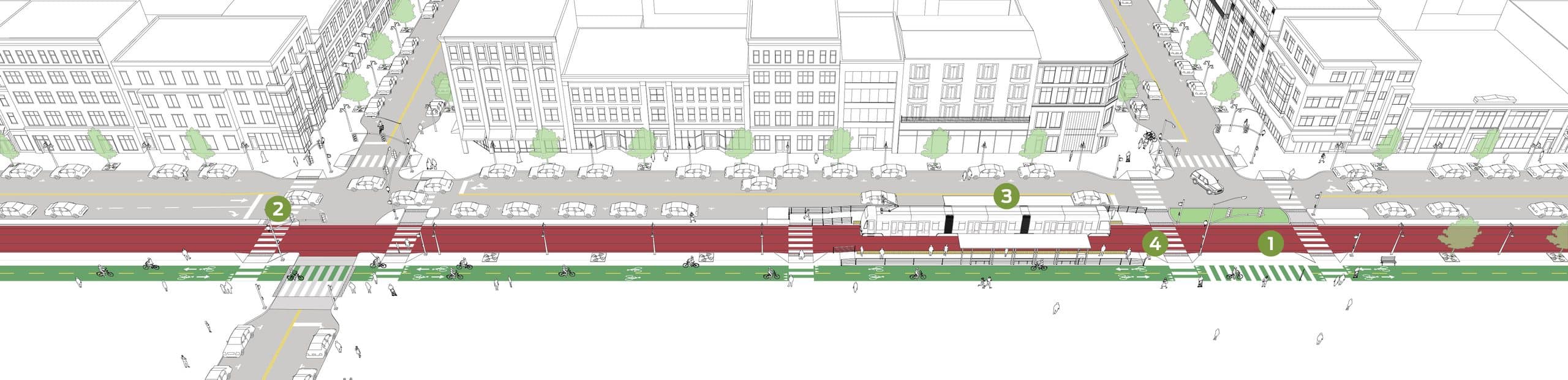
1The configuration of edgefront transit streets—with a bi-directional side transitway located along one side of a street corridor with limited intersecting streets—allows unimpeded transit movement with easy access to the sidewalk (see Side Transitway, for additional guidance).
Since turns across the transitway are extremely limited, a bi-directional transitway can be placed adjacent to a parallel bi-directional bikeway or bi-directional or uni-directional general motor vehicle traffic without significantly increasing the risk of conflicts.
With sufficient turn management, edgefront transit streets can also succeed on a typical street grid.
If limited horizontal separation is available, use vertical separation elements to create a visually exclusive transitway adjacent to vehicle travel lanes (see Transit Lane Separation Elements).
2In the few places where streets cross the transitway, use signage in combination with small curb radii, distinctive materials, and other visual cues to ensure vehicles do not turn into the transitway. Restrict turns across the transitway or use separate turn phases across to avoid conflicts (see Turn Restrictions).
For vehicles turning into travel lanes parallel to the transitway, extending turning lane pavement markings through the intersection helps to indicate the path of travel (MUTCD §3B-08).
Use transit signal heads for the transitway to avoid confusion among other street users.
3In this example, stations accommodate right-side boarding, which can support use by multiple vehicle types, including buses running in an “open BRT” line (for platform design guidance, see Stop Design Factors).
If parking is provided next to the transitway, provide a walkway between the parking and transit lane to permit access to parked vehicles.
4Stations are adjacent to the sidewalk on one side, providing easy pedestrian access. In a downtown or high-activity setting, pedestrian crossings should be provided at all signalized intersections, including T intersections where motor vehicles do not cross tracks. At pedestrian crossings over tracks, provide cues that can be perceived by touch, hearing, and sight. Use audible signals at signalized crossings.
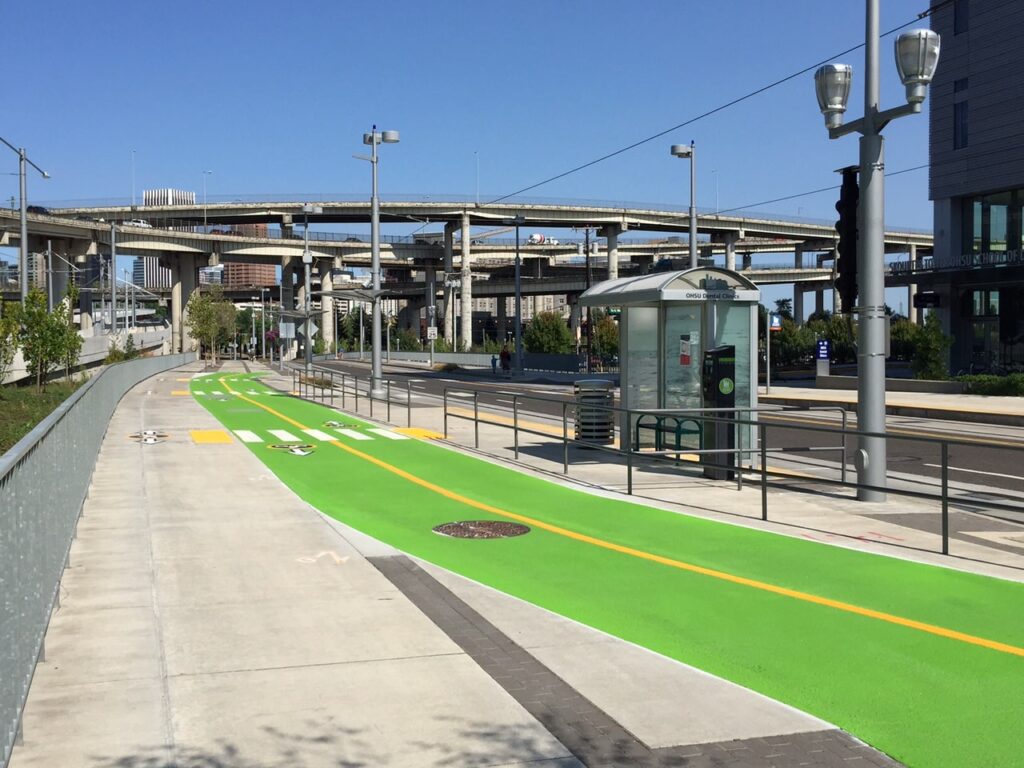
Use street furniture or tactile cues to demarcate the edge of the pedestrian space next to the transit lane. Placing a bikeway between the far sidewalk and the transitway provides additional separation between people on foot and transit vehicles. Use grade separation to prevent bicycles from rolling into the transitway.
Ben Baldwin