Enabling transit vehicles to make in-lane stops confers a broad range of operational and accessibility benefits, and can often be accomplished with little to no adverse impact on general traffic flow.
Transit stops with in-lane boarding require significantly less curb length and do not occupy sidewalk space, freeing room for alternative uses, including expanded pedestrian capacity, green infrastructure, local business access and parking, or street furnishings.
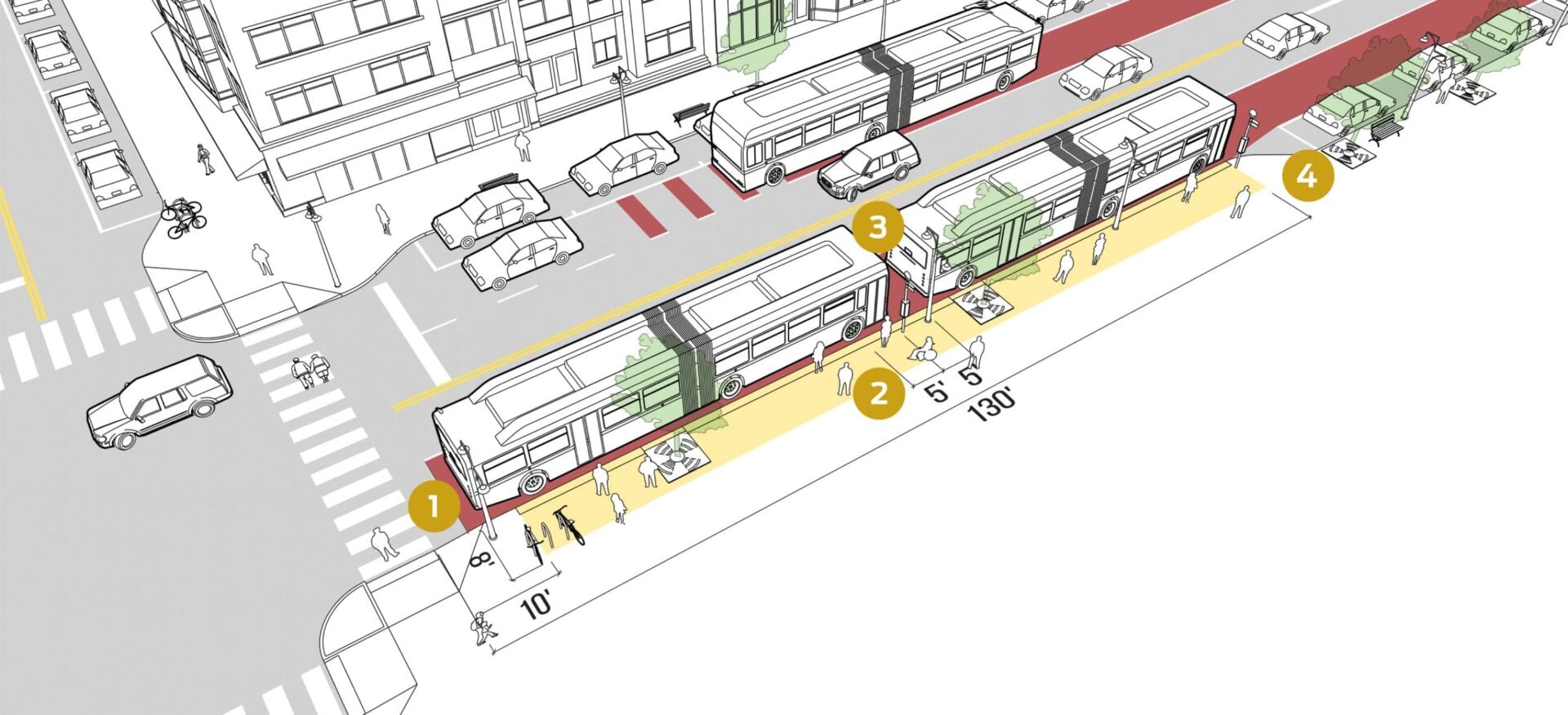
Desired Minimum Platform Length by Vehicle Type (feet)1
| Assessment Criteria | Threshold | Location Performance | ||
|---|---|---|---|---|
| Group 1 | ||||
| Safety | Located on the SAP's High Injury Network | Yes/No | ||
| One or more fatal or serious injury crashes in the past two years | Yes/No | |||
| Ten or more minor injury or property damage crashes in the past two years | Yes/No | |||
| Vehicular Speeds | 50th percentile speed measurement at the location is greater than the posted speed limit for the location | Yes/No | ||
| Vehicular Volumes | Local roads: >100 vehicles during the weekday peak hour | Yes/No | ||
| Collector roads: >300 vehicles during the weekday peak hour | ||||
| Heavy vehicles: >5% of traffic is heavy vehicles | ||||
| Group 2 | ||||
| Schools | Along a designated reduced speed zone or walking route to school (up to 1.5 miles away from a school) | Yes/No | ||
| Community Destinations | Within 0.25 miles of one or more of the following: park, library, community center, city hall | Yes/No | ||
| Land Use Context | Located with a residential or local commercial zone | Yes/No | ||
Dimensions are for standard buses. Streetcar and LRV specifications may vary.
Discussion
Transit vehicles make in-lane stops using boarding bulbs, boarding islands, median platforms, or curbside sidewalk stops.
In-lane stops limit the curb length needed for efficient transit stops, preserving space for other curbside uses.
Boarding bulbs and islands minimize interruption of the sidewalk, providing comfortable space for waiting riders, and shortening crossing distances.
Stop platforms may serve a streetscape function as well, creating space for planters, bioswales, furniture, or bike parking.
Ensure platform length provides adequate space for waiting passengers at high-volume stops and routes.2
At low transit volumes, in-lane stops have little effect on street operations but reduce transit delay.
At high transit volumes, in-lane stops improve transit speed and provide room for more buses per block.
Critical
Refer to the above table for preferred platform lengths with bus stops. Rail platform length will vary based on vehicle length, but should extend from the front door through the rear door.
1Locate platform with at least 10 feet of clear distance from crosswalk or curb return. Measure to transit stop pole at near-side, or rear of transit vehicle at far-side.
2While 5 feet is the minimum curb length for a receiving facility at each boarding door (ADA Std. §810.2.2), design platforms to be continuous through all doors, and consider additional elements to improve passenger comfort. (See: Station & Stop Elements)
3Provide 5–10 feet of distance between each additional transit vehicle expected to be dwelling at the platform consistently throughout the day.3
4Design boarding bulbs and island to accommodate proper drainage and sweeping: tight radil may require maintenance agreement to ensure bulbs are properly cleaned and maintained.
- Cities determine preferred stop length based on available right-of-way, target speed, and agency experience. These charts reflect a range that exists across different US cities. Transit Stops & Stations: Stop Spacing, Location, and Infrastructure. San Francisco Municipal Transportation Agency, San Francisco, CA: 2015. KFH Group. Guidelines for the Design and Placement of Transit Stops. Washington Metropolitan Area Transit Authority, Washington, DC: 2009. Delaware Valley Regional Planning Commission. SEPTA Bus Stop Design Guidelines. Philadelphia, PA: 2012. ↩︎
- Bulb and boarding island widths are usually constrained by available right-of-way to 6–10 feet, depending upon configuration, so additional rider capacity is dispersed along the bulb length. All-door boarding has also demonstrated effectiveness in distributing riders along platforms. Fitzpatrick, Kay, Kevin M Hall, Stephen Farnsworth, and Melisa D Finley. Evaluation of Bus Bulbs. TCRP Report 65, Transportation Research Board, Washington, DC: 2001. ↩︎
- 5–10 feet between each queuing vehicle. Boyle, Daniel K. Better On-Street Bus Stops. TCRP Synthesis 117. Transportation Research Board, Washington, DC: 2015. ↩︎