Transit streets are designed to move people, and should be evaluated in part by their ability to do so. Whether in dense urban cores, on conventional arterials, or along neighborhood spines, transit is the most spatially efficient mode.
Traditional volume measures fail to account for the entirety of functions taking place on urban streets, as well as the social, cultural, and economic activities served by transit, walking, and bicycling. Shifting trips to more efficient travel modes is essential to upgrading the performance of limited street space.
Using person throughput as a primary measure relates the design of a transit street to broader mode shift goals.
While street performance is conventionally measured based on vehicle traffic throughput and speed, measuring the number of people moved on a street—its person throughput and capacity—presents a more complete picture of how a city’s residents and visitors get around. Whether making daily commutes or discretionary trips, city residents will choose the mode that is reliable, convenient, and comfortable.
Transit has the highest capacity for moving people in a constrained space. Where a single travel lane of private vehicle traffic on an urban street might move 600 to 1,600 people per hour (assuming one to two passengers per vehicle and 600 to 800 vehicles per hour),1 a dedicated bus lane can carry up to 8,000 passengers per hour. A transitway lane can serve up to 25,000 people per hour per travel direction.2
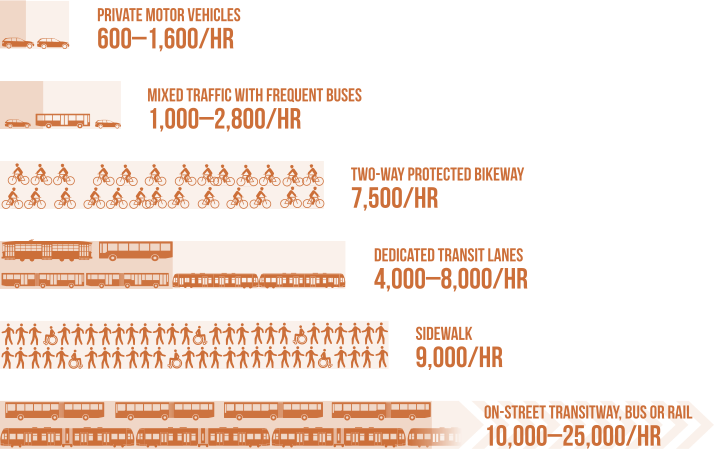
The capacity of a single 10-foot lane (or equivalent width) by mode at peak conditions with normal operations.2
- Oak Ridge National Laboratory. Transportation Energy Data Book, edition 34, “Chapter 8: Household Vehicles and Characteristics.” US Department of Energy, Washington, DC: 2015. ↩︎
- A reasonable planning-level capacity for a dedicated transit lane is 80 buses per hour; assuming 100 riders per vehicle (a comfortable articulated bus capacity), 8,000 riders per hour can be moved through a single transit lane. At two-minute headways (or 30 buses per hour), a standard 40-foot bus, assuming 60 passengers, moves 1,800 passengers per hour. High-capacity LRVs, running four cars per train with a capacity of 125 riders, have a capacity of 15,000 passengers per hour.
Ryus, Paul (PI), Alan Danaher, Mark Walker, Foster Nichols, William Carter, Elizabeth Ellis, and Anthony Bruzzone. “Ch 6, Bus Transit Capacity.” Transit Capacity and Quality of Service Manual, Third Edition. TCRP Report 165, Transportation Research Board, Washington, DC: 2013.
RTD FasTracks. Streetcar and Light Rail Streetcar and Light Rail Characteristics. Regional Transportation District, Denver, CO: 2012. ↩︎ - 60 people per meter per minute, allowing 1.5 sq. meters per pedestrian and a 75 meter per minute walking speed.
Ryus, Paul (PI), Alan Danaher, Mark Walker, Foster Nichols, William Carter, Elizabeth Ellis, and Anthony Bruzzone. “Ch 6, Bus Transit Capacity.” Transit Capacity and Quality of Service Manual, Third Edition. TCRP Report 165, Transportation Research Board, Washington, DC: 2013.
Zhou et al. measured 2,500 bikes per meter per hour on cycle tracks in downtown Hangzhou.
Dan Zhou, Cheng Xu, Dian-Hai Wang, and Sheng Jin. Estimating Capacity of Bicycle Path on Urban Roads in Hangzhou, China. Submitted to the 94th Annual Meeting of the Transportation Research Board, Washington, DC: 2014. ↩︎