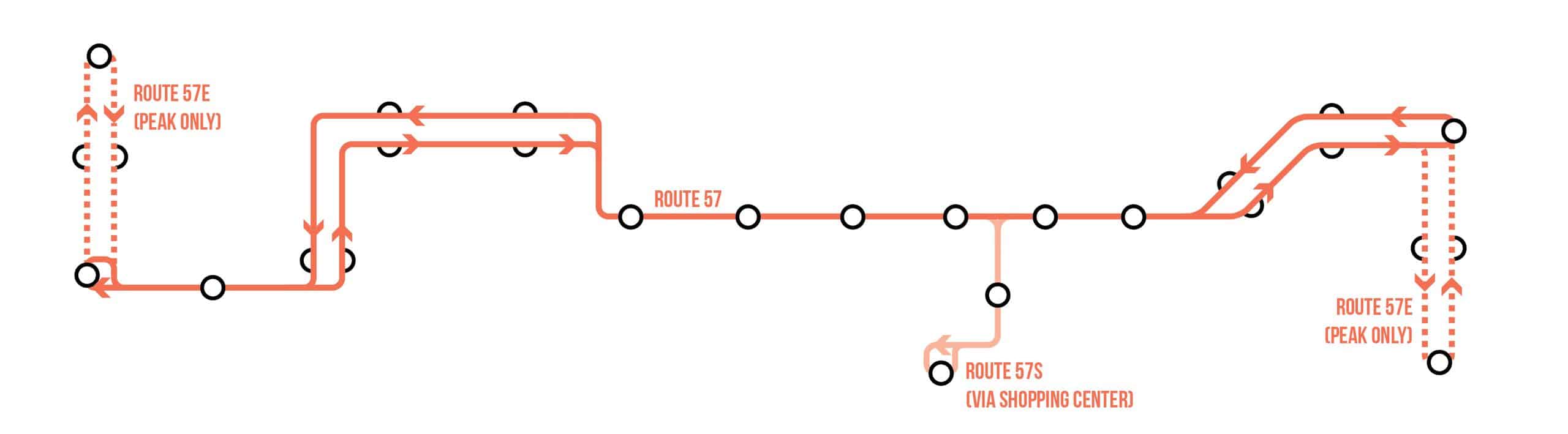
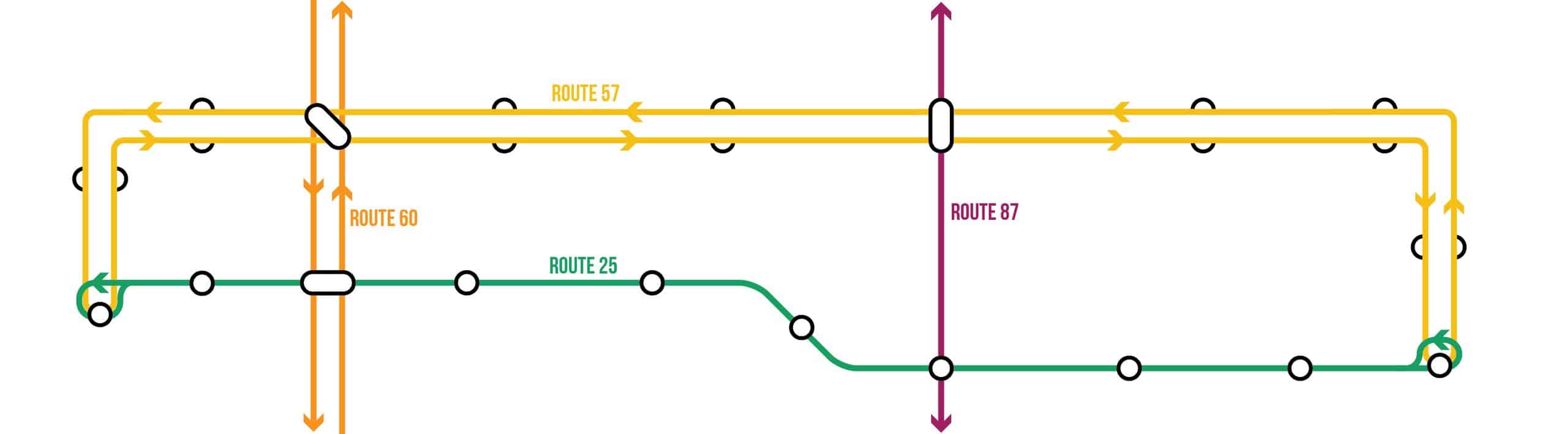
Direct, simple routes are easy to use, and save time compared with circuitous routes. Transit routes that have evolved in a piecemeal fashion over decades can be simplified to create more frequent and direct service.
Dedicated space and signal strategies pair well with projects that straighten a transit line along a main street, helping these changes add up to meaningful time savings.
Before
After
Application
Routes that turn frequently or do not operate in alignment with the existing street grid.
Areas experiencing significant growth or changes in transportation demand including routes that are transitioning from a coverage role to a structural (local or rapid) role in the network.
Systems that have undergone many small, spot-level changes over a long period.
Benefits
Reducing the number of turns, especially through complex intersections, eliminates a large source of transit delay.1
Transit signal progressions, some forms of active signal priority, and dedicated space treatments are easier to achieve on a single main street.
Reducing route “branching” can allow routes to operate at high frequencies.
Considerations
When transitioning to a grid network that relies on transfers, service needs to be frequent and reliable to facilitate predictable trip times.
Moving or eliminating stops or routes requires local public discussion and an understanding of stakeholder needs. Route realignments in areas with inaccessible or disconnected pedestrian infrastructure are much more challenging to plan in a way that supports existing riders. These changes may be unsuccessful in saving costs, as paratransit trips may increase.
Though access distances can be increased, transit service changes should be designed to avoid entirely cutting off passengers from fixed-route service, with special concern for places where a large percentage or number of passengers are fully reliant on transit.
Recommendations
Long routes should be designed to mitigate the cumulative impacts of delay.
Long routes are a high priority for directness, and should be designed to mitigate the cumulative impacts of delay from turns and other causes.
Turns that serve specific destinations should be close to the beginning or end of a route so that only those passengers using that destination are directly impacted by the increased travel time.
To serve multiple large origins and destinations on separate streets, routes should be chosen to provide reasonable walking distances to both locations without diverting. Choosing to run transit on streets in the center, rather than the edge of districts with multiple destinations, can create a stronger route with more all-day and both-directions ridership.
Routing multiple lines to converge onto a single corridor can increase core frequency and justify higher-quality transit treatments.
Structure routes to serve destinations in a straight line.
Routes that divert from a main street to reach a particular stop reflect a preference for shorter walking distances for passengers who use that stop at the expense of travel time for those already on board. Diverging from the street into parking lots or large developments and campuses can be a major time expense; instead, stop on the street, and work with large landowners to develop frontages or improve internal walking circulation.
- Conversion of one-way street to one-way with a contraflow transit lane on Sansome Street in San Francisco resulted in a 36-47% decrease in mean corridor travel time at peak for the 12, 15, and 42 bus lines during peak hours. Additionally, travel time variability fell by almost 80% for the corridor. Simplifying and converging three routes onto the Sansome Street corridor allowed significant travel time savings and service increases for passengers, and much more predictable service planning for Muni.
Mirabdal, Javad, and Bond Yee. First Transit Contra Flow Lane in Downtown San Francisco. City and County of San Francisco, prepared for the Institute of Transportation Engineers, Washington, DC: 1999. ↩︎