Unlocking the enormous potential of transit requires active measures to make trips take less time. To achieve this, the Transit Street Design Guide details street design strategies to improve transit reliability and reduce overall travel times.
Transit service that is reliable and efficient brings value to people and cities, but slow and inconsistent service will discourage passengers and jeopardize local benefits. If a trip takes significantly longer by transit than by other modes, or if actual trip time ranges so widely as to be unpredictable, people may choose not to take transit and cities will miss out on opportunities to reduce congestion and spur development.
For urban transit, getting to a destination faster means removing sources of delay rather than raising top travel speeds. The most significant sources of transit delay are related to both street design and transit operations, calling for coordinated action by transit and street authorities.
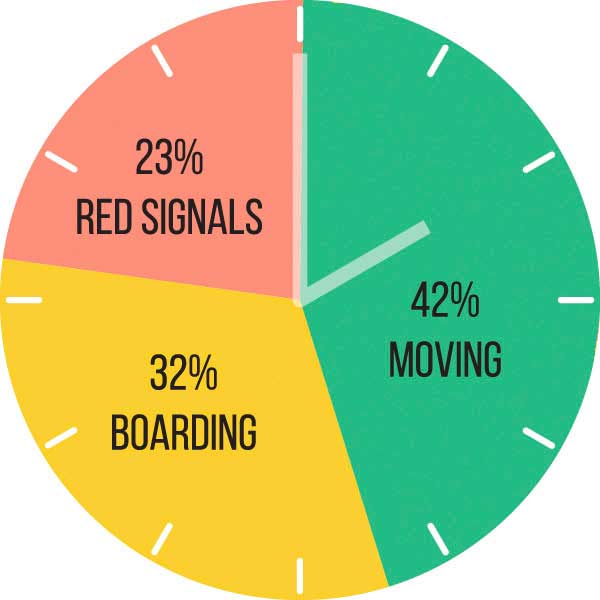
Before:
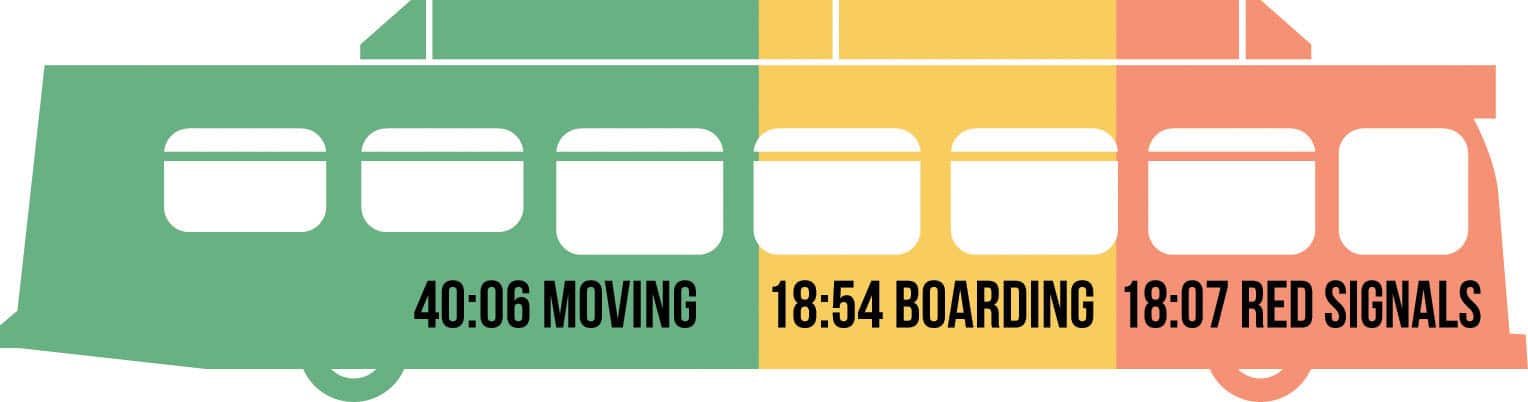
After:
Traffic & Intersection Delay
In mixed traffic, transit is limited by prevailing traffic conditions, and will be delayed by all the factors that delay the cars it shares space with. Time spent waiting for signals or slowing for stop signs, known as intersection delay or traffic control delay, increases as traffic volume nears the capacity of the street, and as cross streets are more frequent or reach their own capacity. Providing transit lanes and using signal strategies can help cut travel times by half, with the greatest benefits made available by using transitways. While these levels of priority stop short of grade-separated facilities, they can be the foundation of every city’s transit design toolbox, and are inherently adaptable to a variety of street conditions.
While signal delay is relatively easy to address through active TSP if traffic queues are short, signals with long or variable queues can add up to very long delays for buses and streetcars in mixed-traffic conditions. Time spent slowly approaching red signals or stop signs in heavy traffic can also contribute to overall delay.
Unreliable travel times are a major issue for transit operations because short delays can quickly snowball as more passengers try to board a late-arriving vehicle. Missing one green signal can cause a bus or streetcar to fall behind enough to delay the transit vehicle behind it.1
Dwell Time
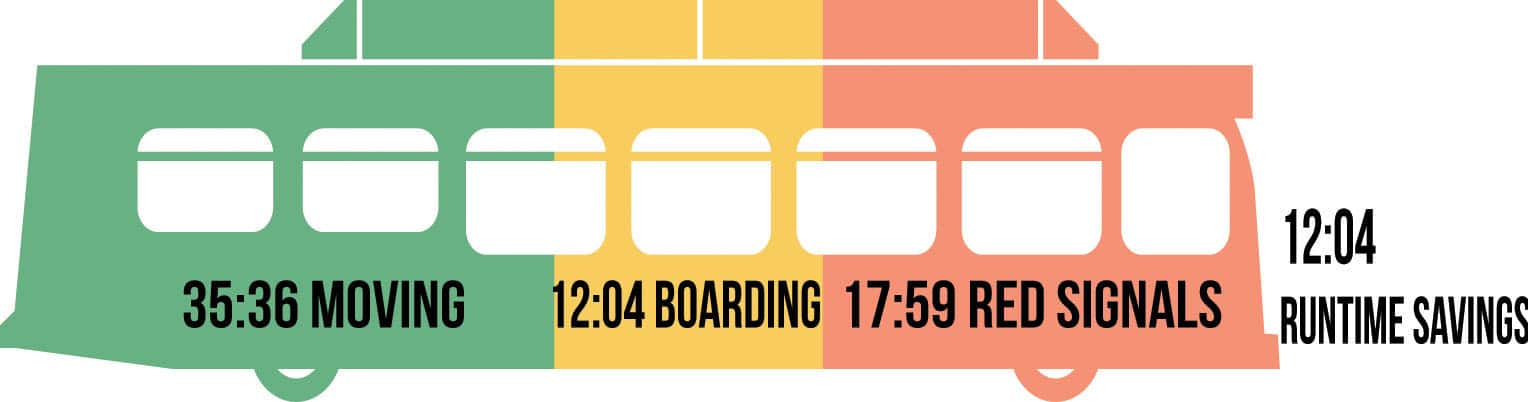
Dwell time related to passenger boarding and payment is a large component of total travel time on productive routes, especially in downtowns and destination areas. Level or near-level boarding multi-door boarding and advanced payment options, and better passenger information can cut dwell time in half or more. Stop consolidation also reduces the amount of time spent dwelling at stops.2
Savings from transit improvements
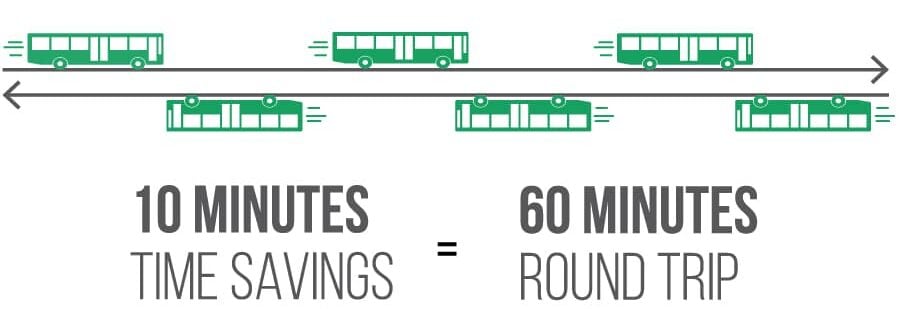
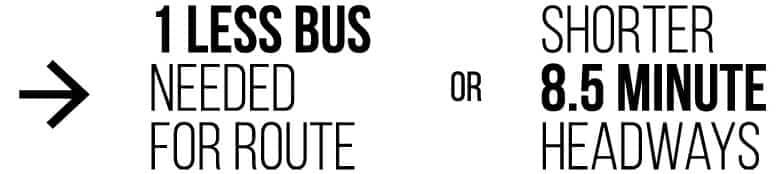
Time in Motion: Acceleration, Merging, and Route Divergence
Acceleration, deceleration, and door operation time approaching or leaving a stop can add 15–30 or more seconds per stop. Consolidating from stops to stations and introducing rapid services can dramatically reduce this time expenditure.
For buses in particular, merging into or re-entering the flow of general traffic after a conventional curbside pull-out stop is a perennial source of delay. Reduce this delay by providing in-lane stops and stop-related signal treatments (see Signals & Operations, and Stop Placement & Intersection Configuration), or by enforcing a yield-to-bus law.
Circuitous routes and turns can be time consuming for transit operators and confusing for passengers, often adding significantly to travel time. Keeping transit lines simple and direct serves to minimize this delay, improving transit travel times. While this may increase the time spent walking to a stop, it can benefit overall trip times. Evaluate any changes based on a walking network model and transit travel times.
Passenger Access and Wait Time
In addition to on-board transit time, a passenger’s trip time also includes time spent walking to a stop, waiting for transit to arrive, making any transfers, and accessing a destination. Since passengers place 2.5 times more value on a shorter wait than on a shorter amount of time spent in motion or a shorter walk to transit, a small improvement in wait time can provide a larger benefit to passengers and a greater boost to ridership than a similar improvement in speed.3
Reliability affects how passengers perceive wait times. If wait time and travel time vary significantly, or are routinely much longer than the scheduled time, passengers build this time into their trips, and transit becomes less useful for them.
Transit and street design can make wait time valuable to passengers by providing comfortable waiting areas at stops (see Stations & Stops), by providing real-time information to reduce start-of-trip wait times, and by reducing the time needed for transfers through network design (see Transit System Strategies). Quality urban street design can make walking to a transit stop a positive feature of transit trips.
Unlocking Operational Efficiencies
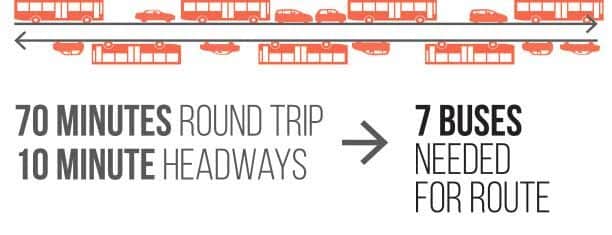
Addressing the main sources of transit delay has two related benefits. It shortens door-to-door time for a passenger trip, improving the competitiveness of transit. It also reduces the time and cost of each transit vehicle’s run, enabling a transit agency to provide more frequent service to each stop with the same number of vehicles and drivers. In this context, a small travel time savings is a large cost savings.
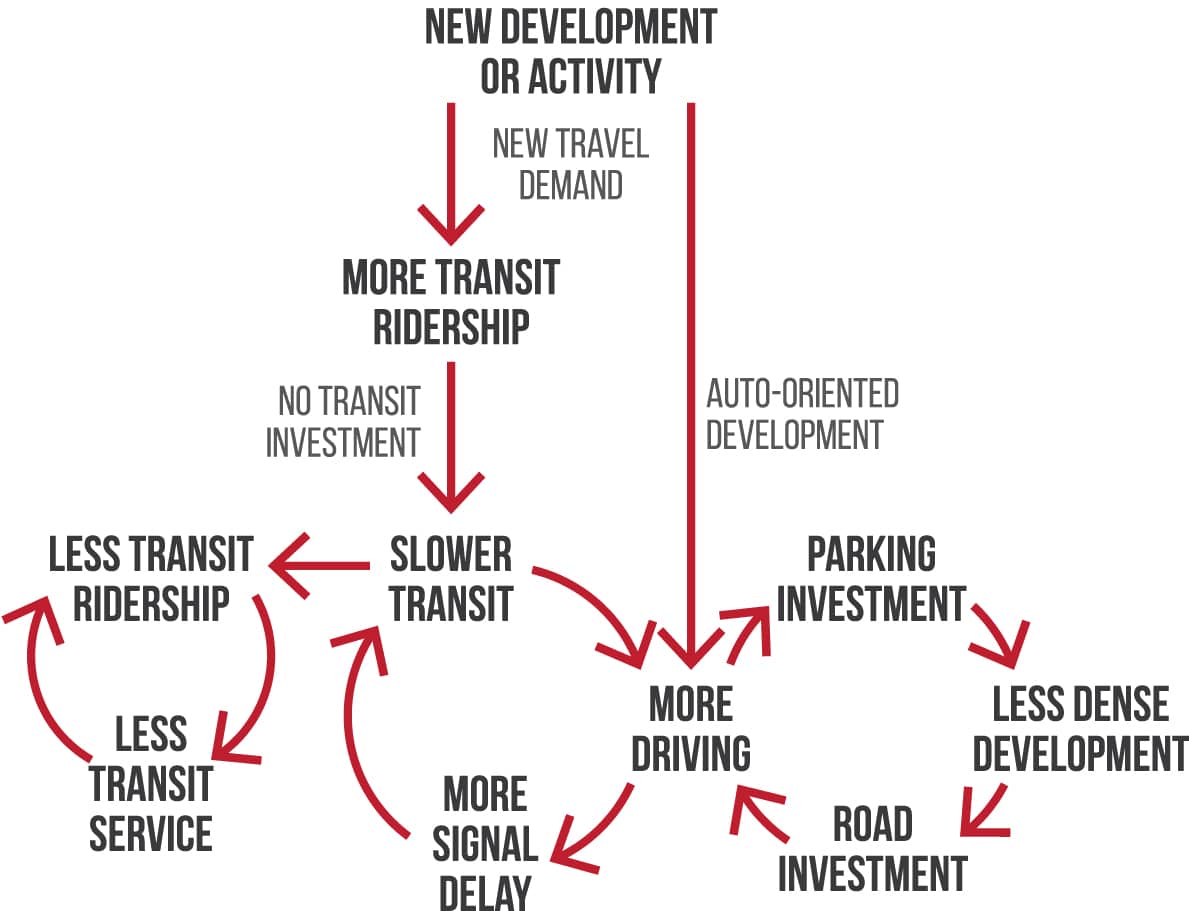
Buses in mixed traffic are susceptible to a downward service spiral, in which increased congestion—exacerbated over the long term by designing streets primarily to accommodate private motor vehicles—results in lower ridership and revenue, resulting in service cuts and lower ridership and revenue.
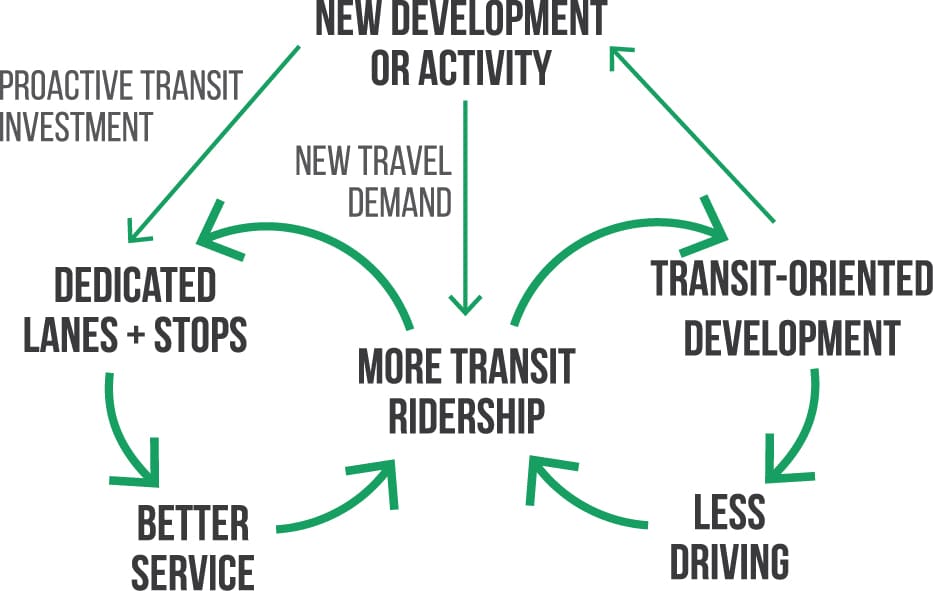
This cycle can be reversed by improving on-street transit travel times. Shorter travel time allows transit operators to run more frequent service, with more runs per hour using the same number of vehicles and drivers. Greater frequency and shorter trip time yields higher ridership, raising revenue and permitting still greater service frequency.
For detailed information and analysis of transit delay, see the Transit Capacity and Quality of Service Manual, 3rd Edition.
Responding to development
- James G. Strathman, Thomas J. Kimpel, and Steve Callas. Headway Deviation Effects on Bus Passenger Loads: Analysis of Tri-Met’s Archived AVL-APC Data. Transportation Northwest Regional Center 10, University of Washington, Seattle, WA: 2003. ↩︎
- The TCQSM defines dwell time as the time spent serving passenger movements and the time spent opening and closing the bus doors. Everything else that causes a bus to sit at the curb is delay. Ryus, Paul (PI), Alan Danaher, Mark Walker, Foster Nichols, William Carter, Elizabeth Ellis, and Anthony Bruzzone. “Ch 6, Bus Transit Capacity.” Transit Capacity and Quality of Service Manual, Third Edition. TCRP Report 165, Transportation Research Board, Washington, DC: 2013. ↩︎
- Table of “Deterrent Effect of Various Kinds of Travel Time,” Exhibit 4-5. Ryus, Paul (PI), Alan Danaher, Mark Walker, Foster Nichols, William Carter, Elizabeth Ellis, and Anthony Bruzzone. “Ch 6, Bus Transit Capacity.” Transit Capacity and Quality of Service Manual, Third Edition. TCRP Report 165, Transportation Research Board, Washington, DC: 2013. ↩︎
- A study of development investment around transit stations found significant returns from bus rapid transit especially, due to its relatively lower cost to implement. Cleveland’s HealthLine BRT and Portland’s MAX Blue Line LRT leveraged the most overall TOD investment of corridors studied—$5.8 billion and $6.6 billion, respectively, though the Cleveland BRT leveraged approximately 31 times more TOD investment per dollar spent on transit than Portland’s MAX Blue Line LRT due to project cost.
Hook, Walter, Stephanie Lotshaw, and Annie Weinstock. More Development for Your Transit Dollar: An Analysis of 21 north American Transit Corridors. Institution for Transportation & Development Policy, New York, NY: 2013. ↩︎