Fare collection and boarding can be time consuming, accounting for half to a third of vehicle revenue time.
Strategies that streamline fare collection and allow for multi-door boarding can dramatically speed up passenger boarding time, reducing dwell time and total run-time.
San Francisco Municipal Transportation Agency Photo Library
San Francisco Municipal Transportation Agency Photo Library
Fare Payment Methods
Cash Payment
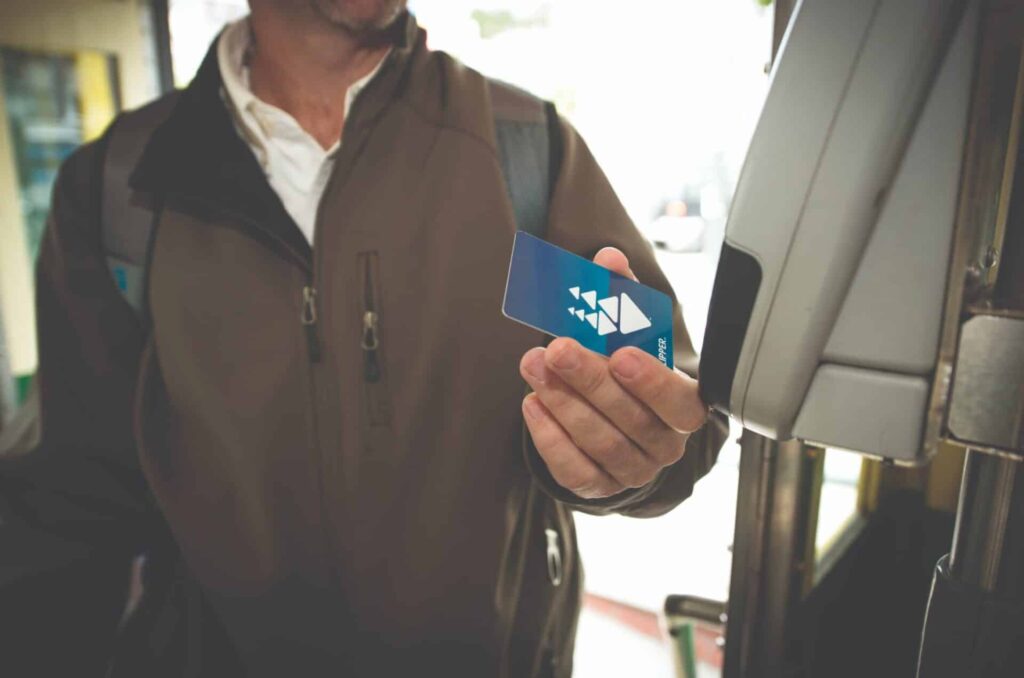
Fares are paid using cashless RFID cards, which must be tapped at a reader to be validated.
On-board RFID readers are placed either at multiple doors as with PoP systems, or at the front door alone for systems with driver fare control.
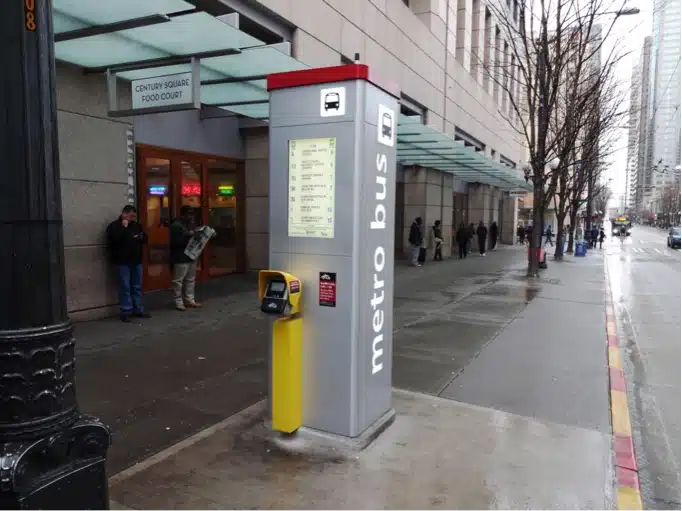
Off-board RFID readers are placed at the stop. Riders scan their RFID cards before boarding the bus, reducing boarding times.
Ticket Vending
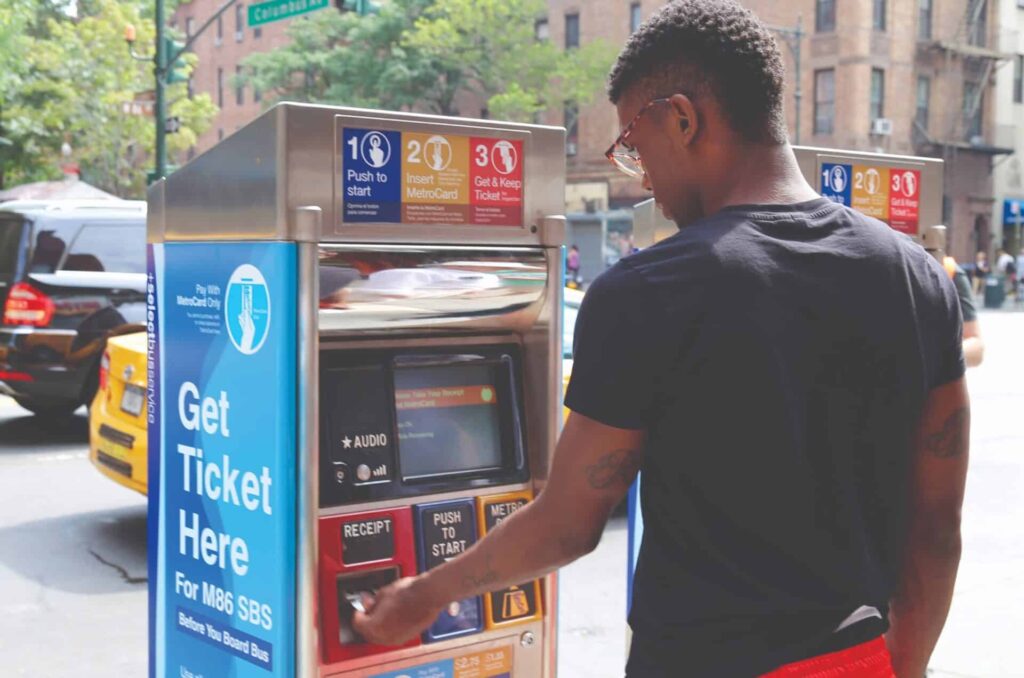
Passengers purchase a ticket at a vending machine, which acts as a proof of payment
Tickets may be bought at on-board or off-board vending machines.
Radio Frequency ID (RDIF) Card
Fares are paid using cashless RFID cards, which must be tapped at a reader to be validated.
On-board RFID readers are placed either at multiple doors as with PoP systems, or at the front door alone for systems with driver fare control.
Off-board RFID readers are placed at the stop. Riders scan their RFID cards before boarding the bus, reducing boarding times.
Mobile App
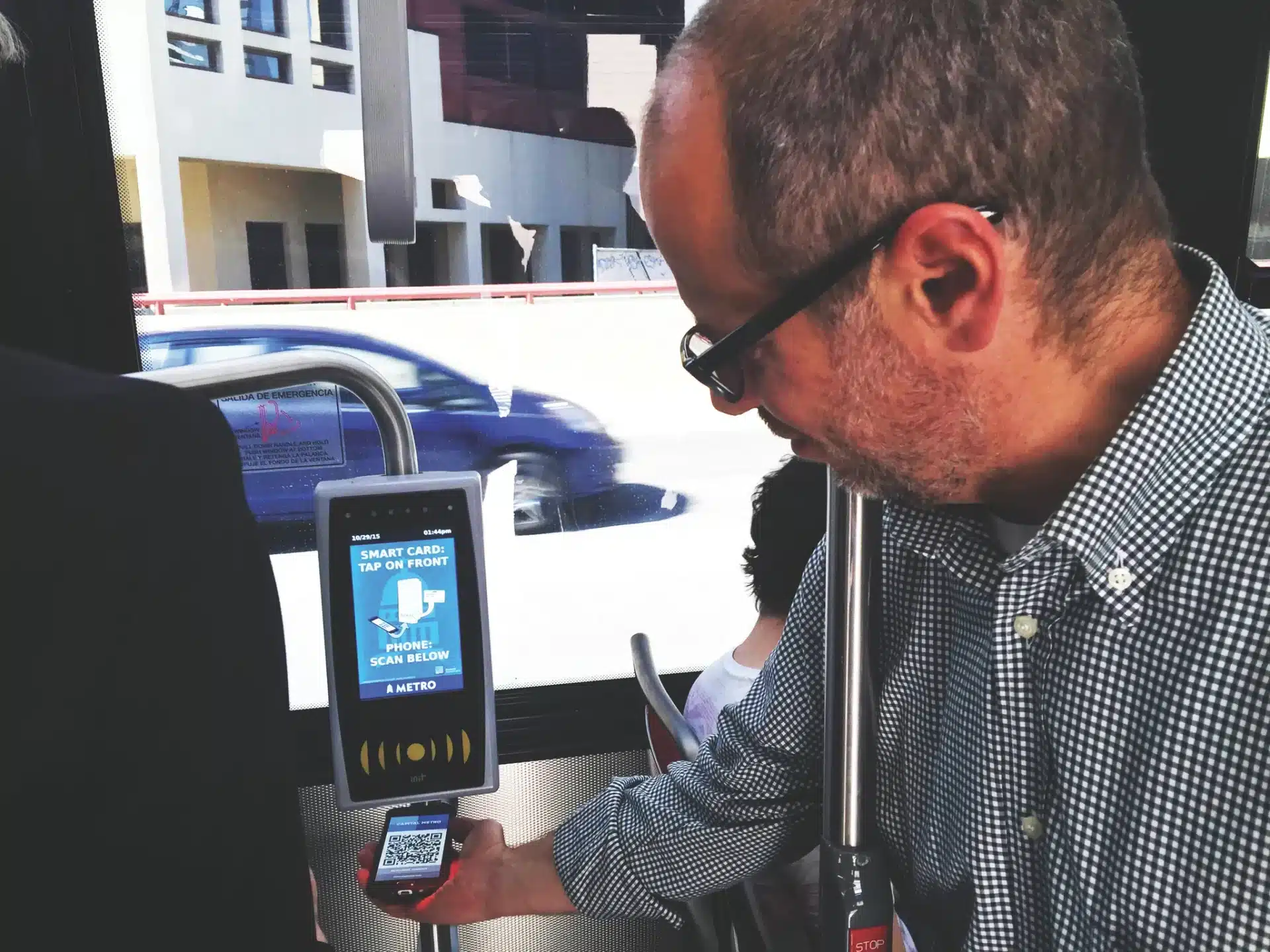
Tickets are purchased via smart phone using a mobile application.
Tickets may be instantly valid, or may require on-board validation by scanning a QR code.
Passengers must present the electronic ticket to driver upon boarding, or to fare control officers upon request.
Fare Control Methods
Proof-of-Payment (PoP)
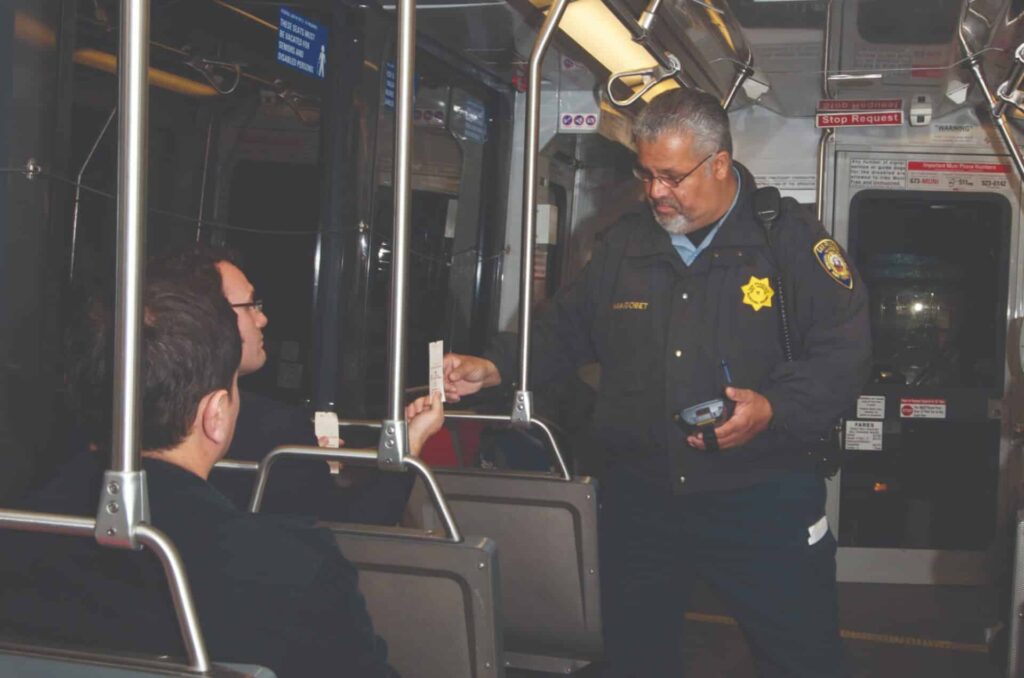
Passengers receive a proof-of payment (PoP) which must be presented to fare control officers upon request. PoPs may be physical or electronic “tickets.”
Many modern systems allow fares to be paid using cashless RFID cards or mobile apps.
Cash payments may be made to the driver, who will provide a ticket or receipt as proof-of payment. Alternately, tickets may be purchased from an on-board vending machine.
PoP tickets are typically valid for a specified amount of time after purchase or validation, such as 60 or 90 minutes.
PoP fare payment is required in systems that permit multi-door boarding.
PoP fare control requires consistent enforcement to be effective.
Fare inspectors make random checks to ensure riders have a valid ticket. Passengers without a ticket are assessed a fine.
Driver Fare Control
Most traditional bus and streetcar services use driver-controlled fare payment.
All passengers must board at the front door, where the driver ensures fares are paid.
Cash fares are paid into a fare box by the driver at the front door.
RFID cards must be tapped at a reader near the front door upon boarding.
Tickets, including physical tickets, mobile tickets, and passes must be presented to the driver for visual inspection.
Driver fare control can slow operations as drivers must collect fare payment in addition to operating the vehicle.
Turnstile Control
At enclosed stations, turnstiles may be used to control passenger entry.
Fares may be paid using machine readable tickets, RFID cards, or other fare media like tokens.
Access may be manually controlled by a station attendant, who can collect cash or tickets.
Gated systems are difficult to implement at on-street stations. High platforms and active enforcement are usually needed.
PoP Payment Styles
On-Board PoP Payment
RFID fare cards must be tapped upon boarding.
Systems using PoP fare control can place RFID readers at multiple doors, allowing for passengers to board at any door.
In systems using driver fare control, an RFID card reader is placed near the front door.
In systems using driver fare control, an RFID card reader is placed near the front door.
On-board ticket vending machines can be installed where physical PoP tickets are required and installing machines at every stop is not feasible.
Some mobile apps require that mobile tickets be validated by scanning a QR code upon boarding.
Off-Board PoP Payment
Off-board RFID readers or ticket vending machines are placed at the stop. Riders scan their RFID cards before boarding the bus, reducing boarding times.
Off-board fare collection can significantly reduce passenger boarding times, with dwell per passenger falling from about 4 seconds to 2–2.5 seconds.
Providing off-board ticketing machines may be expensive.
See Fare Vending for more information about off-board fare vending.
Vehicle Boarding Types
Multi-Door (or All-Door) Boarding
Passengers may board at multiple doors.
Used with PoP fare systems.
Reduces per-passenger dwell time significantly, especially at high-use transit stops.
Faster boarding times move buses faster in congested areas, and move pedestrians faster on crowded sidewalks.
Passengers must board with a valid ticket, tap their RFID card or validate their ticket upon boarding, or purchase a ticket from the driver or an on-board vending machine.
Gather information before and after implementation; invest in automatic passenger counters, or employ short-term counting staff, to assess boarding times, volumes, and improvements.
Front Door Boarding
All passengers board through the front door.
Traditional transit operations commonly use driver fare control, requiring drivers to both operate the vehicle and collect fares, and resulting in slowed operations.
Seattle Department of Transportation
New York City Department of Transportation
Case Study: Muni All-Door Boarding, San Francisco
In San Francisco, SFMTA implemented all-door boarding on a systemwide basis in 2012, extending to buses a practice already in place for light rail. Passengers tap prepaid cards at card readers located at all doors, or board with timed paper transfer tickets. Cash customers pay at the front door, saving the expense of on-street fare collection machines. Since a proof-of-payment system was already in place for non-cash passengers, San Francisco shows the specific benefit of all-door boarding. At busy stops, a 38% reduction in entry/exit time was found for buses: 1.5 seconds per customer, in a system with 100 boardings per bus in the peak hour. Transit travel speeds increased 2% on average after implementation. Coupled with improved enforcement, fare evasion dropped from 9.5% to 7.9%, reducing estimated fare loss nearly $2 million.1
- All-Door Boarding Evaluation Final Report. San Francisco Municipal Transportation Agency, San Francisco, CA: 2014. ↩︎