
Constrained bike lanes have minimal horizontal separation from motor vehicles, often just the width of a single 4-8 in (100-200 mm) line. Buffered bike lanes are a type of constrained bike lane with additional horizontal separation. Typically, this additional separation is created by 1-3 ft (0.3-0.9 m) of buffer between the bike lane and parked cars, or where there is no on-street parking and the bike lane is along the curb, between the bike lane and motor vehicle lane.
The installation of constrained bike lanes, if accompanied by reductions in the number and width of motor vehicle lanes, results in important all-mode safety benefits when compared with multi-lane streets with wide mixed-traffic lanes. On streets with one travel lane in each direction, constrained bike lanes can be expected to reduce injury crashes between 12% and 45%.1 On four-lane streets where one or more motor vehicle lanes or shoulders are converted into constrained bike lanes, the new roadway configuration can be expected to reduce crashes between 19% and 47%.2
While constrained bike lanes were historically the default bike facility type for many jurisdictions in North America, their limitations are more broadly recognized now. Constrained bike lanes do not provide the safety and comfort of protected bike lanes. Converting an existing constrained bike lane to a protected bike lane can reduce crashes between motor vehicles and people on bikes by more than 50%.3 The use of protected bike lanes should be explored wherever possible. Where a protected bike lane is not practicable, designers should implement traffic-calming and volume-management measures to increase the safety of people on bikes and other road users. (See Protected Bike Lanes.)
Constrained bike lanes, including buffered bike lanes, are part of a city’s emerging bike network and sometimes the only feasible bikeway. Where necessary, consider constrained bike lanes on streets with speeds under 25 mph (40 km/h) or volumes up to 8,000 vehicles per day. Buffered bike lanes may be used on streets with daily traffic volumes of up to 12,000. Limit their use on streets with higher operating speeds and higher volumes. Thresholds for AA&A constrained bike lanes are lower. See Designing for All Ages & Abilities below.
Constrained bike lanes work best where curbside activity is low, heavy vehicles are rare, and lane blockages by motor vehicles are unlikely.
Designing for All Ages & Abilities
Constrained bike lanes are AA&A facilities on streets with 3,000 or fewer motor vehicles per day, low curbside demand, and speed limits of 20 mph (40 km/h) or less. Constrained bike lanes may be appropriate design options for bike boulevards where designated space for biking is preferred to shared lanes.
Buffered bike lanes have additional horizontal separation to place people on bikes outside the path of the open doors of parked cars and increased operating space compared to constrained bike lanes. This additional horizontal separation allows buffered bike lanes to be more comfortable than constrained bike lanes for streets with somewhat higher motor vehicle volumes.4 Buffered bike lanes are AA&A facilities on streets with up to 6,000 vehicles per day and operating speeds of 25 mph (40 km/h) or under.
Buffered bike lanes, especially curbside buffered bike lanes, can be converted to protected bike lanes with the addition of vertical separation, such as medians, mid-height barriers, planters, and flex posts. Avoid implementing curbside buffered bike lanes without a vertical means of separation, particularly where curbside demand could result in blocked bikeways. Consider redesigning projects as protected bike lanes and investing in curbside management and speed reduction strategies to ensure AA&A thresholds are met.
| Bikeway | Target Motor Vehicle Speed |
Motor Vehicle Lanes In Same Direction |
Motor Vehicle Volume Per Day |
Motor Vehicle Volume Peak Hour in Peak Direction |
|---|---|---|---|---|
| Constrained Bike Lane |
≤ 20 mph ≤ 30 km/h |
Single lane | ≤ 1,500-3,000 | ≤ 300 |
| Constrained Bike Lane with buffer |
≤ 25 mph ≤ 40 km/h |
Single lane | ≤ 6,000 | ≤ 600 |
Constrained Bike Lanes Design Guidance


Dimensions
Motor vehicle lanes should be narrowed5 to support the widest feasible bike lanes. At posted speeds of 35 mph (60 km/h) or less, general-purpose travel lanes can be 10 ft (3 m) wide and still support transit and truck uses. Where transit or heavy trucks are rare, a travel lane of 9 ft (2.7 m) is an acceptable width for general-purpose travel lanes.
Parking lane widths should be minimized, typically to 7 ft (2.1m), in favor of increased bike lane or buffer width. Even if the parking lane will be used occasionally by wide vehicles, marking a narrow parking lane will encourage drivers to park closer to the curb.6
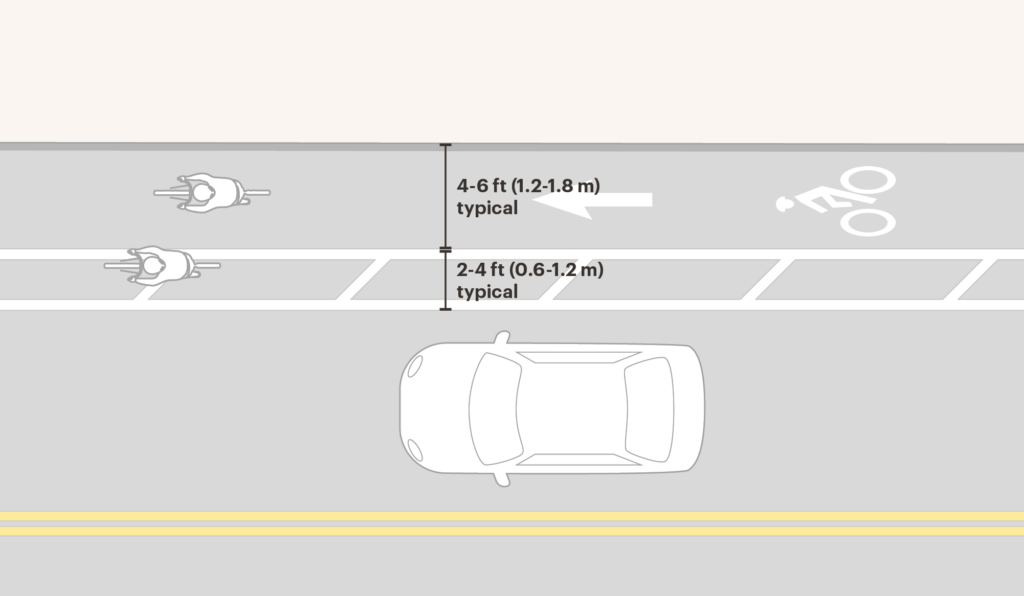
Constrained bike lanes and buffered lanes should still accommodate comfortable side-by-side bike riding, platooning, or passing using the bike lane and a portion of the buffer. The preferred width for a constrained bike lane is 6-7 ft ( 1.8-2.1 m)7, excluding any gutter pan. Alongside the curb, the minimum width is 4 ft (1.2 m), and when adjacent to parking, the minimum combined width of the bike lane and buffer is 5 ft (1.5 m).
Constrained bike lanes narrower than 6 ft (1.8 m) may not accommodate people riding cargo bikes or larger devices. Avoid 7 ft (2.1 m) or wider curbside constrained bike lanes to limit the likelihood that people will use the bike lane for a parking or travel lane; use a protected bike lane instead.
Constrained bike lanes wider than 7 ft (2.1 m) should have a marked buffer of at least 2 ft (0.6 m).
Parking buffers should be 3 ft (0.9 m) wide to accommodate the full swing of a car door and mitigate the potential for injurious crashes, commonly known as “doorings.”8 The preferred combined width for buffered bike lanes is 7-9 ft (2.1-2.7 m), including a buffer of 3 ft (0.9 m) and a bike lane that is 4-6 ft (1.2-1.8 m) wide.9
With low parking turnover, constrained bike lanes alongside on-street parking may omit the parking buffer. This is a common condition for contraflow bike lanes along bike boulevards with one-way motor vehicle operations.
Where additional right-of-way exists but a protected bike lane is not possible, designers may choose a double-buffered bike lane or a buffered curbside bike lane.
A double-buffered bike lane has both a parking buffer and a street buffer. These two buffers guide riders to the safest position within the bikeway, away from both opening car doors and moving vehicular traffic. Where double buffers are used, the bike lane is typically 4-6 ft (1.2-1.8 m) wide, the parking buffer is at least 3 ft (0.9 m) wide, and the street buffer is at least 1 ft (0.3 m) wide.
A buffered curbside bike lane prioritizes the width of the bike lane to accommodate side-by-side riding, platooning, or passing within the bike lane. Street-side buffers are typically 2-4 ft (0.6-1.2 m). This type of bike lane can be easily upgraded to a protected bike lane with the addition of vertical separation in the buffer.
Double-buffered bike lane

Buffered Curbside Bike Lane

Markings


A single 4-6 in (100-150 mm) white stripe separates a constrained bike lane from the motor vehicle lane.
Bike lane symbols or BIKE LANE word markings (MUTCD Figure 9E-1) should be applied at the beginning of a bike lane.10
Bike lane markings should be applied after major driveways, intersections, and at least every 500 ft (150 m) along the bike lane.
Green surface treatments may be added to bike lanes to improve conspicuity.11 Use of a consistent green color within a city or region helps reinforce the expectation that bikers will be in these spaces. Municipalities should adopt practices that ensure consistent use of green surfacing across all projects.
Green surface treatments should be high-friction to reduce loss of traction. Retroreflectivity is not required nor recommended. In the United States, use the chromaticity coordinates for green pavement color as established by the Federal Highway Administration.12
Green surfacing may be used along the full length of a bike lane.
Green surfacing may also be used to increase the conspicuity of the bike lane approaching or departing intersections and driveways. In these locations, apply green surfacing for 20-50 ft (6-15 m).
Buffers must be marked with a solid white line along both edges of the buffer space.13 Diagonal markings or chevrons should be used if the buffer is 2 ft (0.6 m) wide or wider and are required for buffers of 3 ft (0.9 m) or wider. Where used, the spacing of chevrons or diagonal markings should be 10 ft (2 m) or greater. Diagonal markings slant away from the direction of travel in the adjacent motor vehicle travel lane. Chevron markings point toward approaching traffic in the adjacent motor vehicle lane.14
Buffer markings are typically impractical along buffers narrower than 2 ft (0.6 m). These can instead be marked with two parallel 4-6 in (100-150 mm) white lane lines.
Chromaticity Coordinates for Non-Reflective Green Colored Pavements
| Lane Width | Adjacent to Parking | Adjacent to Curb | |||
| 9 ft | 2.7 m | 11 ft | 3.3 m | 4 ft | 1.2 m |
| 10 ft | 3 m | 12 ft | 3.6 m | 5 ft | 1.5 m |
| 11 ft or more | 3.3 m or more | 13 ft | 3.9 m | 6 ft | 1.8 m |

Signs
BIKE LANE (MUTCD R3-17) signs may be posted at the beginning of the bike lane and may be used periodically along the bike lane to supplement pavement markings.
Custom or standard no parking signage (e.g., NO PARKING BIKE LANE (MUTCD R7-9 or R7-9a), NO STOPPING ANYTIME (MUTCD R7-4a), or similar signs) should be posted along blocks with curbside constrained bike lanes where on-street parking is prohibited.
Wayfinding signs used along a constrained bike lane should be integrated into a citywide concept for wayfinding throughout the bike network. (See Bike Route Wayfinding.)

Curbside Uses
To maintain separation between transit operations and bikeway operations along high- or medium-frequency bus routes, create in-lane bus stops by implementing transit boarding islands or shared boarding areas. Where space or project scope does not allow these uses, use constrained bus stop designs to ensure the legibility of the bike lane. (See Transit Stops.)
Accessible parking and loading spaces should be established with the addition of constrained or buffered bike lanes. In the U.S., the Public Right-of-Way Accessibility Guidelines offer information about the number of such spaces necessary per block face. (See Curbside Activity.)
On corridors with moderate to high curbside activity, illegal double-parking or loading in bike lanes renders constrained bike lanes unusable. Designate long stretches of curbside delivery zones and passenger pickup/dropoff zones with five-minute turnovers along the corridor and on nearby streets. Formalize curb uses with parking meters and regulatory loading zones. Establish high-visibility educational campaigns to inform users of new curbside regulations, including on-street outreach and media coverage. Any enforcement action should occur only after a warning period. If illegal double-parking or loading continues, prioritize reconfiguring the corridor to include protected bike lanes.
Consider complementary curbside uses, such as parklets, bike parking, shared micromobility stations or corrals, streeteries, or other pedestrian-oriented uses.

Speed and Volume Management
Speed and volume management strategies should be used to improve the comfort and safety of constrained bike lanes. Lane reductions and lane narrowing will reduce excess capacity and discourage unsafe speeding and other dangerous driving behaviors. (See Speed and Volume Management.)
Mid-block raised crosswalks and raised intersections are common strategies, even along bus routes. Where transit vehicles are not expected, a series of speed cushions or speed humps can slow vehicular speeds.
Roundabouts, mini-roundabouts, and neighborhood traffic circles are also effective tools for slowing speeds. Consider using medians, turn restrictions, and diverters to limit vehicular volumes turning onto or continuing on a street with constrained bike lanes.

Intersections
Constrained bike lanes, including any buffer markings, should continue through intersections and driveways.
At driveways, use dotted bike lane lines to continue the bike lane. Cities may choose to apply crossbike markings through busier driveways and intersections.
To mitigate turn conflicts, provide greater separation from motor vehicle traffic by adding wide buffers and/or vertical separation. Consider other geometric changes, including corner islands, slow-turn wedges, or medians to slow vehicular turns across constrained bike lanes.
Avoid situations that mix or merge bicycle and motor vehicle traffic into the same lane, such as designs that drop the bike lane buffer or allow turning cars and trucks into the bike lane on the intersection approach. (See Designing Safe Intersections.)
Contraflow and Two-Way Constrained Bike Lanes
Accommodating two-way biking on a street that was previously used for one-way operations can greatly expand the reach of the bike network. Contraflow constrained bike lanes, with or without bike lane buffers, are a commonly used and effective design across North America. Two-way constrained bike lanes are less common, in favor of protected two-way bike lanes, but may be used where the potential for consistent motor vehicle incursion is very low.
Contraflow or two-way constrained bike lanes, with or without buffers, are most appropriate for streets with speeds of 25 mph (40 km/h) or less and motor vehicle volumes of around 6,000 per day or less.
Curbside uses can include residential parking or other low-turnover parking or loading. With increases in any of those variables, the contraflow or two-way constrained bike lane should be converted to a protected bike lane.
Contraflow constrained bike lanes should be marked so that opposing traffic is to the left of people biking, in accordance with normal rules of the road.15 Contraflow bike lanes may be against the curb or adjacent to on-street parking.
The contraflow direction can be achieved with a two-way constrained bike lane. Special care should be given to proper management of curbside uses in these conditions. The preferred alignment for two-way constrained bike lanes is contextual, depending on conflict points, intersection operations, curbside uses, and network connectivity. (See Designing Bikeways for All Ages and Abilities.)
Designing Contraflow and Two-Way Constrained Bike Lanes for All Ages and Abilities
Contraflow and two-way constrained bike lanes can provide All Ages & Abilities network connections in the same conditions as one-way marked bike lanes: speeds no greater than 20 mph (30 km/h) and motor vehicle volumes less than 3,000 daily. With a buffer, contraflow and two-way constrained bike lanes can serve All Ages & Abilities with vehicle speeds up to 25 mph (40 km/h) and vehicular volumes of up to 6,000 per day. As on other streets with marked bike lanes, speed management with vertical or horizontal deflection should be applied to bring motor vehicle speeds and volumes in line with all Ages & Abilities bicycling conditions.
Contraflow and Two-Way Constrained Bike Lanes Design Guidance

Dimensions
Contraflow and two-way constrained bike lanes should still accommodate comfortable side-by-side riding, platooning, or passing. The preferred width for a contraflow constrained bike lane is 6-7 ft ( 1.8-2.1 m), excluding any gutter pan. Alongside the curb, the minimum width is 4 ft (1.2 m), and when adjacent to parking, the minimum width is 5 ft (1.5 m). Constrained bike lanes narrower than 6 ft (1.8 m) may not accommodate people riding cargo bikes or larger devices.
Unless a buffer is provided, avoid widths of 7 ft (2.1 m) or wider to limit the likelihood that people use the bike lane for parking or travel.
Buffers may be used where available width for a contraflow bike lane exceeds 5 ft (1.5m). Parking buffers must be 3 ft (0.9 m) wide to accommodate the full swing of a car door and mitigate the potential for injurious crashes commonly known as “doorings.” The preferred combined width for buffered bike lanes is 7-9 ft (2.1-2.7 m), including a buffer of 3 ft (0.9 m) and a bike lane that is 4-6 ft (1.2-1.8 m) wide.
With low parking turnover, contraflow constrained bike lanes alongside on-street parking may omit the parking buffer. This is a common and safe condition along bike boulevards with one-way motor vehicle operations.16
Two-way bike lanes may be placed against the curb when accompanied by appropriate curb management strategies to avoid their use as parking, loading, or pick-up/drop-off areas. This behavior can be dangerous for cyclists who are traveling in the contraflow direction and must merge out into oncoming traffic.
Two-way bike lanes should be at least 13 ft (3.9m) wide to accommodate all types of bicycles, side-by-side riding, platooning, and passing. The absolute minimum width is 9 ft (2.7 m) and should be avoided except on short street segments.
Markings
Jurisdictions should standardize markings for both contraflow and two-way constrained bike lanes for consistent use and legibility.
The lane lines for contraflow and two-way constrained bike lanes, with or without a buffer, are dependent on the overall roadway alignment.


Contraflow Bike Lane Lines
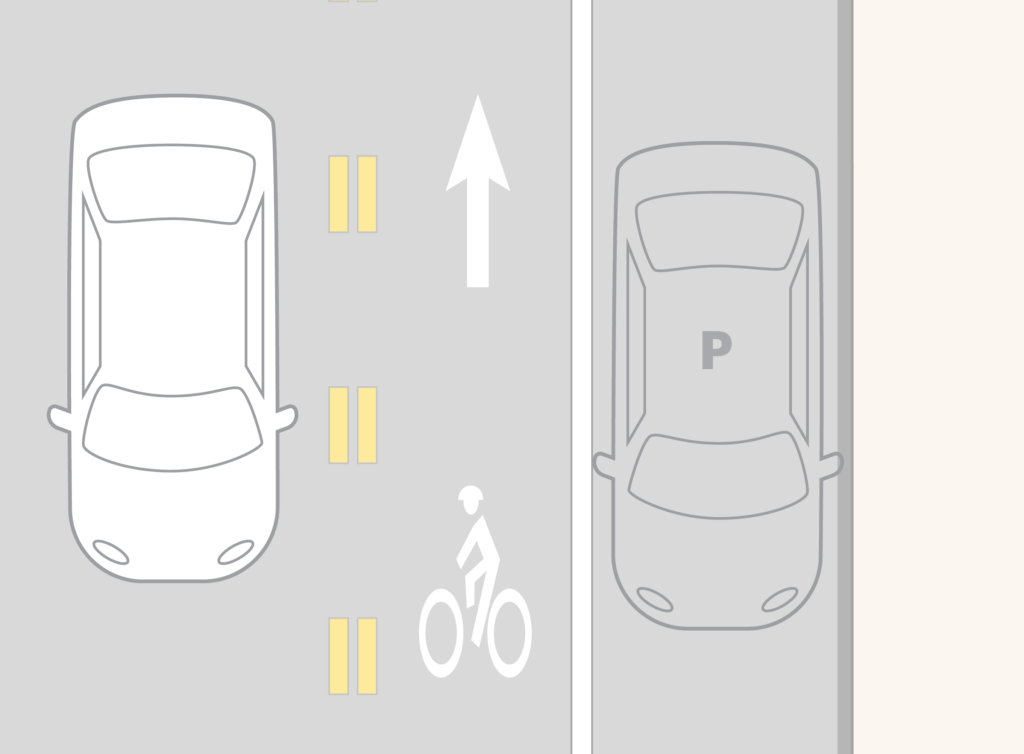
- Contraflow bike lanes should be placed such that people are biking on their right-hand side of the street with opposing traffic on the left.17
- Contraflow bike lanes are marked with double-yellow lines.18
- For contraflow bike lanes with streetside buffers, buffer lines and any diagonal or chevron markings are yellow.
- If parking is permitted between bike lanes and the curb, dotted double-yellow centerlines should be used.
- For contraflow bike lanes with parking buffers, the buffer lines, diagonal, and/or chevron markings are white.

Two-way Bike Lane Lines
- Two-way constrained bike lanes may be used on streets with two-way or one-way vehicular traffic.
- Where a two-way bike lane is to the right of motor vehicle drivers, as is the case on two-way streets, buffer or linear bike lane markings should be white and consistent with edge line markings.
- Where the two-way bike lane is to the left of motor vehicle drivers, a solid white lane line or white buffer lines should be used.
- Two-way bike lanes should use a dotted single yellow centerline to separate directions of travel. BIKE LANE symbols or “BIKE LANE” markings (MUTCD Figure 9E-1) should be used in the direction of bike travel in each line.
In contraflow and two-way bike lanes, install BIKE LANE symbols or “BIKE LANE” markings (MUTCD Figure 9E-1) after driveways, intersections, and at least every 500 ft (150 m) along the bike lane. Consider more frequent application of bike lane symbols in contraflow bike lanes where such facilities are unusual or rare or when first installed.
Green surfacing may be used in contraflow and two-way bike lanes in a similar manner to constrained bike lanes described above.
The design of buffers for contraflow or two-way bike lanes should match those used on constrained bike lanes.
At residential driveways or those with less use, use dotted white bike lane lines or yellow centerlines as appropriate to extend the bike lane markings.
Signs
In addition to the signs required along directional constrained bike lanes, contraflow and two-way bikeways require additional regulatory and warning signage.
Along streets with one-way motor vehicle traffic and two-way biking, install EXCEPT BIKES (R3-7bP) plaques under DO NOT ENTER (R5-1) signs.
In the U.S., ONE-WAY (R6-1 or R6-2) signs are prohibited along streets with two-way biking. To emphasize that the street has two-way bike traffic, warning signage should be used at any T intersection or major driveway and may be used periodically along the route. Consider a modified TWO-WAY sign (modified MUTCD W6-3) or custom sign to clarify operations.
Intersections
Constrained two-way and contraflow bike lanes, including any buffer markings, must not be mixed into motor vehicle traffic at intersections.
To mitigate turn conflicts, provide greater separation from motor vehicle traffic by adding wide buffers and/or vertical separation. Consider other geometric changes, including corner islands, turn wedges, or medians to slow vehicular turns across bikeways.
Apply crossbike markings through intersections for all contraflow or two-way bike lanes.
Additional measures to improve intersection visibility alongside contraflow and two-way bike lanes should be considered.
Along contraflow and two-way bike lanes, intersection traffic controls along the street, such as STOP (R1-1) signs and traffic signals, must also be installed and oriented toward bicyclists in the contraflow lane. STOP (R1-1) and other regulatory signs for the contraflow lane can be smaller, typically 18×18 in (450×450 mm), to emphasize that only bike traffic is permitted to travel in the contraflow direction.
New signal equipment and phasing should be included in the scope of all two-way and contraflow bike lane projects. Signals should be able to detect bikers without forcing them to dismount. (See Signalized Intersections.)
Constrained Bike Lanes and Transit Lanes
Transit lanes support reliable and robust transit service by accommodating high volumes of transit vehicles separately from motor vehicle traffic. Transit lanes are an especially important tool for high-frequency routes where transit headways are 4 minutes or less.
Where transit service is provided by trolleys, light rail, or other vehicles using tracks, people on bikes cannot share the same space as the transit vehicles. Tracks pose a real safety hazard for bicycling.
Shared Bus-Bike Lanes
Shared bus-bike lanes should be avoided. Shared bus-bike lanes are never AA&A facilities, and they are not substitutes for dedicated bikeways. However, where no dedicated bike infrastructure exists, people will frequently ride bikes and other micromobility devices in the bus lane. Avoid situations where people riding bikes are allowed to use bus lanes where buses are traveling more than 20 mph (30 km/h); create a designated transitway in these cases and seek a nearby, relatively direct route for prioritizing bike traffic.
Shared bus-bike lanes should be 10-12 ft (3-3.6 m) wide.
If 13-14 ft (3.9-4.2 m) of space is available, a marked buffer can be added on the left side of the bus-bike lane so that buses are guided to the right, allowing any passing bicycle traffic to use the buffer area at stops.
Where more than 15 ft (4.5 m) of space is available, consider marking a constrained bike lane to the left of the bus lane, marked with bike symbols. Do not apply red surface treatment in the bike lane.
Use a solid white lane line to demarcate the bus-bike lane. Add BIKE BUS ONLY or similar markings.
Apply red high-friction surface treatment to the full width of the bus-bike lane.19
Install signs permitting buses and bicycles while excluding other traffic. Overhead signs are preferred.
Bus drivers should receive training on how to navigate space with people on bikes, including being discouraged from passing cyclists and honking at them. Education and outreach programs can help people on bikes learn not to pass stopped buses to the right nor to try passing buses in-lane.
Peak-Only Bus Lanes
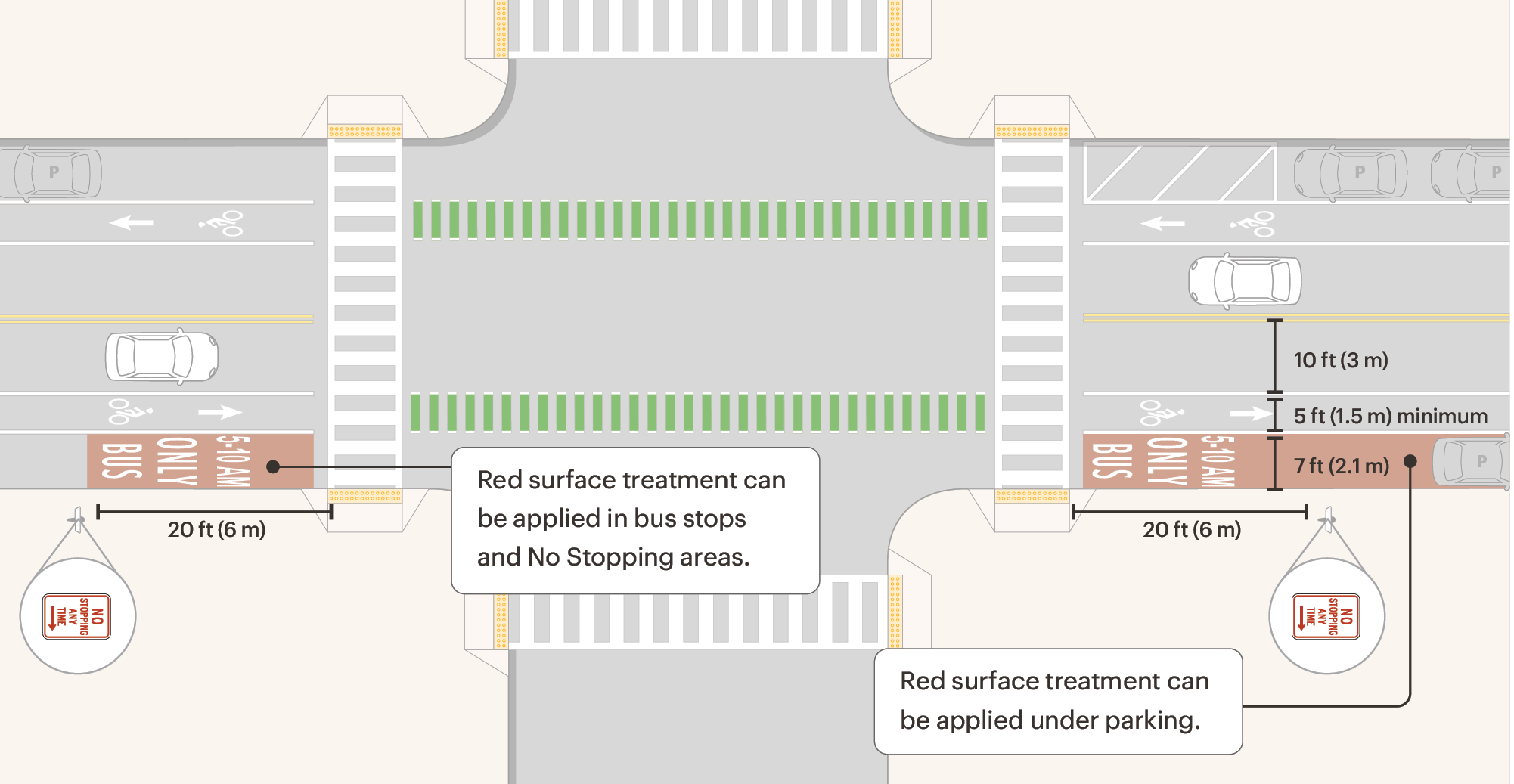
Constrained bike lanes adjacent to parking may be converted to peak-only bus lanes where traffic is noticeably heavier during the morning or evening commute hours. Corridors without heavily peaked traffic volumes may be better served by installing bus boarding islands or shared boarding areas; these will provide all-day reliability improvements to bus service.
To be converted to a peak-only bus lane, the combined width of the constrained bike lane and parking lane must be at least 12 ft (3.6 m). The bike lane must be at least 5 ft (1.5 m) at all times, including when off-peak parking is permitted.
The bike lane is designed as a standard constrained bike lane with solid white lane lines on either side of the bike lane.
Bike lane symbols or BIKE LANE word markings (MUTCD Figure 9E-1) should be applied at the beginning of a bike lane and intermittently along each block.
At bus stops and at the farside of each intersection, use pavement markings to indicate that the lane is for buses during peak times. Cities can use general terms (“AM ONLY BUS”) or indicate specific hours (“7-10 AM LANE BUS”).
Green surface treatments may be added to bike lanes to improve conspicuity. Green surfacing may be used along the full length of a bike lane. Green surfacing may also be used to increase the conspicuity of the bike lane approaching or departing intersections and driveways.
Red surface treatment can be applied underneath the parking lane. It may also be used at bus stops and at the farside of intersections.
Do not use red surface treatment in bike lanes.
Signs must indicate the times of parking prohibition (e.g. “No Parking, 7-10 AM”) and communicate that bicycling is permitted at all times. Overhead signs are preferred.
- Federal Highway Administration. Developing Crash Modification Factors for Bicycle-Lane Additions While Reducing Lane and Shoulder Widths. Publication Number FHWA-HRT-21-012. USDOT, 2021. https://www.fhwa.dot.gov/publications/research/safety/21012/21012.pdf. ↩︎
- “Installing a Road Diet can lead to an expected crash reduction of 19 to 47 percent. Variables affecting safety effectiveness include pre-installation crash history, installation details, traffic volumes, and the urban or rural nature of the corridor.”
Federal Highway Administration. Road Diet Informational Guide. Publication Number FHWA-SA-14-028. USDOT, 2014: 6. https://safety.fhwa.dot.gov/road_diets/guidance/info_guide/rdig.pdf. ↩︎ - Federal Highway Administration. Developing Crash Modification Factors for Separated Bicycle Lanes. Publication Number. FHWA-HRT-23-078. USDOT, 2023. https://highways.dot.gov/media/33856. ↩︎
- McNeil, Nathan, Christopher M. Monsere, and Jennifer Dill. “Influence of Bike Lane Buffer Types on Perceived Comfort and Safety of Bicyclists and Potential Bicyclists.” Transportation Research Record: Journal of the Transportation Research Board 2520, no. 1 (2015). https://pdxscholar.library.pdx.edu/cengin_fac/221/. ↩︎
- “Overall, this study found no evidence that narrower lanes are associated with the higher number of crashes and that narrow lanes (9-foot and 10-foot) increase the risk of vehicle accidents, after controlling for cross-sectional street design characteristics and other confounding variables.”
Hamidi, S, and R. Ewing. A National Investigation on the Impacts of Lane Width on Traffic Safety. Johns Hopkins Bloomberg School of Public Health, November 2023: 3. https://narrowlanes.americanhealth.jhu.edu/report/JHU-2023-Narrowing-Travel-Lanes-Report.pdf. ↩︎ - “When a second solid white lane line was added, dividing the bicycling-cum-parking area into a 5-ft bike lane and a 7-ft parking lane, mean parking offset fell by almost 3 in.”
Furth, Peter, Daniel Dulaski, Mapolo Buessing, and Parham Tavakolian. “Parking Lane Width and Bicycle Operating Space.” Transportation Research Record: Journal of the Transportation Research Board 2190, no. 1 (2010): 45. https://doi.org/10.3141/2190-06. ↩︎ - Research has found that a 5- to 6-foot bicycle lane width had positive implications for reducing vehicle crashes and 6- to 7-foot bicycle lanes were effective in reducing nonmotorized (bicyclist and pedestrian) crashes.
Park, Juneyoung, and Mohamed Abdel-Aty. “Application of Random Effects Nonlinear Model for Analyzing Motorized and Nonmotorized Traffic Safety Performance.” Journal of Transportation Engineering, Part A: Systems 147, no. 1 (2020). https://doi.org/10.1061/JTEPBS.0000485. ↩︎ - “Door zone crashes account for 12-27% of bicycle-motor vehicle collisions. Providing a buffer leads to almost no cyclists traveling in the door zone.”
Schimek, Paul. “Bike lanes next to on-street parallel parking.” Accident Analysis and Prevention 120 (November 2018): 74-82. ↩︎ - Research suggests that even a 4’ bike lane with 2’ buffer adjacent to parking has advantages over a 6’ marked bike lane.
National Cooperative Highway Research Program. Recommended Bicycle Lane Widths for Various Roadway Characteristics. Report 766. Transportation Research Board, National Academies of Sciences, Engineering, and Medicine, 2014. https://www.trb.org/Publications/Blurbs/171010.aspx. ↩︎ - “The first symbol or word marking in a bicycle lane should be placed at the beginning of the bicycle lane and downstream symbol or word markings should be placed after major intersections. Additional symbol or word markings should be placed at periodic intervals along the bicycle lane based on engineering judgment.”
Federal Highway Administration. Manual on Uniform Traffic Control Devices, 11th Edition. USDOT, 2023: Section 9E.01, paragraph 03. https://mutcd.fhwa.dot.gov/pdfs/11th_Edition/part9.pdf. ↩︎ - “Green-colored pavement is used to enhance the conspicuity of locations where bicyclists are expected to operate, and areas where bicyclists and other traffic might have potentially conflicting, weaving, or crossing movements. Green-colored pavement is also used to enhance the conspicuity of word, symbol, and/or arrow pavement markings when these markings are used in certain bicycle facilities.”
Federal Highway Administration. Manual on Uniform Traffic Control Devices, 11th Edition. USDOT, 2023: Section 3H.06, paragraph 01. https://mutcd.fhwa.dot.gov/pdfs/11th_Edition/part3.pdf. ↩︎ - 23 CFR Chapter 1 Subchapter G Part 655 Subpart F. https://www.ecfr.gov/current/title-23/chapter-I/subchapter-G/part-655/subpart-F. ↩︎
- Federal Highway Administration. Manual on Uniform Traffic Control Devices, 11th Edition. USDOT, 2023: Section 9E.06. https://mutcd.fhwa.dot.gov/pdfs/11th_Edition/part9.pdf. ↩︎
- Federal Highway Administration. Manual on Uniform Traffic Control Devices, 11th Edition. USDOT, 2023: Section 3B.25. https://mutcd.fhwa.dot.gov/pdfs/11th_Edition/part3.pdf. ↩︎
- Federal Highway Administration. Manual on Uniform Traffic Control Devices, 11th Edition. USDOT, 2023: Section 9E.08. https://mutcd.fhwa.dot.gov/pdfs/11th_Edition/part9.pdf. ↩︎
- Tait, Caroline, Roger Beecham, Robin Lovelace, and Stuart Barber. “Contraflows and cycling safety: Evidence from 22 years of data involving 508 one-way streets.” Accident Analysis & Prevention 179 (2023). https://doi.org/10.1016/j.aap.2022.106895. ↩︎
- Federal Highway Administration. Manual on Uniform Traffic Control Devices, 11th Edition. USDOT, 2023: Section 9E.08. https://mutcd.fhwa.dot.gov/pdfs/11th_Edition/part9.pdf. ↩︎
- Federal Highway Administration. Manual on Uniform Traffic Control Devices, 11th Edition. USDOT, 2023: Section 3B.01. https://mutcd.fhwa.dot.gov/pdfs/11th_Edition/part3.pdf. ↩︎
- 23 CFR Chapter 1 Subchapter G Part 655 Subpart F includes chromaticity requirements for red surface treatments. https://www.ecfr.gov/current/title-23/chapter-I/subchapter-G/part-655/subpart-F. ↩︎