As designs shift–from mixing people on bikes with motor vehicles to providing a distinct network for bicycling–new points of interaction emerge between people walking and people on bikes. Some bikeway projects introduce specific design needs for pedestrians, but even when they do not, the design process typically reveals pedestrian needs that have gone unaddressed.
Accessibility is required on all streets. With or without bike-specific infrastructure, people with disabilities have specific design needs at mid-block crosswalks, skewed intersections, complex signalized intersections, and roundabouts. Many bikeway projects offer an opportunity to provide for people with disabilities, including the addition of non-visual navigation tools.
People who are blind or have low vision navigate the built environment by:

Aligning with a pedestrian pathway. By using a combination of the edges of buildings, curbs, furnishings, and sounds, people are able to stay aligned with a sidewalk. In complex environments, Tactical Directional Indicators (TDI) can help indicate an unobstructed path of travel.
Aligning with a crosswalk. Many people who are blind or have low vision use the sound of motor vehicle traffic running parallel to the crosswalk to place themselves in an intersection. Curb ramps should be aligned with a straight pedestrian path of travel and be marked with a Detectable Warning Surface (DWS). Crosswalk markings are often used by pedestrians to keep themselves aligned through the intersection.
Detecting a gap. People who are blind or have low vision rely on their hearing to detect gaps between motor vehicles and determine whether a person in a car or on a bike has yielded to them. However, in most urban environments, they cannot hear bicycles or electric vehicles over typical background noise. Audible, vibrotactile indicators used at traffic signals and beacons and ahead of temporary pedestrian paths help pedestrians who are blind or have low vision better understand their physical surroundings. Such indicators make a low noise to help pedestrians find them and then offer a sound or spoken message that indicates how and when to continue traveling.
Detailed design guidance for pedestrian accessibility can be found in the Public Rights-of-Way Accessibility Guidelines published by the U.S. Access Board.
Detectable Surfaces Toolbox
Tactile Walking Surface Indicators (TWSI) refer to a suite of walking surfaces that help pedestrians who are blind or have low vision navigate. All surfaces must contrast light-on-dark or dark-on-light with the surrounding surface.

Detectable Warning Surface (DWS) is a standardized surface comprised of truncated domes that warn of hazards on a circulation path. DWS is required at curb ramps and along transit boarding platforms that do not have screens or guards. Crossing islands that are at least 6 ft (1.8 m) wide should also have DWS.
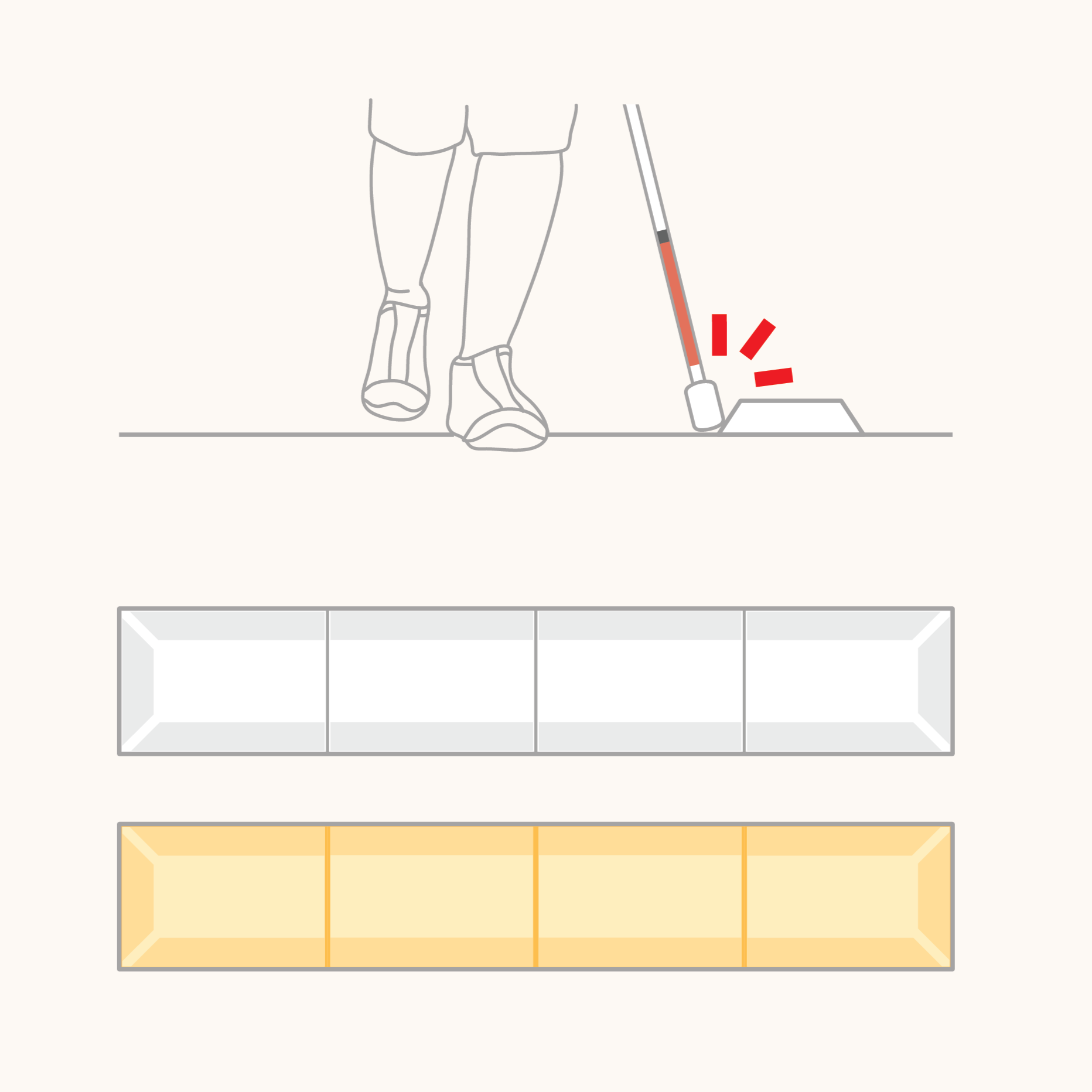
Tactile Warning Delineator (TWD) is a raised, trapezoidal surface that indicates the edge of a sidewalk or pedestrian route. TWDs warn of a hazard when crossed. TWDs are research-backed and becoming a recommended practice in North America. TWDs are used along the edge of a sidewalk-level protected bike lane and may be used to identify the edge of the pedestrian path in a shared street.
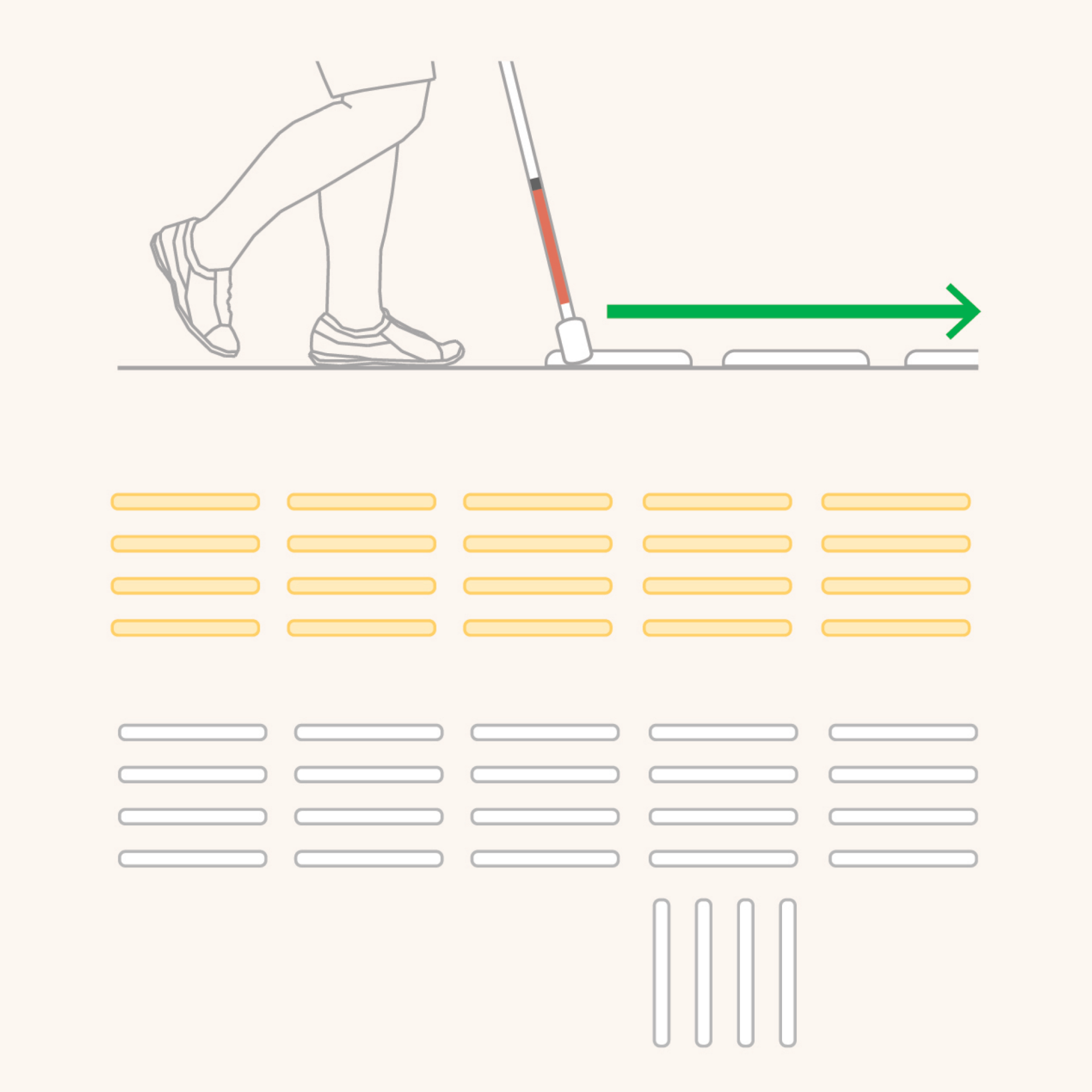
Tactile Directional Indicator (TDI) is a surface comprised of raised, parallel, flat-topped, elongated bars. TDIs are widely used internationally but are an emerging practice in the U.S. and Canada. In most cases, TDIs are installed parallel to the direction of travel and centered in the clear pedestrian route. Blind pedestrians and those with low vision understand that TDIs can normally be followed along either side. They also understand that TDIs may be crossed without encountering a hazard, as TDIs do not indicate a hazard or risk.
TDIs have a growing number of uses. TDIs are recommended for leading people to transit stops, aligning with street crossings, and identifying clear pathways in a shared street. Two-foot-wide strips of TDIs oriented perpendicular to the direction of travel are recommended to help pedestrians find and align with crosswalks. A similar layout can be used across a sidewalk to orient pedestrians to a transit stop.