Bikeways of all types benefit from a smooth surface with no seams in the direction of travel. While a bikeway can have a different surface material than other portions of the roadway, it should never be constructed from unit pavers, which create unreasonable bouncing and jostling for people using the bikeway, even when well-maintained. If the bikeway is constructed with concrete, use saw-cut joints rather than hand-tooled joints to ensure a smooth surface for riding.
Patching, Repaving, and Utility Grates
Develop proactive maintenance practices to ensure that bikeway surfaces are maintained to a high degree. While minor potholes, longitudinal cracks and seams, and other roadway defects may be fine for motor vehicles, these are serious hazards for smaller-wheeled devices.
Utility trenching, micro-trenching, patches, and other repairs along bikeways should be held to high standards and inspected following installation. Restoration work should span the width of the bikeway, placing any longitudinal joints out of the path of travel for people on bikes.
When using metal plates, apply non-skid surfacing to reduce the likelihood of slick surfaces for people on bikes. Plates should be recessed and secured to the adjacent pavement surface. Non-recessed plates must be ramped with a berm of 2 ft (0.6 m) of asphalt in the traveled direction and 1 ft (0.3 m) of the non-traveled direction.
A smooth interim and final surface are required where a utility cut runs along the bikeway longitudinally. If the cut or plate transverses the bikeway, such lips must be no more than 0.5 in (1.2 cm). Final repairs must be rectangular in shape. When preparing the final surface, apply a tack coat on all surfaces, including vertical surfaces.
While it is sometimes efficient to resurface only part of a roadway, narrower sections of asphalt are usually more difficult to maintain in the long term. If only resurfacing the bikeway, consider how the bikeway and remaining asphalt roadway surface can be maintained in the future. For touch-ups, prioritize intersection markings, which tend to get worn out soonest.
On concrete streets, seal any longitudinal joints within the bikeway. Where people on bikes share a lane with other traffic, seal joints within the area where bikes tend to operate: within the 6 ft (1.8 m) adjacent to parked cars or to curbs.
As a typical practice, orient stormwater grates perpendicular to the path of travel or use grid pattern grates. This ensures that people on bikes or other micromobility devices will not catch their wheels in the grate. In reconstruction projects, work to move stormwater grates and utility covers entirely out of protected bike lanes.
By entirely excluding motor vehicle traffic, protected bike lanes have long-term maintenance advantages over constrained bike lanes. However, resurfacing may need to be scheduled independently of the roadway as smaller equipment will be necessary.
Railway Tracks
In-street tracks for light rail or trolleys, as well as crossings for heavy railway tracks, create safety concerns for people on bikes. Rails can be more slippery than surrounding streets. Flangeways can catch smaller wheels, especially when crossed at a low approach angle. Rail crossings, especially those that are not regularly maintained, can have abrupt changes in grade, material seams, and other pavement deficiencies. Pay special attention to these areas.
Make Bikeway Crossings Level
Work with the transit operator or rail company to minimize lips and gaps between tracks and the bikeway surface. Prioritize seamless material transitions and durable surfaces, preferably concrete, around tracks that cross bikeways. Asphalt installed over the track bed is not sufficiently durable.
Use flangeway gap fillers in urban contexts where rail vehicles will not be traveling fast.
Incorporate the bikeway in the rail crossing infrastructure, including gate arms.
If track crossing panels are used, as is common with light rail and railroad crossings, work with the transit agency or railroad to ensure that the metal edges of the panels do not line up with the bike path of travel.
Cross Rails at or Near 90 Degrees
Where in-street tracks are present, consider alternative design treatments that improve the positioning of people on bikes while crossing the tracks and highlight the potential danger.
Clearly delineate the bikeway and the suggested path for users, using solid lane lines (or dotted lane lines if through an intersection).
Where the bikeway and rail tracks cross at an angle less than 90 degrees, use a “bend-out” design to redirect the bikeway out and then across the rails at a safer angle. Do not angle bikeways across rails at anything under a 60-degree angle. To avoid the risk of slipping on the rails, the bikeway must be fully straightened out at least 6 ft (1.8 m) ahead of the rails. Avoid forcing people on bikes to dismount or enter a shared travel lane.
Use a GRADE CROSSING ADVANCE WARNING (MUTCD W10-1), SKEWED CROSSING (MUTCD 10-12), or custom “rider hazard” warning sign to bring attention to the hazards associated with riding over tracks. Such signs alone are not a sufficient design treatment.
Bridge Decks
Bridges are an important part of bike networks and deserve additional attention to ensure safe passage.
Open metal decking on bridges can be particularly slippery, hazardous, and uncomfortable for all users, but especially those with small and narrow wheels. Lightweight fiberglass plates can provide a non-skid surface for people on bikes and other micromobility devices while minimizing the additional weight load on a bridge. These plates can be customized to the grating pattern of the bridge and are a lightweight, durable, and attractive solution. If the bridge does not have a dedicated bikeway, apply the plates along the outer 4-6 ft (1.2-1.8 m) of the outside travel lanes.
When rebuilding a bridge, aim to provide protected bike lanes that are distinct from both travel lanes and sidewalks. Take advantage of the reconstruction to recalculate the total weight of the bridge so that concrete may be used instead of open grating.
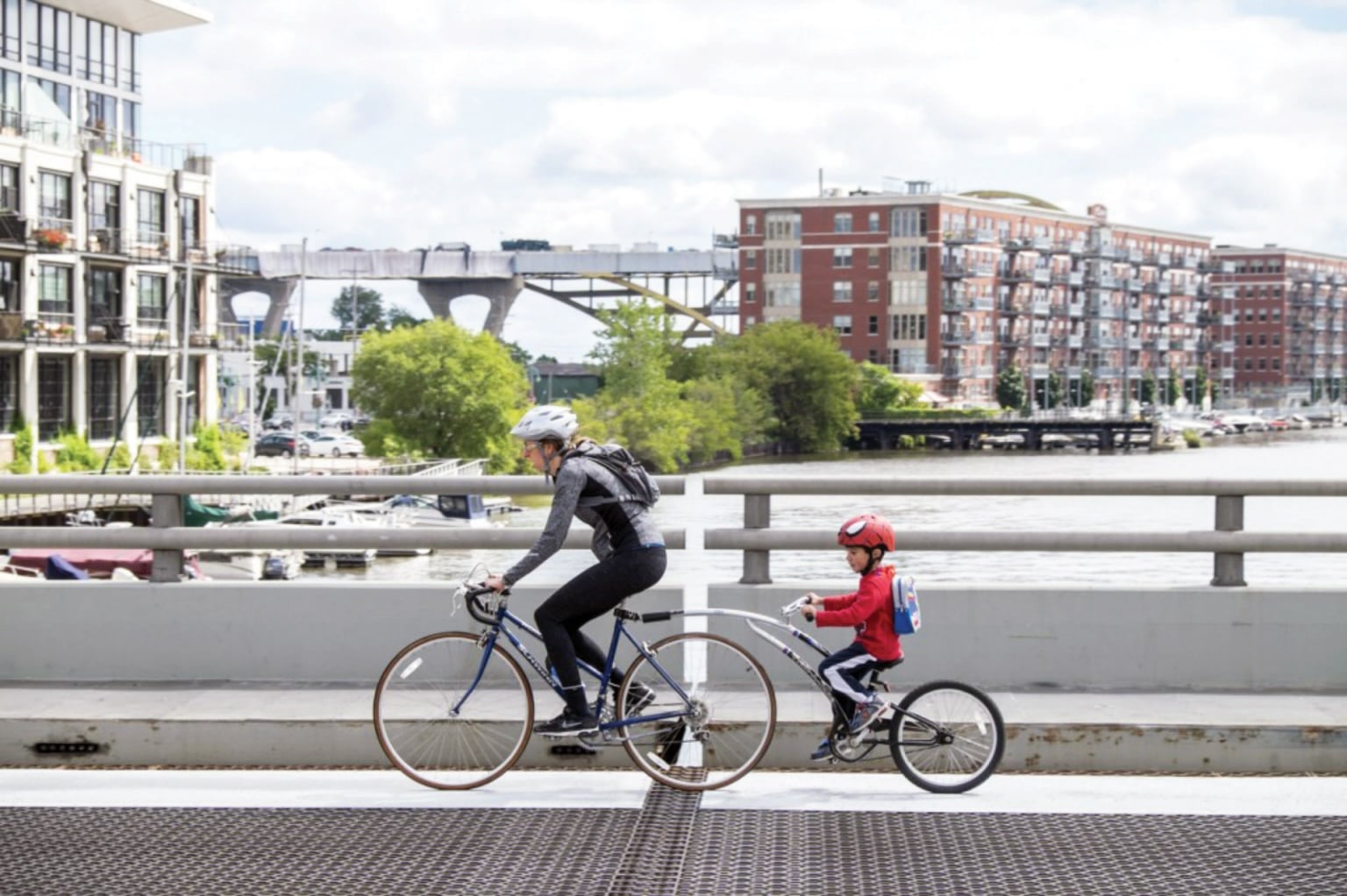
Credit: David Schlabowske, Wisconsin Bike Fed