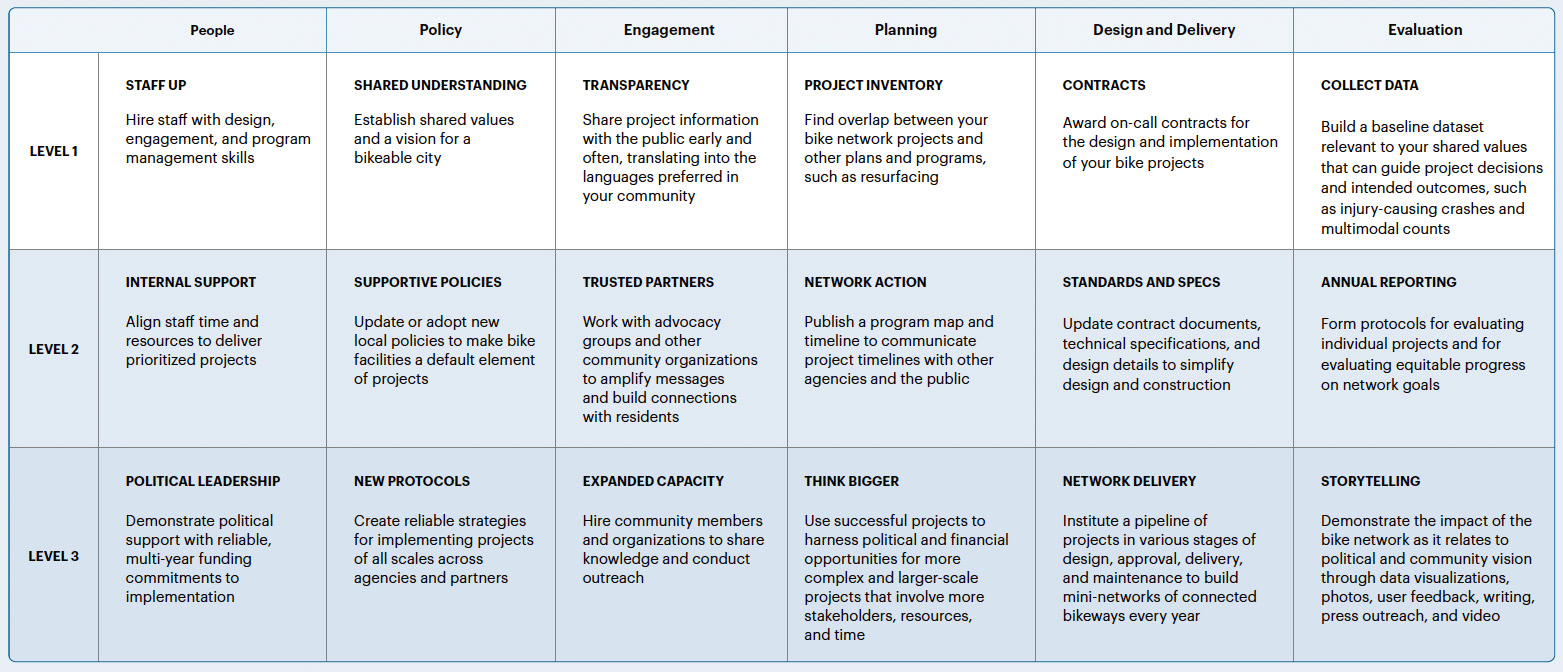
Cities need to have the internal infrastructure to deliver safe, sustainable, and equitable transportation systems. When city agencies align internal conditions and desired outcomes, they are more likely to deliver projects on time and on budget and more able to scale outputs to meet needs and solve issues early and quickly.
A Bike Network Plan is an opportunity to begin moving from a project-by-project workstream to a programmatic one. Transportation agencies need to establish streamlined and scalable approaches to political engagement, community collaboration, network and project planning, project delivery, and project and program evaluation. This process might be challenging at first, but over time the process will become smoother and less energy-intensive.
| People | Policy | Engagement | Planning | Design and Delivery | Evaluation | |
|---|---|---|---|---|---|---|
| LEVEL 1 |
Staff Up Hire staff with design, engagement, and program management skills |
Shared Understanding Establish shared values and a vision for a bikeable city |
Transparency Share project information with the public early and often, translating into the languages preferred in your community |
Project Inventory Find overlap between your bike network projects and other plans and programs, such as resurfacing |
Contracts Award on-call contracts for the design and implementation of your bike projects |
Collect Data Build a baseline dataset relevant to your shared values that can guide project decisions and intended outcomes, such as injury-causing crashes and multimodal counts |
| LEVEL 2 |
Internal Support Align staff time and resources to deliver prioritized projects |
Supportive Policies Update or adopt new local policies to make bike facilities a default element of projects |
Trusted Partners Work with advocacy groups and other community organizations to amplify messages and build connections with residents |
Network Action Publish a program map and timeline to communicate project timelines with other agencies and the public |
Standards and Specs Update contract documents, technical specifications, and design details to simplify design and construction |
Annual Reporting Form protocols for evaluating individual projects and for evaluating equitable progress on network goals |
| LEVEL 3 |
Political Leadership Demonstrate political support with reliable, multi-year funding commitments to implementation |
New Protocols Create reliable strategies for implementing projects of all scales across agencies and partners |
Expanded Capacity Hire community members and organizations to share knowledge and conduct outreach |
Think Bigger Use successful projects to harness political and financial opportunities for more complex and larger-scale projects that involve more stakeholders, resources, and time |
Network Delivery Institute a pipeline of projects in various stages of design, approval, delivery, and maintenance to build mini-networks of connected bikeways every year |
Storytelling Demonstrate the impact of the bike network as it relates to political and community vision through data visualizations, photos, user feedback, writing, press outreach, and video |