Lateral Shifts
Lateral shifts are related to the anticipated design speed of people on bikes and their physical space to maneuver. Design lateral shifts to accommodate the design bicycle. The control bicycle, typically a cargo bike, should be able to navigate the taper but may track over a flush buffer space. Do not plan or design lateral shifts to unnaturally slow the speeds of people on bikes or other small devices, as that can lead to instability.
Lateral shifts in the bikeway should be gradual and are typically accomplished by either a taper or a pair of reverse curves.
Tapers
Tapers must be long enough that two-wheeled devices can ride at a stable speed and users can proceed with minimal braking. To determine the appropriate taper, designers may use the equation L=WS^2/60, where L is the lane shift, W is the width of the offset, and S is the operating speed.
Tapers of at least 1:5 will allow most users to continue at their typical operating speeds. Consider more gradual tapers on steep downhills.
On flat bikeways, in high-pedestrian contexts, along short blocks, and in other locations planned for low bikeway speeds (e.g., near a stop-controlled intersection or a transit stop), a 1:3 taper may be appropriate for unidirectional bike lanes. Bidirectional bike lanes typically require a 1:5 taper to allow bikes in opposing directions to navigate safely without encroaching on each other’s operating space.
Reverse Curves
A pair of reverse curves can be used to create a lateral shift. Use a slight lean angle to determine the radii needed for these curves as many devices in bike lanes have three wheels. The rideable width of the bike lane through reverse curves should allow for larger devices to track into buffer areas.
Speed and Minimum Edge Radius
| Approach Speed | Minimum Edge Radius* | ||
|---|---|---|---|
| 10 mph | 16 km/h | 18 ft | 5.4 m |
| 12 mph | 20 km/h | 27 ft | 8.1 m |
| 14 mph | 23 km/h | 36 ft | 10.8 m |
| 16 mph | 26 km/h | 47 ft | 14.1 m |
| 18 mph | 29 km/h | 60 ft | 18 m |
| 20 mph | 32 km/h | 74 ft | 22.2 m |
*R=0.067V^2/Tan(lean angle degree)1
Bike Ramps and Vertical Grade Transitions
Bike ramps raise or lower a street-level bike lane to the height of the sidewalk. Ramps are often used at the beginning or end of a raised bike lane, at intersections, for shared boarding areas, and when passing a boarding island. Avoid the over-use of ramps within a single corridor, as they reduce the comfort of the bike lane and create difficult conditions for sweeping and plowing bike lanes.
Bike ramps intended for the exclusive use of bicyclists and other micromobility devices do not need to comply with accessibility requirements for pedestrians. As such, they can be steeper than pedestrian ramps. Bike ramps should provide a smooth vertical transition with a preferred slope of 1:20 (5%) and a maximum slope of 1:10 (10%). Minimize or eliminate lateral shifts when transitioning bikes vertically. Steeper ramps may be necessary in constrained conditions. In these cases, the maximum slope is 1:5 (20%).2 Steep ramps cannot have any lateral shift.
Grade breaks should be perpendicular to the path of travel for people on bikes because it will cause instability for those riding cargo bikes or adult tricycles. Where grade breaks cannot be perpendicular to the path of travel, widen the bike lane.
Ramps on shared-use paths must be compliant with accessibility requirements for pedestrians. The running slope must be no more than 1:12 (8.3%) and the cross-slope must be a maximum of 1:48 (2.1%). Grade breaks must be perpendicular to the direction of the curb ramp.3
If ramps must be narrower than the bikeway, use striping to narrow the bikeway in advance of the ramp.
Ramps will create new drainage patterns. Additional catch basins or other stormwater infrastructure may be required.
Vertical lips, seams, and large algebraic changes in grade (e.g. a transition from a 5% downslope to a 5% upslope, resulting in a difficult 10% change in grade) can be more impactful to the comfort of people on bikes than the bike ramp slope alone. Designers should seek configurations without abrupt seams between the ramp and the rest of the bikeway where possible.
Ramps directly entering a lane shared with motor vehicles should be avoided. Provide a receiving bike lane before requiring people riding bikes to merge with general traffic.
Non-Visual Navigation at Bike Ramps
Bike ramps can be challenging for people who are blind or have low vision. Where bike ramps lead onto sidewalks, shared-use paths, sidepaths, or other places where pedestrians and bicyclists will share space, non-visual wayfinding is necessary to avoid confusion and reduce conflict.
Do not use Detectable Warning Surfaces (DWSs) at the top or bottom of bike ramps because they could be misinterpreted to mean the ramp is a place to cross the street. While this treatment was recommended in the past, it is no longer acceptable practice.
Use the geometric layout of the street to help guide pedestrians along the desired pedestrian path. Where possible, place bike ramps wholly within the furnishing zone, with a detectable edge along the length of the ramp. Maintain a straight pedestrian path of travel. This will help pedestrians avoid using the bike ramp and entering the bikeway or street.
When a bike ramp cannot be placed out of the way of the pedestrian path, place Tactile Directional Indicators (TDIs) on the sidewalk. TDIs should be placed in the center of the pedestrian path of travel and extend at least 5 ft (1.5 m) in both directions from the top of the ramp. TDIs should be at least 2 ft (0.6 m) wide. Alternatively, TDIs may be placed along the top of the bike ramp.
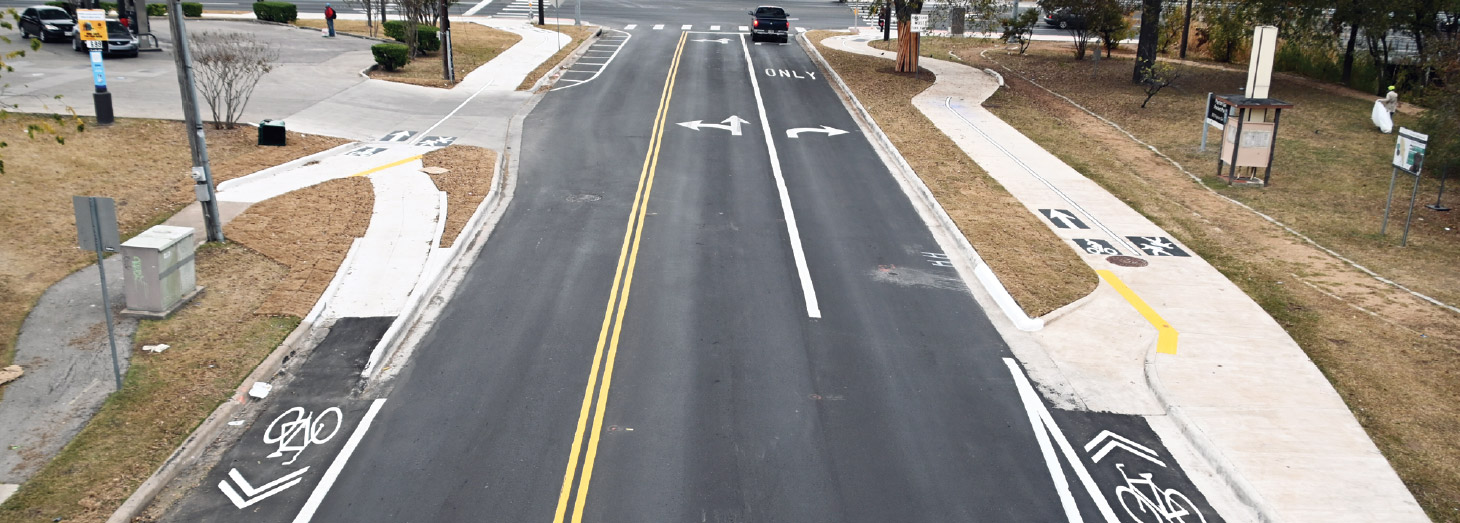
Credit: Austin Transportation and Public Works Department
Departure Ramp
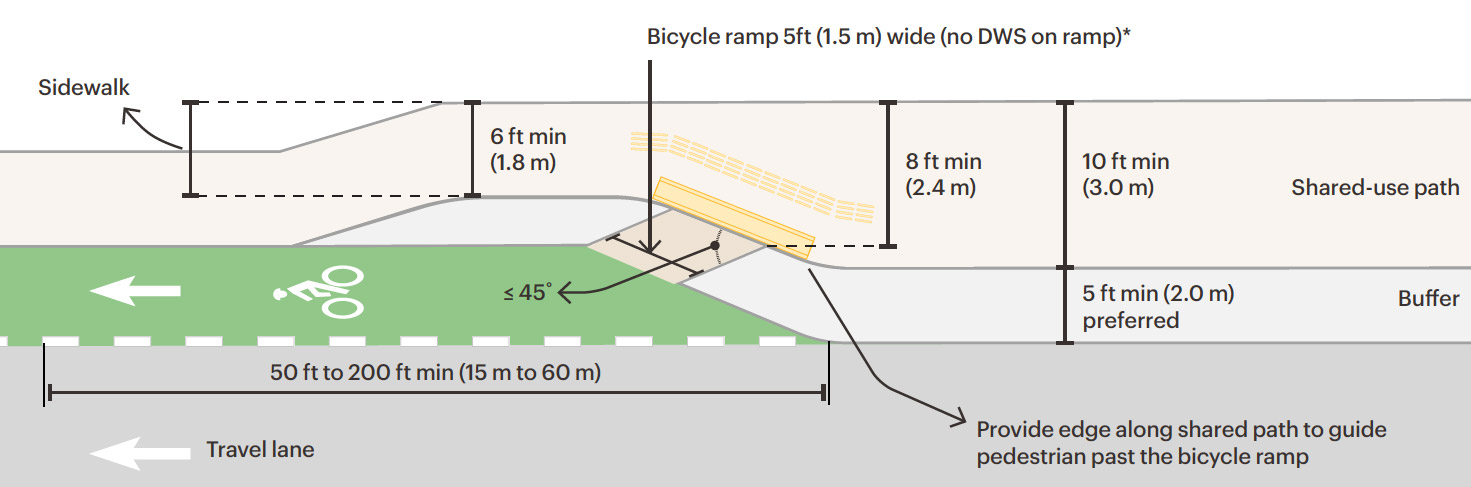
Approach Ramp

- American Association of State Highway and Transportation Officials. Guide for the Development of Bicycle Facilities, 4th Edition. AASHTO, 2012: Table 5-1. ↩︎
- National Cooperative Highway Research Program. Guide for Roundabouts. Research Report 1043. Transportation Research Board, National Academies of Sciences, Engineering, and Medicine, 2023: Section 10.4.5. https://www.nationalacademies.org/publications/27069 ↩︎
- US Access Board. Public Right-of-Way Accessibility Guidelines. US Access Board, 2023: Section R304 Curb Ramps and Blended Transitions. https://www.access-board.gov/prowag/technical.html#r304-curb-ramps-and-blended-transitions ↩︎