Signals along bikeways can operate with exclusive bike phases, protected bike phases, partially protected bike phases, or fully permissive phases with complementary motor vehicle and pedestrian movements. At higher-volume turn locations or along higher-volume bikeways, signal phasing techniques are used to separate the stream of turning vehicles from people biking, rolling, and walking. At intersections with relatively low motor vehicle turn volumes, geometric design is often sufficient to mitigate turn conflicts.
Not all turn movements at an intersection will get the same treatment for a single bikeway approach. For example, a bike phase may be fully protected for left turns but protected-permissive for right turns. Engineering judgment should be applied after considering vehicular turn volumes, visibility, grade, crash history, current and expected bike and pedestrian volumes, and the percentage of heavy vehicles moving through the intersection.

Right Turns Over Bikeways
Right turns that operate concurrently with bikeway movements can introduce crash risks to people biking. These conflicts can be mitigated with geometric design strategies that reduce turn speeds and improve mutual visibility on the intersection approach.
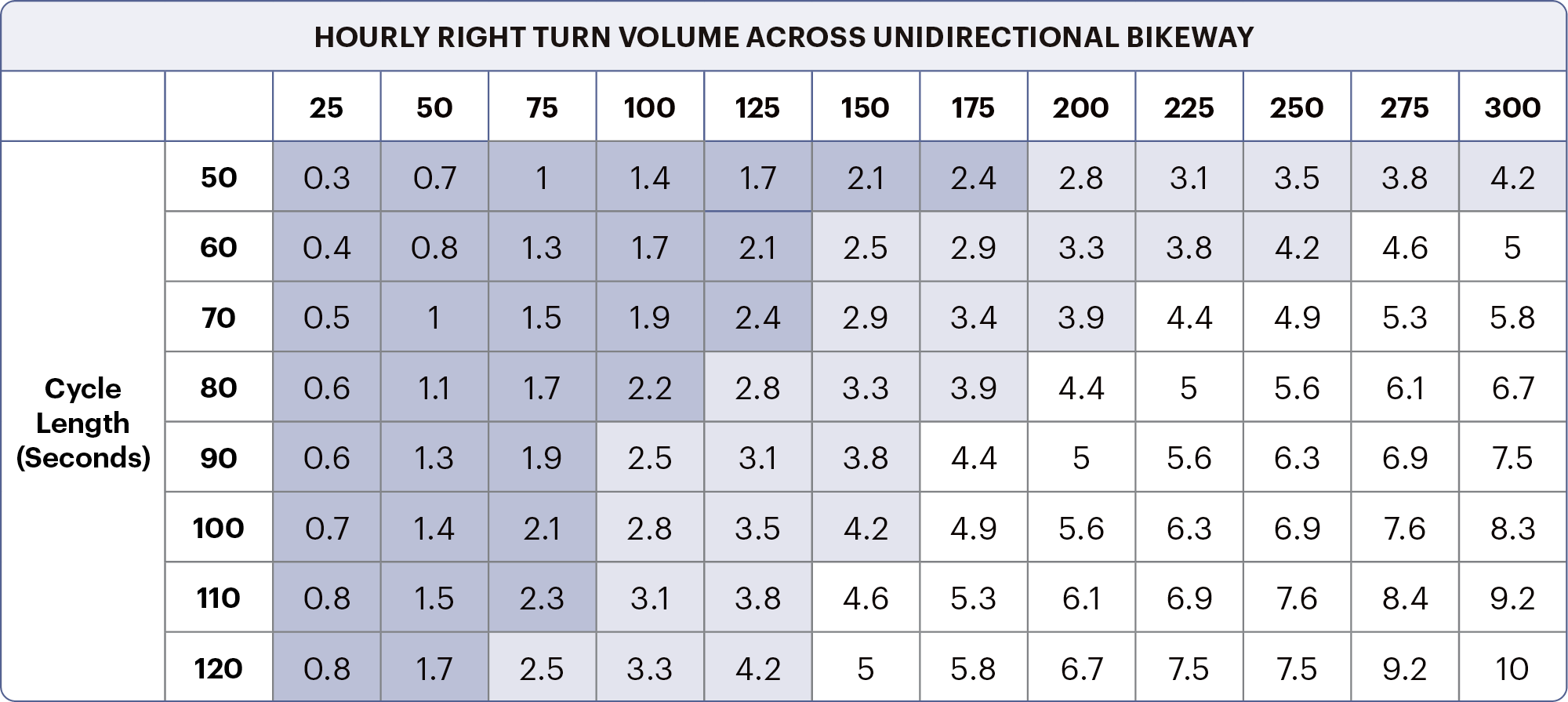
Through exclusive, protected, or partially protected bike phases, phase separation is recommended when peak-hour vehicle right turn volume exceeds approximately 2.5 per cycle over unidirectional bikeways1 and approximately 2 per cycle over bidirectional bikeways.
Phase separation should also be considered in intersections with large effective radii, channelized turn lanes, and downhill approaches.
Shorter cycle lengths minimize potential conflicts within a given phase, potentially mitigating the need for exclusive, protected, or partially protected bike phases.


Left Turns from a One-Way Street
On one-way streets where the bikeway is on the left of the general travel lanes, apply the same considerations as for left turns over bikeways.
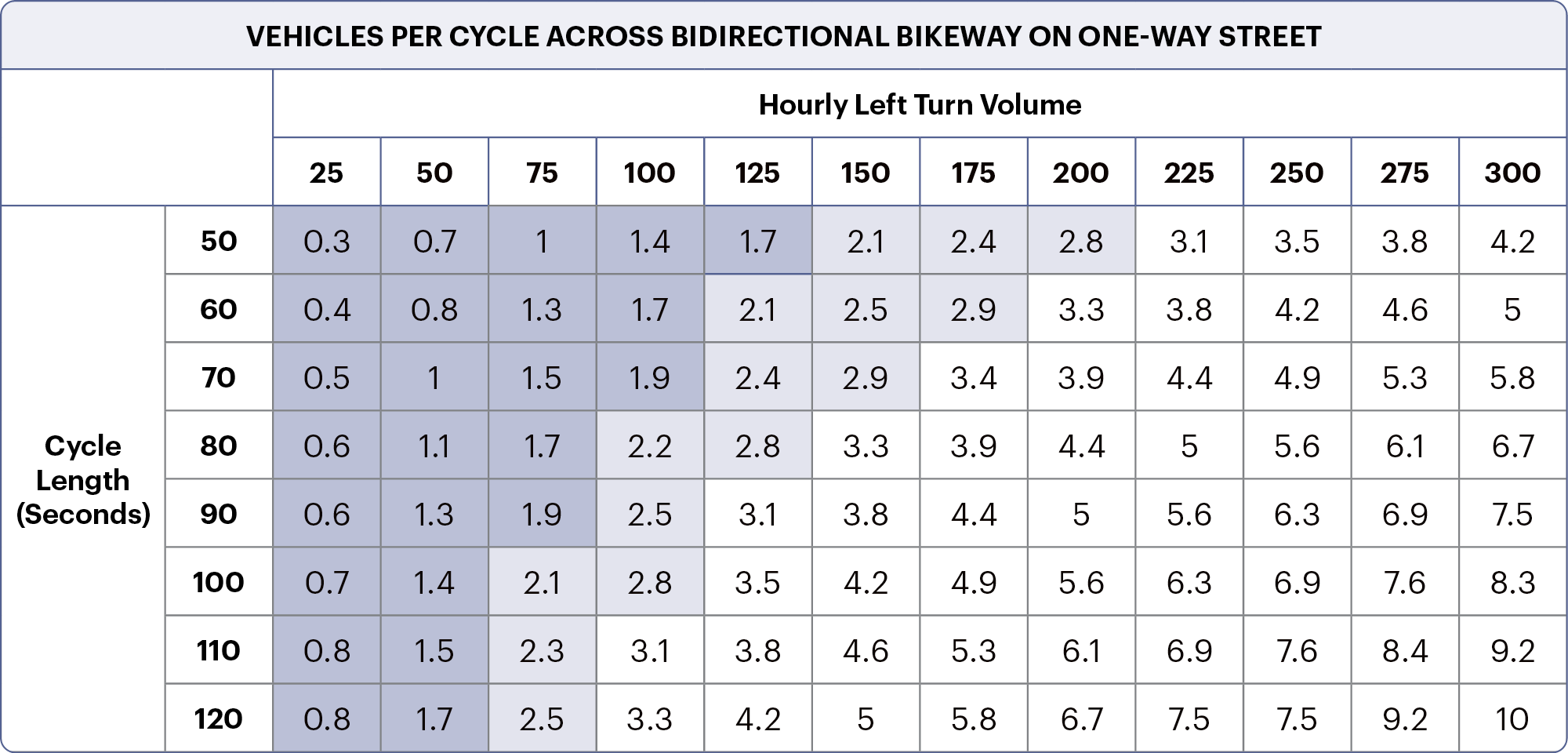
Partially protected or protected phases are recommended when peak-hour vehicle left turn volume exceeds approximately 2.5 per cycle over unidirectional bikeways and approximately 2 per cycle over bidirectional bikeways.


Left Turns Over Bikeways on Two-Way Streets
Permissive left turns from two-way streets are one of the most significant sources of crashes (and severe crashes) for all modes2, particularly for people biking and walking.3 Drivers turning left are faced with assessing the approach speed of oncoming vehicles in one or more lanes to find gaps in motor vehicle, bike, and pedestrian traffic simultaneously. Platoons of oncoming motor vehicles sometimes block the sightline between left-turning drivers and oncoming bikeway users. Research shows that eliminating permissive left turns by installing protected left-turn phasing can reduce fatal and severe left-turn crashes by 16%, fatal and severe right-angle crashes by 19%, and total left-turn crashes by up to 70%.4
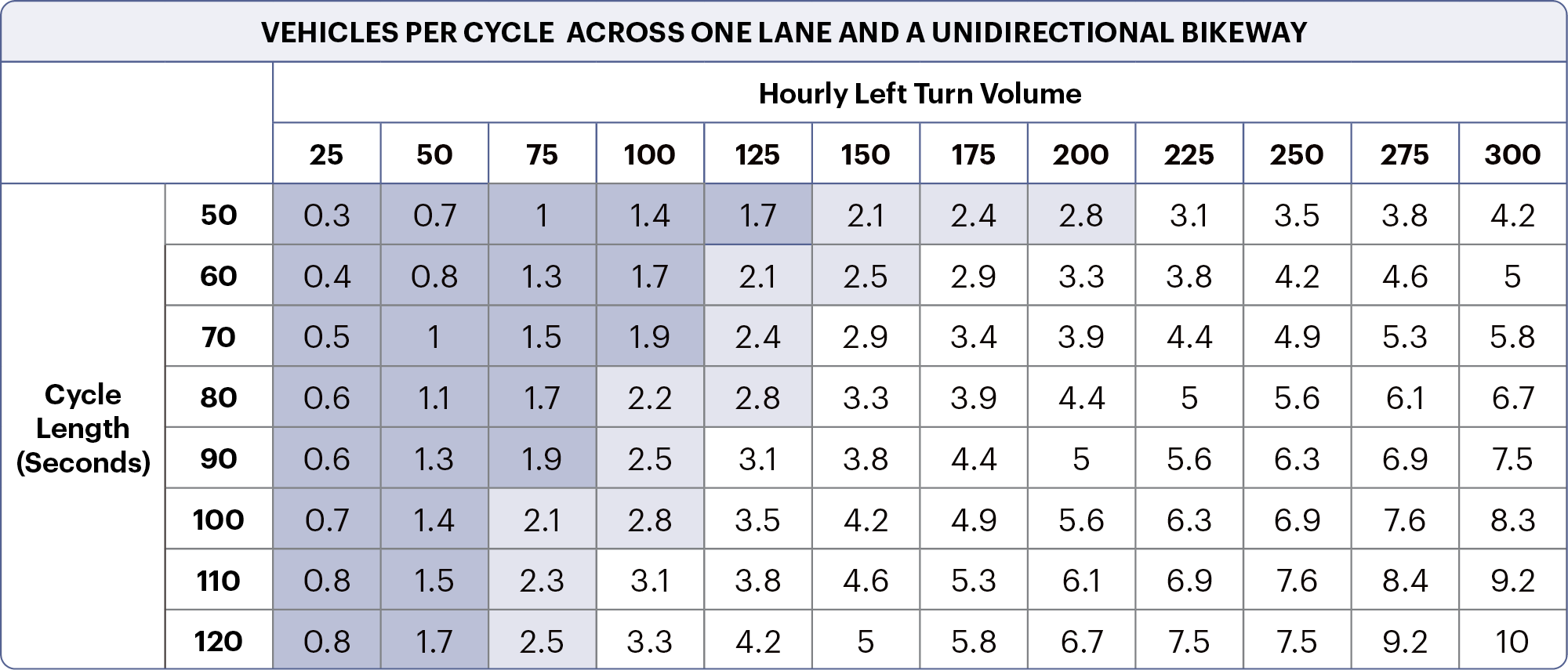
While these conflicts can be mitigated through centerline hardening5 and visibility zones, phase separation is often necessary. Where vehicular left turns cross only one general travel lane, an exclusive, protected, or partially protected bike phase is necessary above two turns per cycle when the bikeway is unidirectional and approximately 1 turn per cycle when the bikeway is bidirectional. If the bikeway is bidirectional, apply an exclusive, protected, or partially protected bike phase.
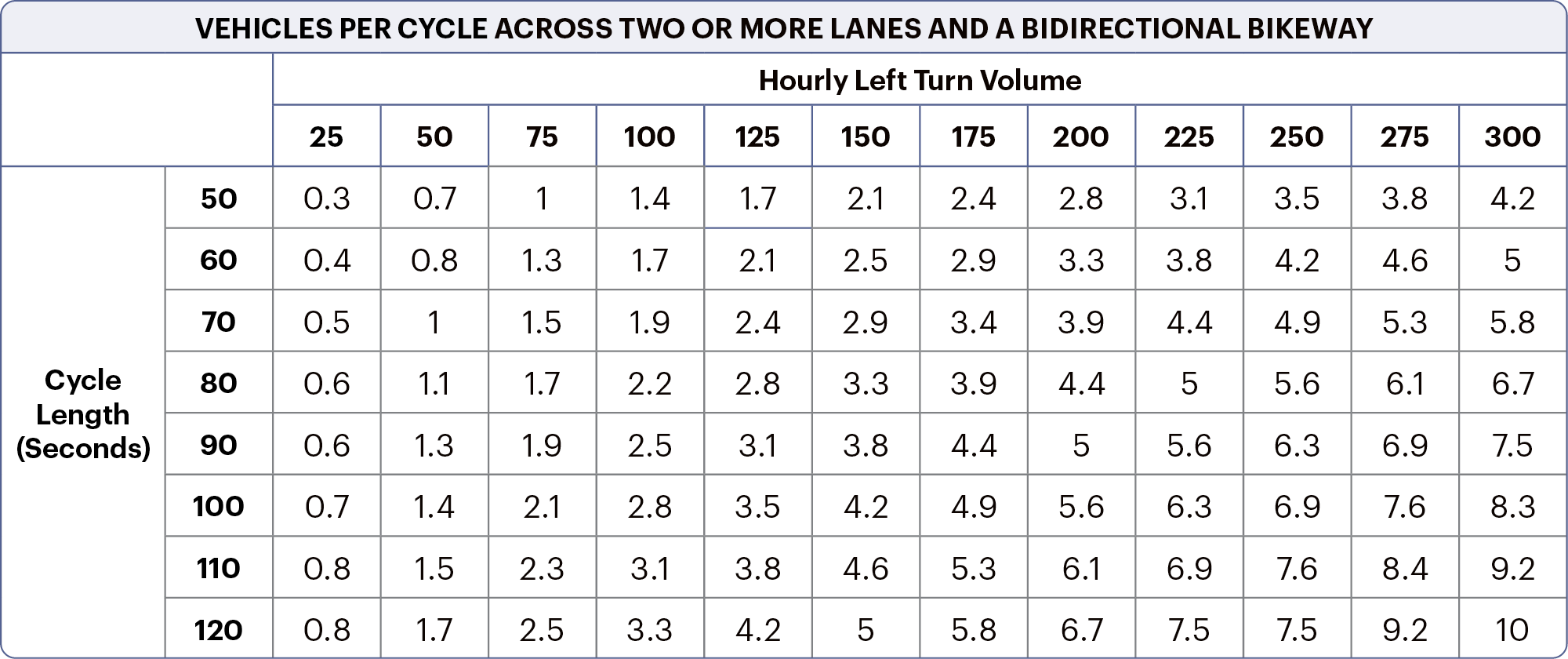
If left-turning drivers must cross two or more general travel lanes, including transit lanes, before crossing a unidirectional bikeway, apply an exclusive, protected, or partially protected bike phase when peak-hour vehicular left turn volume exceeds approximately 1.5 per cycle. If the bikeway is bidirectional, left turns and bikeway movements cannot occur concurrently.


- Milligan, C., D. Passmore, A. Pushka. “Advancing North American design practices to mitigate bicycle right-hook conflicts.” MicroTraffic Road Safety Video Analytics, 2022. ↩︎
- Synthesis from three studies in Michigan showed a 32% average reduction in all crashes with a 58.9% reduction in injury crashes by replacing permissive left turns with protected only operation. Federal Highway Administration. “Intersection Case Study: Permissive/Protected Left-Turn Phasing.” Publication Number FHWA-SA-09-015. USDOT, 2010. https://highways.dot.gov/sites/fhwa.dot.gov/files/FHWASA09015_intersection6.pdf. ↩︎
- “NYCDOT performed a before and after crash analysis of 34 intersections and found that left turn only signals reduced intersection related pedestrian and bicycle injuries by 25 percent.”
New York City Department of Transportation. “Don’t Cut Corners: Left Turn Pedestrian and Bicycle Crash Study.” NYCDOT, 2016. https://www.nyc.gov/html/dot/downloads/pdf/left-turn-pedestrian-and-bicycle-crash-study.pdf. ↩︎ - Federal Highway Administration. Desktop Reference for Crash Reduction Factors. Publication Number FHWA-SA-08-011. USDOT, 2008: 11-12. https://www.cmfclearinghouse.org/collateral/FHWA_Desktop_Reference_Guide.pdf. ↩︎
- New York City Department of Transportation. “Don’t Cut Corners: Left Turn Pedestrian and Bicycle Crash Study.” NYCDOT, 2016. https://www.nyc.gov/html/dot/downloads/pdf/left-turn-pedestrian-and-bicycle-crash-study.pdf. ↩︎