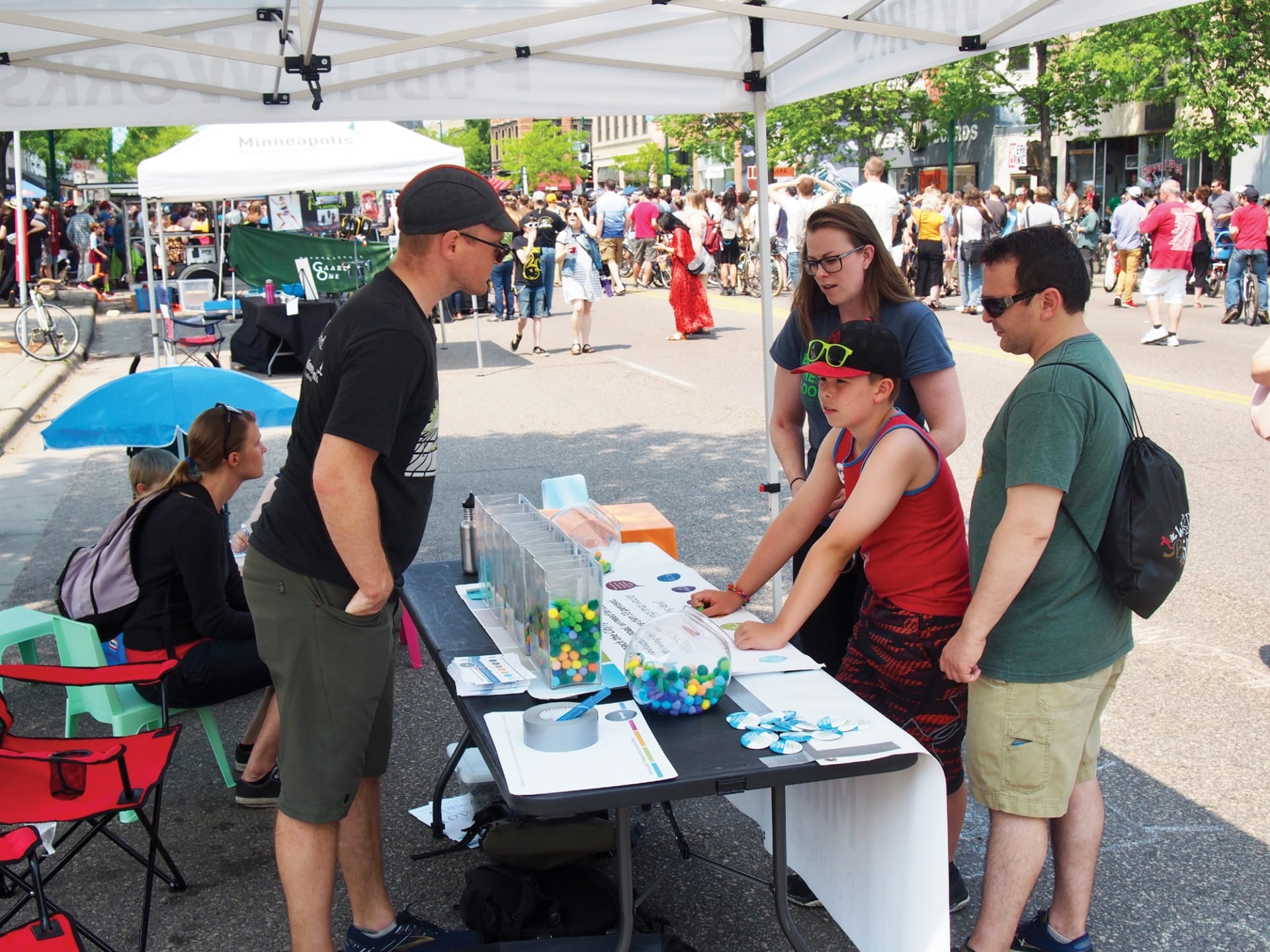
Credit: Minneapolis Public Works, Transportation Planning and Programming
At this point in the process, cities have developed the Bike Network Plan, prioritized projects, and created an action plan for project delivery. To effectively deliver bike projects, a project development process with key steps and associated activities for each step should be defined. Having a standard project development process can lead to more successful project outcomes: community buy-in, support from elected officials, and a project delivered on time and on budget.
Every city has a different approach to project delivery, which varies based on their city context, departmental organization, and budgetary processes. In general, there are three phases that project development and delivery can be organized under. These three phases of project development and delivery, described below, are meant to be a generalized approach that can be scaled from quick build types of projects up to major capital investments.

1. Scoping and conceptual design. The project team establishes a clear project purpose, works collaboratively with community partners and residents to develop a robust conceptual design, and aligns internal resources to design and deliver the project.
2. Detailed design and delivery. The project advances through key design milestones with regular public updates and opportunities for problem-solving. Internal teams work through design iterations and finalize a design that embodies the values of the Bike Network Plan. The project moves into implementation in a process typically led by a capital delivery project manager. This more detailed design and construction work will typically take up the majority of a project’s schedule and budget.
3. Operations, evaluation, and learning. After a project is constructed, monitoring use and operations is crucial to ensure long-term success and identify any potential hazards, maintenance headaches, or drainage issues. Sharing findings with community stakeholders—and gathering their feedback—can also help identify and correct outstanding problems. Lessons learned during this stage of the project can also inform other projects in the action plan.
Cities can be prepared for these opportunities by hiring in-house staff or having on-call contractors who have experience doing similar construction projects and quick-build work with the department, and by having clear lines of program management and approval. In these instances, an in-house project manager can lead the entire project from concept to implementation oversight.
1. Scoping and Conceptual Design
In this first phase of the project development process, city staff should lay the groundwork to ensure the project aligns with community needs, budgetary and staff capacity constraints, and broader transportation goals. By the end of the scoping and conceptual design phase, the team should have a clear design proposal for a bike project that aligns with the goals of the Bike Network Plan, has buy-in from community partners, and is feasible within the given budget and design constraints.
A strong project purpose identifies how the project supports the goals in the city’s bike plan and why this specific connection is an important step in expanding the bike network. As part of identifying the project purpose, consider who benefits from or is harmed by the problems that the project purports to solve, and whether the project—and the process for developing it—will address existing disparities.
Project managers should seek input from a broad group of community stakeholders on project goals, budget, and implementation strategy. Such stakeholders include relevant elected officials, other city departments, transit agencies, neighboring jurisdictions, business improvement districts, transportation advocates, community-based organizations focused on compatible issues (e.g. affordable housing, voting rights), and any other entities that may represent the interests of the area. This can be a time-intensive step, but building these relationships early helps city staff gain a deeper understanding of stakeholders’ needs, expectations, and values. It also builds mutual trust that can increase support for a project and allow city staff to better navigate any challenges or pushback during implementation.
The scoping and conceptual design phase is crucial to the overall success of a project. Jumping into detailed design work without a clearly defined project concept can impact schedule and budget by forcing the team to redo design work to accommodate new information or incorrect assumptions. This kind of backtracking also erodes trust with community members and other stakeholders.
1a. Define the Project
Develop a project charter to guide the work of both in-house staff and external consultants. This document clearly defines who does what and who makes decisions. It also articulates the role of other agencies or partners who should be consulted on the project. As you develop the project charter, keep in mind the structure of your agency and the other teams or divisions that need to be kept in the loop through the project process. Coordinating work with the construction management crew or street-lighting team, for example, may allow for aligned schedules and consolidated projects in ways that save time and resources.
Identify the implementation vehicle for the project. Decide which people, partnerships, and agreements are needed to bring the project to life. Choose whether work will be completed by in-house design and construction crews or external contractors. See if the work can be accommodated by existing construction contracts or if the project needs to be bid out under a new contract.
Define a clear understanding of needs, expectations, and values for community engagement. Too often, community engagement becomes a source of friction and frustration for city agencies looking to develop projects. Community engagement processes may be treated as perfunctory exercises that “check a box,” or they may become so convoluted and dominated by the opposition that they derail projects instead of improving them. City staff should think deeply about their goals for community engagement, asking what they hope to accomplish, what the role of the community is in developing this project, and how the differing ideas, expertise, and expectations of community members can be honored and integrated with those of city staff.
Consider bringing together and paying a small group of external advisors who represent community-based interests. These advisors can help inform appropriate engagement strategies for the neighborhood by suggesting locations and dates for events, confirming that outreach plans make sense for the community, and spreading the word about the project to their networks and neighbors. This group should not be empowered to make design decisions.
Craft a communications plan. Articulate key messages about the benefits of a project, the audiences those messages need to reach, and the communications tools and media that are best designed to meet those audiences. External-facing language should be clear and free of technical terms the general public may not understand. Consider the communications tools and mediums available, including video, text, social media, and traditional media. Plan for translation or interpretation services that will be necessary.
Identify budget estimates and implementation strategies. Fully fund the anticipated design, communications, and engagement costs at this point. Estimate construction costs based on the anticipated level of construction intensity, the possible types of intersection treatments, and the amount of signal work. The more comprehensive the initial budget estimate is, the more likely the project can stay on schedule and on budget in future stages.
1b. Collect and Analyze the Data
Robust data collection informs the planning, design, and engagement decisions made on individual projects. Equally important is a thoughtful review and analysis of the data to identify particular vulnerabilities, inequities, or other considerations.
To achieve a successful All Ages & Abilities design, project development needs to be informed by data and driven by the values of the Bike Network Plan. Understanding the potential impact on vehicle operations, for example, provides the opportunity to mitigate those impacts or to accept them in return for the safety and connectivity improvements of the project.
Existing conditions data should be both quantitative and qualitative:
Qualitative data collection illuminates the lived experience of people affected by the project for agency staff and other stakeholders. Personal stories and observations can reveal specific challenges, such as the absence of crosswalks outside a school or a lack of designated delivery and loading zones for businesses. Broader concerns and fears, including housing costs or inadequate public transit, will also arise. Project staff will need to partner with other agencies or teams to respond and share information on such topics.
Quantitative data collection must reflect the goals of the Bike Network Plan and extend beyond a traditional look at vehicle delay. Prioritize understanding who is using the street and how. For example, are more people riding bikes in one direction than the other? Does bicycle activity peak at the same time as motor vehicle activity? Are there intersections where the number of turning drivers creates conflicts with people on bikes or walking across the street? Apply a Safe Systems lens to any analysis, watching for outliers in speed, injurious crash locations, and the allocation of space within the right-of-way to potentially dangerous activities (such as blocking sight lines with parked cars).
Agency staff can use this data to illustrate trends and make a compelling case for design decisions to stakeholders. This information also forms the “before” analysis of individual projects and network-wide changes.
Whenever possible, share data and analyses publicly to build trust with community members and other key partners.
- Observations of the different ways people are using the street in its current form at various times during the week, including weekends.
- Crash history and crash reports from the last three to five years.
- Existing features that are likely to result in poor safety outcomes, such as skewed intersections, uncontrolled crosswalks over multiple traffic lanes, missing curb ramps, and poor sightlines.
- Mid-block speed and volume for all modes, including people on bikes and other micromobility users.
- Turning movement counts for all modes at signals and major driveways.
- Transit data, including stop locations, lengths, and boarding/alighting data. (Transit agencies may also be able to provide typical travel times for recent years.)
- Curbside regulations and, if resources allow, a study of loading activity, occupancy, and turnover.
- An engineering survey for projects requiring construction, or field measurements to understand available curb-to-curb widths for projects that won’t require construction.
- Network usage and other high-level metrics from big data sources can give insight into trip origins and destinations along particular corridors and average trip times over several years.
- Stories, anecdotes, and problem statements from local residents, street users, and other community stakeholders such as school teachers and parents, library patrons, and small business managers.
- Photos of existing uses, notable issues, or potential opportunities, for use in project materials and as documentation of existing conditions
1c. Develop Concept Designs
After a project scope has been defined, the first steps of design can begin.
Affirm the AA&A facility type. Based on existing data, determine the type of bikeway that will provide a safe, comfortable AA&A environment for people on bikes. Protected bike lanes are appropriate on all streets, but on streets with lower motor vehicle speeds and volumes, a bike boulevard, advisory bike lanes, or even constrained bike lanes may be appropriate. (See Guidance for Selecting All Ages and Abilities Bikeways.)
Consider additional design and infrastructure needs. Achieving an AA&A bike facility may require other changes to the street. Vertical traffic calming, travel lane reallocation, and curbside regulations are common design features in bikeway projects. If budget allows, consider the potential to improve pedestrian ramps, implement green stormwater infrastructure, or rebuild sections of sidewalks to address specific community concerns discovered via qualitative data collection.
Check the impact on walking and transit. Projects scoped to achieve AA&A bikeways can also be opportunities to improve streets for people walking and using public transit. Similarly, a bike project may have impacts on those modes that will need to be mitigated in future design iterations. Consider how changes to intersection operations could improve pedestrian safety. Determine if a transit queue jump could mitigate possible delays from lane reductions. Finding potentially viable solutions now can help avoid delays and opposition down the road.
Consider materials that reduce maintenance needs. Regardless of how quickly a project can be implemented, it is likely to be around for years to come. Staff must consider the financial and logistical maintenance requirements that different materials pose. More durable materials may have a higher upfront cost but will require less frequent or intensive maintenance going forward.
Check concept designs against the available budget. Different design choices have different financial impacts. Before sharing potential concepts with the public, confirm that each is financially feasible. If certain items are beyond the possible budget, set them aside for now.
Share findings with residents and stakeholders and explain what they mean. More people are likely to engage with concept designs than abstract ideas. Staff should be prepared to discuss the project purpose, candidly acknowledge trade-offs for vehicular access, and illustrate how the concept designs help accomplish citywide goals and needs. City staff should answer community questions and welcome ideas for mitigating any concerns or negative impacts. Staff should be able to speak confidently and knowledgeably about the reasons why certain designs are not possible. City leaders should be present at key opportunities to support the staff in making these points.
Document everything. Lessons uncovered during concept development can help inform the project design and be useful for demonstrating the design process to internal and external stakeholders. Maintain an up-to-date webpage for the project with information about each engagement activity and how it was advertised.
2. Detailed Design and Delivery
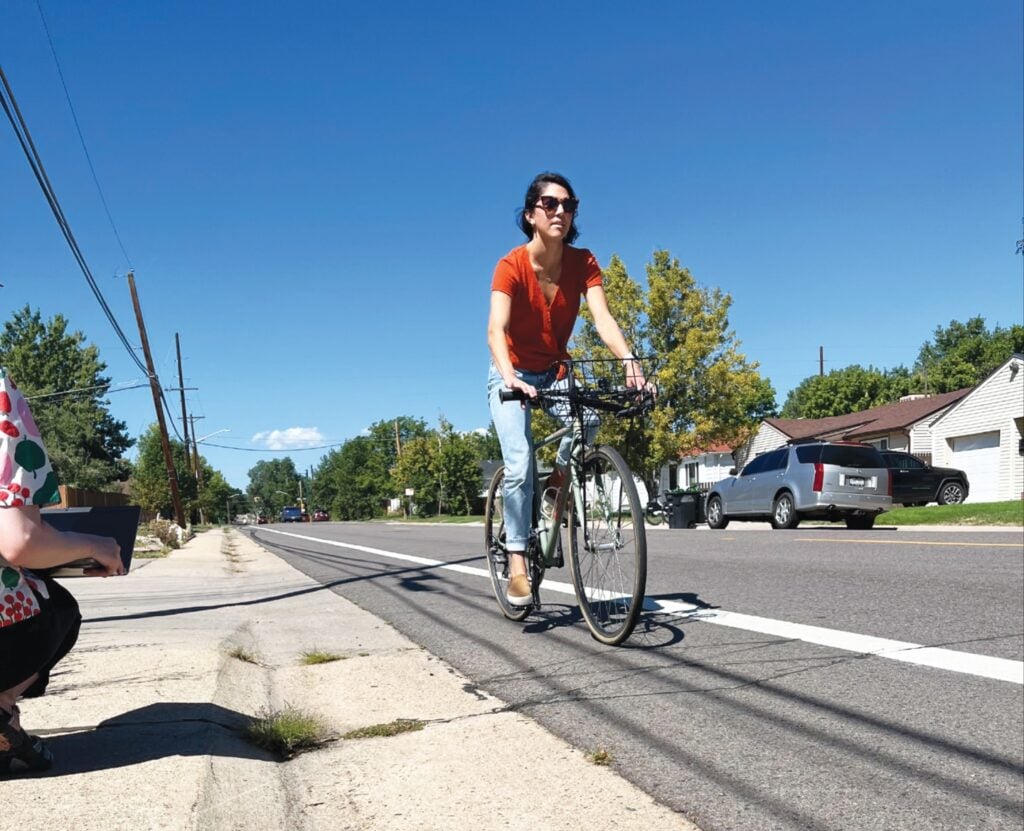
Credit: Taylor Phillips
2a. Develop a Cross-Section and Intersection Approach
Project staff should use the project purpose, as well as the data analysis, conceptual design, and community stakeholder input collected to this point to identify a preferred cross-section. At this step, agency leadership should confirm their support with staff. Sign off from high-level staff ensures that the core design will not be heavily compromised during detailed design.
Explore how the cross-section applies to each block and intersection. Test, and re-test, design elements along the street, including: buffer width, bikeway width, transit stops, accessible parking spaces, loading zones, and the impact of uncontrolled driveways. (See Designing Bikeways for All Ages and Abilities.) Develop and test strategies for intersections, optimizing for the safety of all users with slower turns, increased visibility, and appropriate control of turning movements to reduce conflicts. (See Designing Safe Intersections.)
Use this period to confirm buy-in among different teams and departments. Tell the story of the project, including community feedback and data analysis, and how it meets citywide goals and needs. Share the design trade-offs and potential implications, such as temporary routing for transit during implementation, to ensure the construction team is familiar with the materials needed.
2b. Consistently Share Project Updates with the Public
Plan ahead for regular updates to the public. During the detailed design phase, it can feel disruptive or secondary to engage the public. However, long periods of quiet weaken trust and encourage speculation. Let residents and stakeholders know what is going on “behind the scenes.” No update is still an update.
Explain how project details address community needs and get input on design challenges. Outwardly demonstrate how the team is balancing needs and prioritizing safety. Explore non-traditional settings to engage people in conversations rather than relying on traditional presentations. Offer in-depth looks at topics that the community cares about (e.g., designing for accessibility, ideas for managing the curb). This will help deepen trust with residents and stakeholders while increasing the visibility of the project and engaging more people.
2c. Refine the Estimated Budget
As the design details begin to come into focus, the project team should identify necessary budget adjustments. If the refined budget estimate exceeds available resources for the project, city staff should strategize potential sources of additional funding, separate the project into phases, or revise the design to reduce the budget while remaining aligned with the project purpose. At each design phase, an Opinion of Probable Cost can be used to understand and adjust the construction budget and identify materials needed for an on-call or IDIQ construction contract.
2d. Finalize and Share the Project Design
Final plans should be made available to residents and stakeholders as a specific, planned phase of engagement. Avoid large “town hall” meetings and instead provide opportunities for reflection and conversation. Highlight how the design meets needs identified in data collection, responds to feedback collected during the design process, and relates to citywide goals. Be prepared to answer questions about implementation, including an anticipated schedule and phasing for the work.
Even after undertaking a collaborative project design process, opposition to the final design may still be present. Project staff and agency leadership should anticipate opposition and be prepared to hold firm, refer to the process, and continue to respond to relevant questions.
2e. Implement and Celebrate the Project
Develop a final implementation schedule. The full details of this schedule should be shared with all internal staff and stakeholders, while a less-detailed, more accessible outline schedule should be shared with the public. Both should be updated regularly. Maintain clear and consistent internal communication to ensure that construction-period challenges are managed and resolved quickly.
Upon completion, bring together key community members, residents, and stakeholders to celebrate the project. Encourage residents to take a bike ride together and highlight community places now accessible by bike. Invite city leaders and elected officials for a photo opportunity and ribbon-cutting.
3. Operations, Evaluation, and Learning
3a. Observe Operations and Make Refinements
Sometimes, problems and shortcomings are not revealed until after a project is installed. City staff should be empowered to make minor adjustments immediately after project implementation based on feedback received via intercept surveys, constituent phone calls or emails, or from operations teams, as well as their own observations about how people are using the street. Tweaks to signal timing, the creation of new curb regulations, and the installation of flexible materials such as flex posts can happen relatively quickly. As these initial observations and adjustments progress, city staff should be clear with residents and other partners about what types of changes are and are not possible.
3b. Collect and Analyze “After” Data
Comparative “before and after” analysis is the foundation of project evaluation. By comparing reliability and safety metrics, such as the number of people biking on the street, the average speed of motor vehicles and buses traveling along the corridor, and crash rates before and after the project was implemented, cities can comprehensively analyze their work.
These before-and-after comparisons help cities evaluate how well a project is achieving its stated objectives, and provide support for program staff as they continue to make the case for why these projects are important for meeting the city’s broader safety and equity goals. When projects are highly contentious, this data can help demonstrate that the potential negative impacts of a project were never realized. Conversely, before and after analyses can help city agencies understand how a project needs to change to mitigate unforeseen impacts.
It is also valuable to gather “after” data on a scheduled timeframe after the project is completed. While some positive impacts may be measurable within just a few months, it is also valuable to examine impacts after a full year of use to account for seasonal variation. Crash data should not be compared until at least three years have passed.
The specific data that you collect, and the ways in which it is shared, may change slightly depending on the characteristics of the specific project. Make a plan for ongoing data collection and analysis that works across the full Bike Network Plan, so impacts can be accurately understood.
3c. Document Lessons Learned
Every project represents an opportunity to learn, improve, and do more in the future. After spending months or years in the weeds of developing a specific project, it can be tempting to get bogged down with what might have been better or to continue to adjust small aspects of the project, such as signal timing or curb regulations. Instead, host formal debrief sessions with the project team to gather and share thoughts together. Where changes should be made for the next project, document those and implement them in the future. Update typical details or develop new ones. Maintaining momentum is necessary to complete other projects on the action plan.
A bike network and the projects defined within the Bike Network Plan are important blueprints for the future, but they can and should be iterated as the network is built out. Evaluating the program as a whole can lead to improved outcomes and deeper stewardship for the entire network from community members, agency staff, and city leadership.

Credit: Philadelphia Office of Transportation and Infrastructure Systems