Cities investing in an All Ages & Abilities bikeway network must also address the policies and practices governing temporary traffic control. Encroachment in the bikeway can create dangerous conditions, even for temporary work. Long-term encroachment weakens the overall connectivity of the bike network.
Teams who review and approve permits should partner with contractors to develop clear, standardized construction details for common scenarios. While site-specific adjustments are inevitable, standardization will guide contractors toward best practices and ensure consistency across projects.
Contractors must be responsible for keeping bikeways and walkways clear and clean. Any accumulation of debris, snow, or ice in the typically constrained areas of bikeways and walkways adjacent to work zones can create impassable conditions.
Allocate Right-of-Way to Pedestrians and Bikes
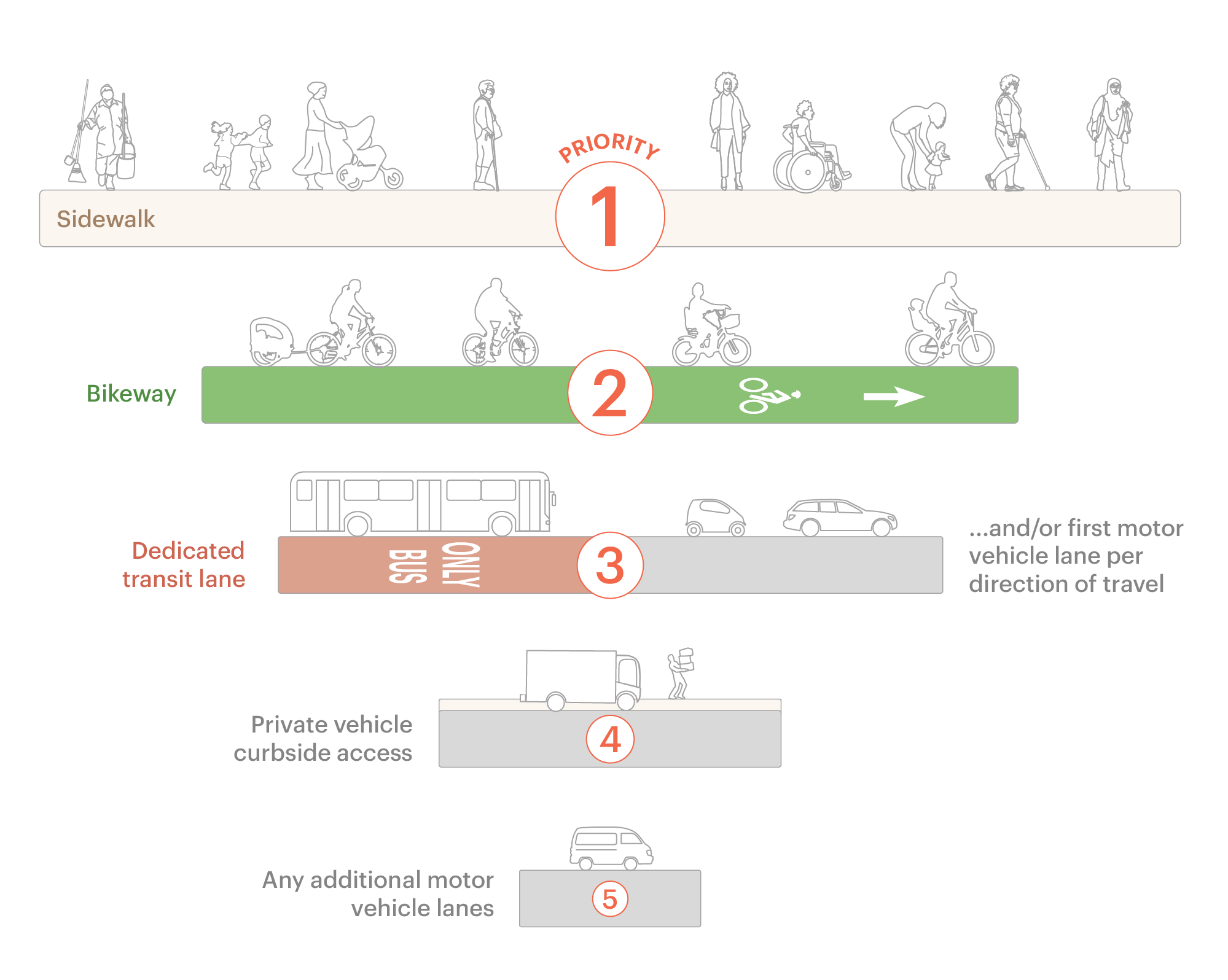
Prioritize available roadway space to accommodate pedestrian and bike safety and access. Temporary bikeways should provide accommodations equal to or better than bikeways being closed or detoured. If the impacted bikeway is a protected bike lane, a temporary protected bike lane should be provided instead of a constrained bikeway or shared lane. A constrained bikeway may be upgraded to a protected bikeway during construction, but should not be downgraded to a shared lane. Reducing the level of bikeway separation by one level (e.g., a protected bike lane to a buffered bike lane or a buffered bike lane to a constrained bike lane) is an option only in severely constrained conditions. Detours should be considered only as a final option.
Narrow general-purpose travel lanes to their minimum temporary width, typically 9 ft (2.7 m). This pinched width is limited to the extent of the construction zone and to the time period of the construction work. As a temporary condition for motor vehicles, these lane widths should not be held to the same scrutiny as permanent street design. Coordination with the local transit agency is recommended for any travel lanes under 10 ft (3 m).
Curbside access should be restricted on each side of the street to prioritize space for walking, biking, and moving traffic.
Maintain pedestrian access along both sides of the street and to all bus stops, using temporary ramps if necessary to provide the alternate travel path. If a sidewalk is closed, pedestrians must be notified of the upcoming closure at a point where a safe, accessible crosswalk is provided to the opposite sidewalk.
During construction, do not aim to meet existing motor vehicle level of service targets. Prioritize maintaining a dedicated bikeway along the block and through intersections. Consider temporarily removing or restricting turn lanes, including two-way center turn lanes to avoid constraining walkways and bikeways.
In constrained conditions, where the space available for two-way motor vehicle travel is less than 18 ft (5.4 m), consider using two-way flag control during work hours or temporarily closing an entire direction of travel during construction.
| Existing number of general travel lanes | Minimum number of general travel lanes to remain open during construction |
| 1 | 1 |
| 2 | 1* |
| 3 | 2 |
| 4 | 2 |
| 5 | 3 |
| 6 | 4 |
* In many cases, two-way general-purpose traffic can be maintained by narrowing travel lanes and restricting additional curbside uses. Where a clear width of 18 ft (5.4 m) for two-way travel cannot be maintained, explore non-traditional options, including requiring the use of two-way flag control to share the space or changing a two-way street to a one-way street by restricting oncoming traffic at the nearest intersection.
Means of Separation During Construction
Prioritize the same level or greater separation between the bikeway and the motor vehicles. Construction plans should use appropriate temporary materials based on the duration of the encroachment.
Short-term encroachment (30 days or less)

Temporary materials are acceptable and vary based on the buffer area available, including weighted traffic cones where 1.5-2 ft (0.5-0.6 m) is available and curb-mounted flexible delineator posts attached to the roadway surface with epoxy for narrow spaces.
If actively managed by flaggers or other traffic control staff, markings are optional. If adding markings, use temporary bike lane markings to clarify bike positioning.
Long-term encroachment (more than 30 days)
Use durable materials that are less likely to be dislodged, including jersey or water-filled barriers where 3 ft (0.9 m) of space for separation is possible and anchored curb-mounted flexible delineator posts and/or parking stops for narrow spaces.
Additional intersection control may be needed during construction. Evaluate visibility zones and mitigate any decrease in sightlines with appropriate controls, including all-way stop controls or temporary signalized intersections. At signalized intersections, ensure traffic signals are within the cone of vision of the temporary bike lane and install temporary traffic signals as needed.
Long-term markings should be remarked and blackout paint should be reapplied. Black paint is preferred over scarifying the markings if the street will not be resurfaced following the construction.
Install bike symbols at the beginning and end of the temporary bikeway.