A New Era for Safe, Bikeable Cities
Biking is an increasingly integrated and integral part of city life across North America. Cities are building more places for people to bike, shared micromobility systems are registering record ridership, and people are riding down bike lanes on an increasingly wide variety of mobility devices, including electric bikes, cargo bikes, scooters, and adult tricycles. New, creative street designs are meeting this surge in demand, making biking even more popular and accessible.
We’ve come a long way since 2009 when cities banded together to develop NACTO’s Urban Bikeway Design Guide. This first-of-its-kind document–bikeway design guidance developed by cities, for cities–sparked a design revolution nationwide, elevating city ingenuity and values in service of safe, vibrant streets and transportation networks.
The first and second editions of the Urban Bikeway Design Guide established a new vision for city streets: safe, accessible, and inviting for people on bikes. This groundbreaking resource documented how cities collaborated to exchange ideas, vet designs, codify best practices, and implement bike-forward street redesigns. It was endorsed by the U.S. Department of Transportation and dozens of local and state governments across North America. NACTO’s new guidance gave transportation practitioners permission to experiment, confidence to demonstrate what was possible, and clarity about what to build to improve bikeability. As a result, in the years since the Urban Bikeway Design Guide was first published, cities have championed people-centered streets as a critical tool in stemming North America’s traffic safety, equity, and climate crises.
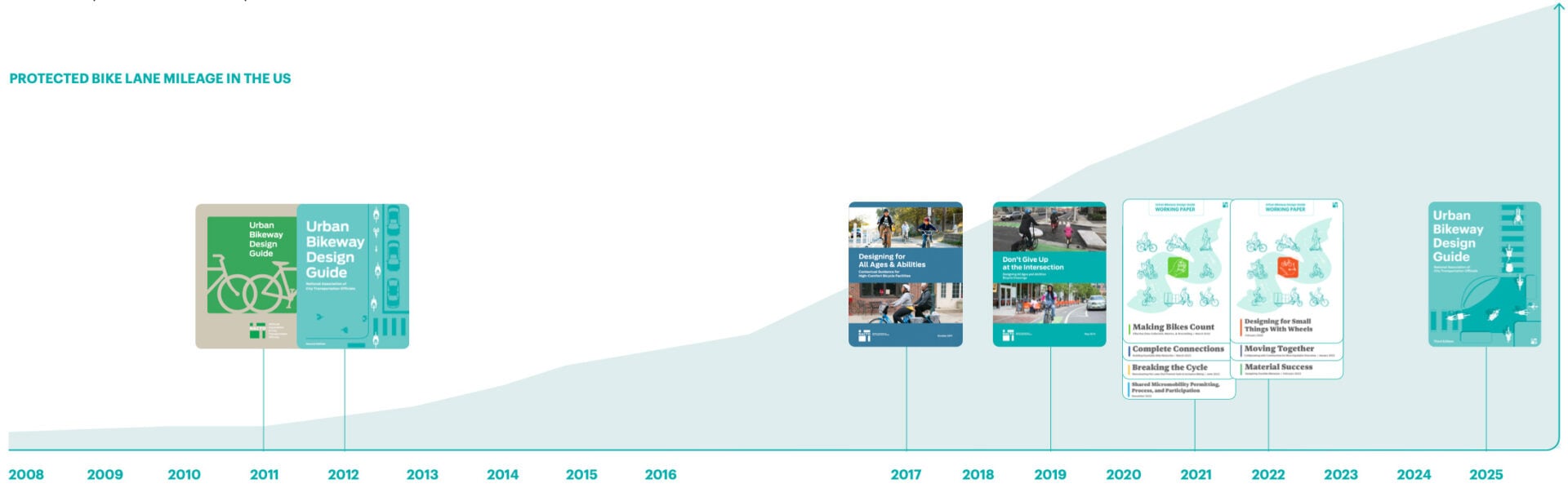
This third edition of the Urban Bikeway Design Guide moves beyond illustrating what we can do. Instead, it defines what we must do to make city streets safe, connected, accessible, and equitable.
It sets new standards for bike network planning, bikeway design, and program and project evaluation to create bikeable cities for people of all ages and abilities. It identifies new practices for integrating faster-moving vehicles, such as e-bikes and scooters, and wide vehicles, such as cargo bikes, into the design process. And it demonstrates how to center equity as the cornerstone of a safe and connected bike network.
What was once groundbreaking is now routine, with millions of people riding bikes and scooters to commute to work and school, meet friends, pick up groceries, or access healthcare. However, there is much more to be done. NACTO and our members are proud of the Urban Bikeway Design Guide’s role in transforming streets. With this new edition of the guide, we commit to raising the state of the practice again–and call for policymakers, elected officials, engineers, planners, and community members to join us by committing to help usher in a new era of sustainable, accessible transportation for all–with biking at the fore.

For much of the last century, the streets of most North American cities were designed primarily to quickly move people driving in cars, trucks, and SUVs. The human cost of this design approach has been immense. People in the U.S. are far more likely to be killed in traffic crashes than in other industrialized countries.1 The transportation sector is the largest source of greenhouse gas emissions in the U.S., and 81% of transportation emissions come from passenger cars, trucks, and SUVs.2
Importantly, these crises have not affected all communities equally. Black, Latine,3 and Indigenous pedestrians are more than twice as likely to be struck and killed by a motor vehicle4 as white pedestrians and more than four times as likely to be killed while riding a bike.5 Likewise, Black people in the U.S. are exposed to 31% more fine particulate air pollution6 as compared to white people in the U.S.
In the past two decades, a different vision for our cities has gained momentum. Innovative cities across North America are increasingly designing streets not solely as corridors that move motor vehicles but as vibrant places that safely connect communities to opportunity and to each other.
In this vision, cities have safe, sustainable, accessible, and equitable transportation systems that allow communities to access the resources they need to thrive. These are cities where children can safely travel to school or the park without fear of being hit by a speeding driver, where Black residents are not arrested for biking down the sidewalk on a busy street, or where working parents do not arrive late because of infrequent transit connections. In these cities, jobs, healthcare facilities, supermarkets, and social and cultural institutions are easily accessible without a privately owned motor vehicle. The transportation systems in these cities are multimodal, provide access to people of all ages and abilities, and serve to link neighborhoods–rather than divide them. Streets in these cities make the lives of those who use them safer, healthier, more convenient, and more joyful.
While a high-quality bike network is not the only tool necessary to bring this vision of vibrant and successful cities into reality, it is a crucial one. Streets that are thoughtfully designed to prioritize biking are safer for everyone7–not just people using bikes, but those walking, riding in motor vehicles, and using other mobility devices. Bikeable streets are also more sustainable; even a small shift in mode share from private motor vehicles to bikes and e-bikes can produce a significant drop8 in carbon emissions, and micromobility devices play a key role9 in reducing global oil consumption.
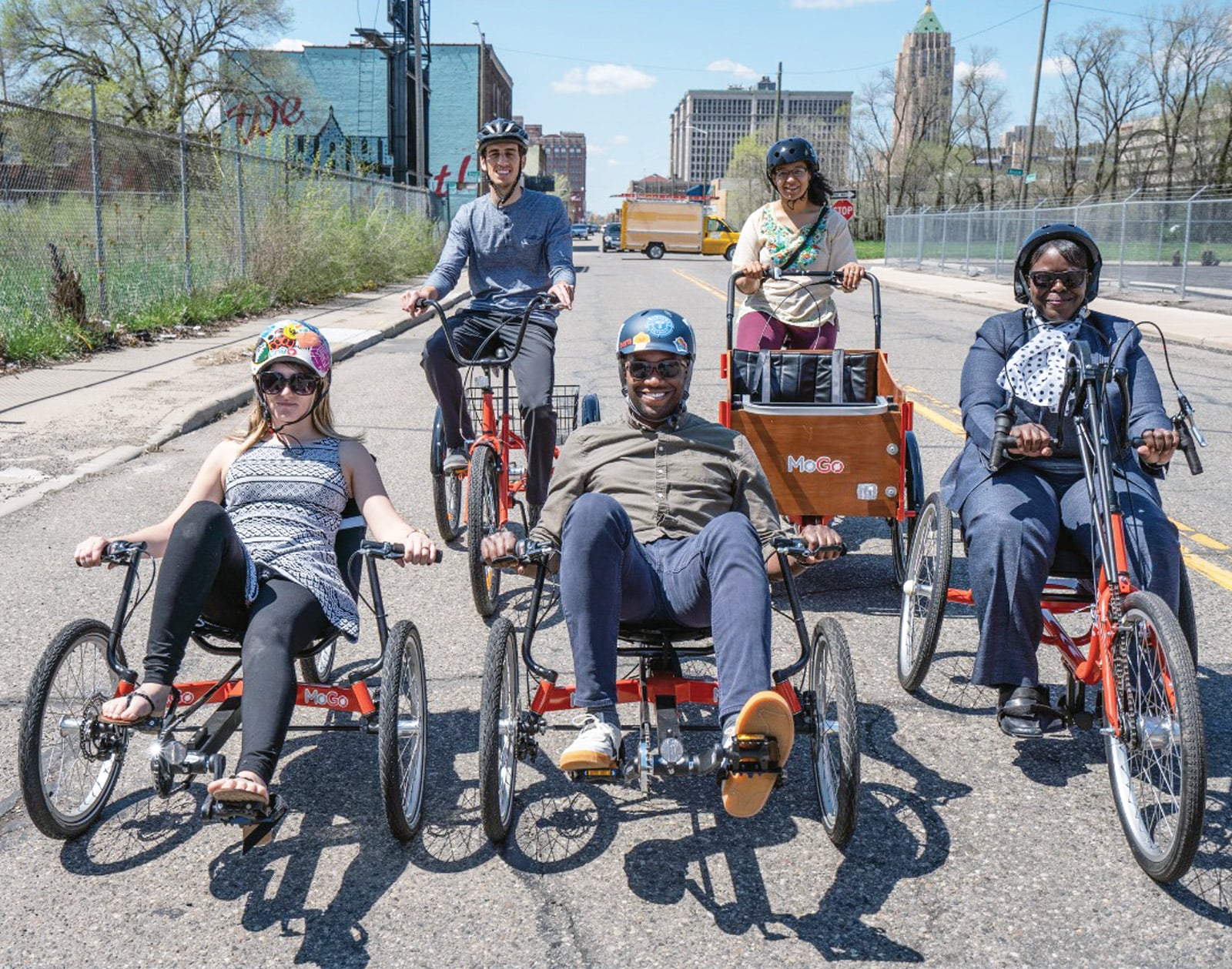
Credit: MoGo Detroit
When cities build for bikes and other micromobility devices, they build a more accessible and equitable future. Buying and maintaining a bike is significantly more affordable than owning a car, which costs an average of more than $12,000 per year,10 factoring in fuel, maintenance, insurance, and other costs. Owning a bike costs as little as $400 per year.11 Government rebates for e-bikes as well as income-eligible discounts for bike share systems have made biking even more cost-effective. Research demonstrates12 that equitable, well-connected bike networks encourage more women and people with low incomes to bike and can also reduce the alarming racial gap13 in traffic deaths and discriminatory traffic enforcement practices that disproportionately put Black, Latine, and Indigenous communities at risk.
Streets that are thoughtfully designed to prioritize biking are safer for everyone—not just people using bikes, but those walking, riding in motor vehicles, and using other mobility devices.
Investing in bike infrastructure makes smart economic sense for cities. High-quality bike infrastructure can often be built within existing infrastructure with relatively low-cost materials, and can help spur job creation14 and increased economic activity.15 It can also make our communities healthier16 and happier17, not only because of the individual benefits to health and well-being that bikes offer, but because safer streets create more opportunities for residents to connect with each other and with the anchors of their community.
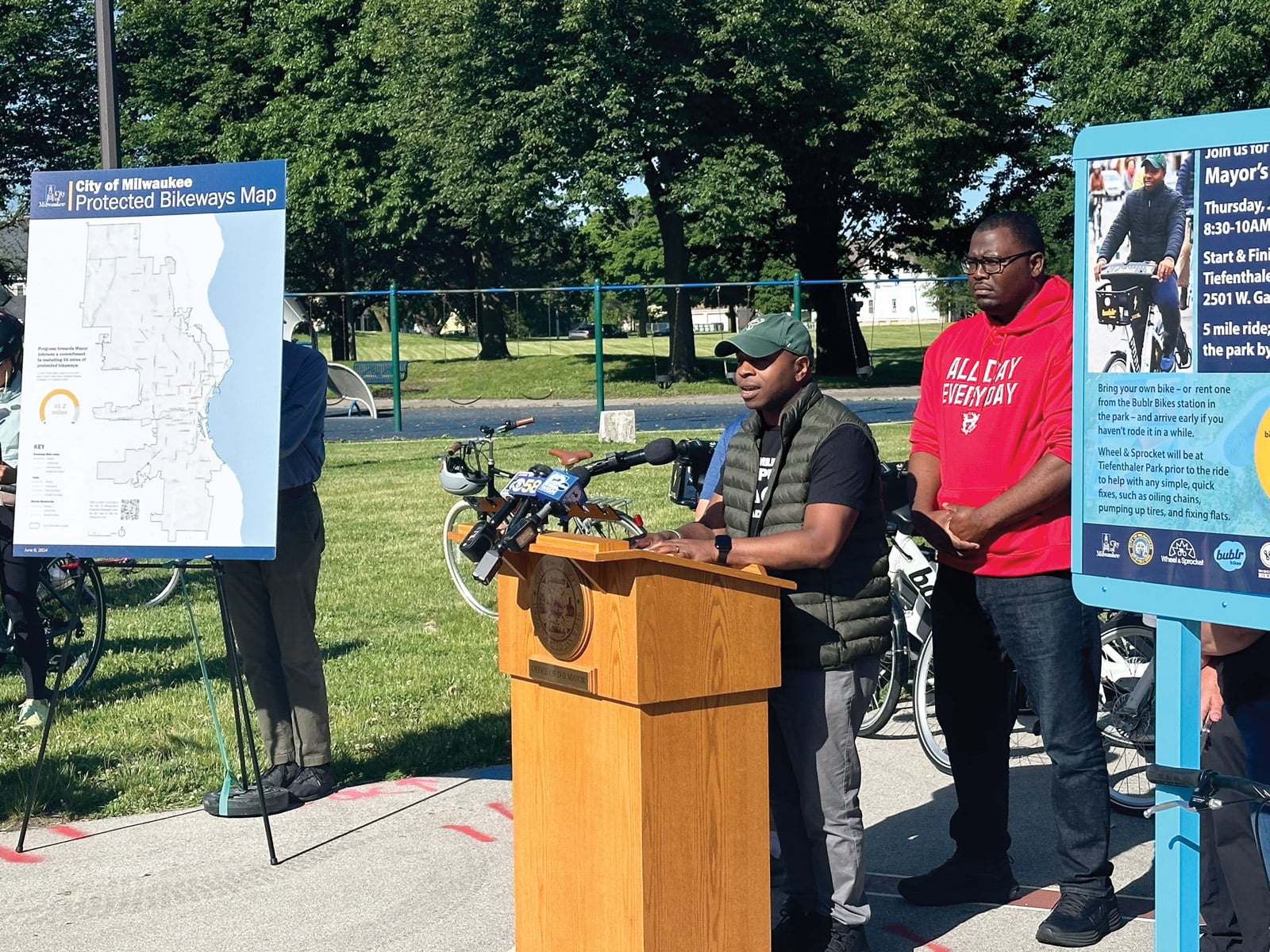
Credit: Milwaukee Mayor Cavalier Johnson
What Leadership Looks Like
Today’s top city leaders recognize the key role that transportation plays in solving current climate, economic, safety, equity, and health challenges.
But true leadership requires more than just a recognition of the importance of transportation. It requires setting a vision, dedicating resources, laying the groundwork for success, and committing political capital, so that when the work gets tough, projects still get done and a city’s transportation network reaches its full potential.
An impactful leader starts by articulating a broad vision for city transportation: where streets are safe, transit connects people to their destinations, and biking is accessible to people of all ages, abilities, and backgrounds. In this city, residents can walk out their door, hop on a bike or scooter, ride on safe, well-designed streets, connect to transit, and arrive at their appointments on time and without worry.
To be effective, this vision is codified and repeatedly underscored–in speeches, interviews, policy-setting documents, and in meetings with elected officials, with residents, and, importantly, with the staff entrusted to make their city a great place to walk and bike.
For this vision to be successful, leaders must pave the way not just with broadly stated support but with real resources, structures, and backing when progress gets tough.
For transformative change on city streets and in transportation networks, leaders must provide:
An articulation of what a transformative bike network looks like.
A transformative bike network requires high-quality bike infrastructure that is comfortable and inviting for riders of all ages and abilities, designed as part of a connected network, and built equitably so that the neighborhoods that would most benefit from safer, more inviting streets are prioritized.
An organizational structure that supports the delivery of high-quality bike projects.
When city agencies are strategcally and intentionally organized, with strong coordination and clear hand-offs, they are more likely to deliver projects on time and on budget, scale outputs to meet needs, and solve issues early and quickly.
Clearly outlined policies, priorities, and commitments to biking.
Outlining coherent goals (such as 50% of residents living within a three minute walk of a high-quality bike facility), priorities (safe travel instead of more on-street parking), and policies (e-bike purchase subsidies, reformed traffic laws) can connect an inspiring vision to tangible change on the ground. These policies and priorities also connect biking to other city goals–such as extending the reach of transit, making streets safer for everyone, increasing access to jobs, and reducing greenhouse gas emissions.
Reliable and sufficient funding to accomplish priority projects and policies.
When agency staff can count on a predictable funding stream, they can efficiently match the resources available instead of chasing one-off projects. Sufficient and reliable funding is key for staff to move from scrambling to thoughtfully engaging all units of city government, contractors, and residents in predictable, carefully planned, year-over-year improvements to city streets.
An investment in staff.
Dedicated leaders invest in their staff. They advocate for new positions to meet the city’s goals and hire using equitable practices. They support and champion their workforce, from office staff to field staff. They help managers create and use clear, transparent, and accessible processes to deliver projects and develop an inclusive, supportive working environment.
Resources for community engagement and communication.
Robust staffing and support for community engagement practices that match neighborhood needs is essential. Agency staff need resources to work alongside residents, helping them understand how they can shape their streets and how citywide priorities can be applied to transportation projects like building transformative bike networks.
Clear decision-making processes.
Clarifying and publishing decision-making processes helps agency staff and community members build alignment, trust, and a shared understanding of how to effectively collaborate and reduces the risk of individual voices canceling or diminishing safety-forward street projects.
A willingness to pivot and rapidly respond.
Pushback is part of the process of making change. Effective leaders listen with openness to community concerns, work to understand the bigger picture, and act nimbly to address concerns and show progress.
Upgrading streets that have not meaningfully changed in decades is hard and requires real leadership. Residents must be able to tangibly see the positive impacts of safer streets and inviting places to ride–and until then, leaders must commit to working through a process of communication and patience that can be difficult and complicated.
With committed leadership, the end result can be transformative. By building high-quality bike networks–and therefore safer, more equitable, and inviting streets–leaders can connect their residents to opportunity and to each other. Investing boldly, thoughtfully, and comprehensively will enable city leaders to make streets safer, unlock opportunities for their residents, and make their cities healthier and more joyful.
An Effective Bike Network Is High-Quality, Connected, and Equitable
Biking is a fundamental part of a vibrant, connected, sustainable city. Bikes increase access to cities, expanding opportunities for where people can live, work, and play. The decisions people make about how they travel are informed by the projects and programs cities design and the level of safety, reliability, and affordability those projects and programs provide. We cannot expect a growing number of people to bike unless we provide safe and connected places for them to ride.
For biking to reach its potential, cities must push beyond piecemeal development of individual bike lanes to plan for and invest in bike networks that are high-quality, connected, and equitable:

High-quality bike infrastructure, from concrete-separated bikeways to traffic-calmed boulevards, is safe and comfortable and accommodates users of all ages and abilities. High-quality infrastructure protects riders from vehicular traffic and uses durable materials that require limited maintenance, allowing cities to reconfigure more streets as safe places for everyone.
When bikeways are part of a connected system with well-designed intersections, they create a network that makes biking efficient and convenient. Networks that link neighborhoods to each other and to jobs, education, and social, cultural, and transit hubs enable longer and more diverse trips, promote multimodal transportation options, and reduce congestion.
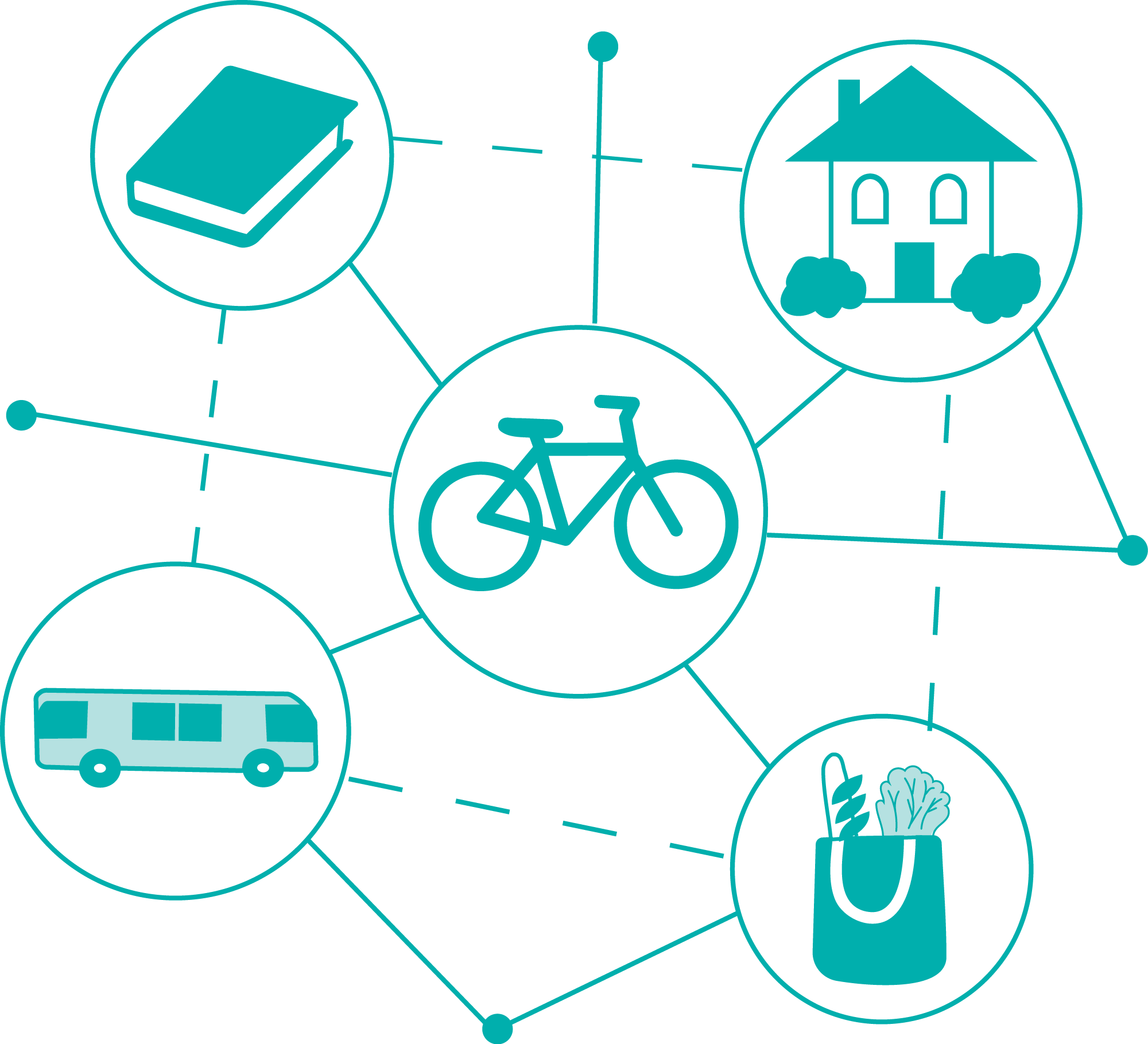

For bike networks to truly serve all communities, they need to be developed equitably, offering historically-disinvested neighborhoods access to safe and convenient places to ride that are connected to the professional, personal, and communal opportunities in cities. Doing this work means acknowledging and beginning to address the racial and economic inequities reflected in and caused by our transportation policies. These policies historically and currently marginalize low-income communities, communities of color, immigrant communities, and people with disabilities.
- National Association of City Transportation Officials. “Rethinking Safety.” In City Limits, 11-13. NACTO, 2020. https://nacto. org/publication/city-limits/the-need/rethinking-safety/. ↩︎
- US Environmental Protection Agency. “Fast Facts on Transportation Greenhouse Gas Emissions.” Last Updated on October 31, 2023. https://www.epa.gov/greenvehicles/fast-facts-transportation-greenhouse-gas-emissions. ↩︎
- While terminology varies across North America, and no term can inclusively capture the vast diversity of people encompassed by similar terms, NACTO uses ‘Latine’ to refer to Hispanic/Latino/a/e/x communities, unless individuals, organizations, or groups have another stated preference. ↩︎
- Smart Growth America and National Complete Streets Coalition. Dangerous By Design. Smart Growth America, 2022. https://smartgrowthamerica.org/dangerous-by-design/. ↩︎
- Raifman MPP, Matthew A., and Ernani F. Choma PhD. “Disparities in Activity and Traffic Fatalities by Race/Ethnicity.” American Journal of Preventive Medicine 63, no. 2 (June 2022): 160-167. https://www.ajpmonline.org/article/S0749-3797(22)00155-6/fulltext. ↩︎
- Tessum, Christopher W., David A. Paolella, Sarah E. Chambliss, Joshua S. Apte, Jason D. Hill, and Julian D. Marshall. “PM2.5 polluters disproportionately and systemically affect people of color in the United States.” Science Advances 7, no. 18 (April 2021). https://doi.org/10.1126/sciadv.abf4491. ↩︎
- Marshall, Wesley E., and Nicholas N. Ferenchak. “Why cities with high bicycling rates are safer for all road users.” Journal of Transport & Health 13 (June 2019). https://doi.org/10.1016/j.jth.2019.03.004. ↩︎
- McQueen, Michael, John MacArthur, and Christopher Cherry. “The E-Bike Potential: Estimating regional e-bike impacts on greenhouse gas emissions.” Transportation Research Part D: Transport and Environment 87 (October 2020). https://doi. org/10.1016/j.trd.2020.102482. ↩︎
- Bullard, Nathaniel. “Not All Electric Vehicles Are Cars, You Know.” Bloomberg, May 21, 2020. https://www.bloomberg.com/news/articles/2020-05-21/not-all-electric-vehicles-are-cars-you-know. ↩︎
- Moye, Brittany. “Annual New Car Ownership Costs Boil Over $12K.” American Automobile Association Newsroom, August 30, 2023. https://newsroom.aaa.com/2023/08/annual-new-car-ownership-costs-boil-over-12k/. ↩︎
- Blue, Elly. “How Much Do You Spend on Cycling Gear Every Year?” Bicycling Magazine, February 21, 2017. https://www. bicycling.com/rides/a20024531/how-much-do-you-spend-on-cycling-gear-every-year/. ↩︎
- Shi, Wei. “The Impacts of the Bicycle Network on Bicycling Activity: a Longitudinal Multi-City Approach.” PhD diss., Portland State University Nohad A. Toulan School of Urban Studies and Planning, March 2020. https://www.doi.org/10.15760/etd.7319. ↩︎
- Smart Growth America and National Complete Streets Coalition. Dangerous By Design. Smart Growth America, 2022. https://smartgrowthamerica.org/dangerous-by-design/ ↩︎
- Institute for Transportation and Development Policy. “How Cycling Powers People and Economies.” ITDP, 2022. https://www.itdp.org/2022/06/14/how-cycling-powers-people-and-economies/. ↩︎
- Institute for Transportation and Development Policy. Making the Economic Case for Cycling. ITDP, 2022. https://www.itdp. org/publication/economics-of-cycling/. ↩︎
- Atre, Uma. “Better Bike Infrastructure Improves Environmental and Human Health.” Environmental and Energy Study Institute, March 25, 2020. https://www.eesi.org/articles/view/better-bike-infrastructure-improves-environmental-and-human-health. ↩︎
- World Health Organization. Walking and cycling: latest evidence to support policy-making and practice. WHO, 2022. https://www.who.int/europe/publications/i/item/9789289057882. ↩︎