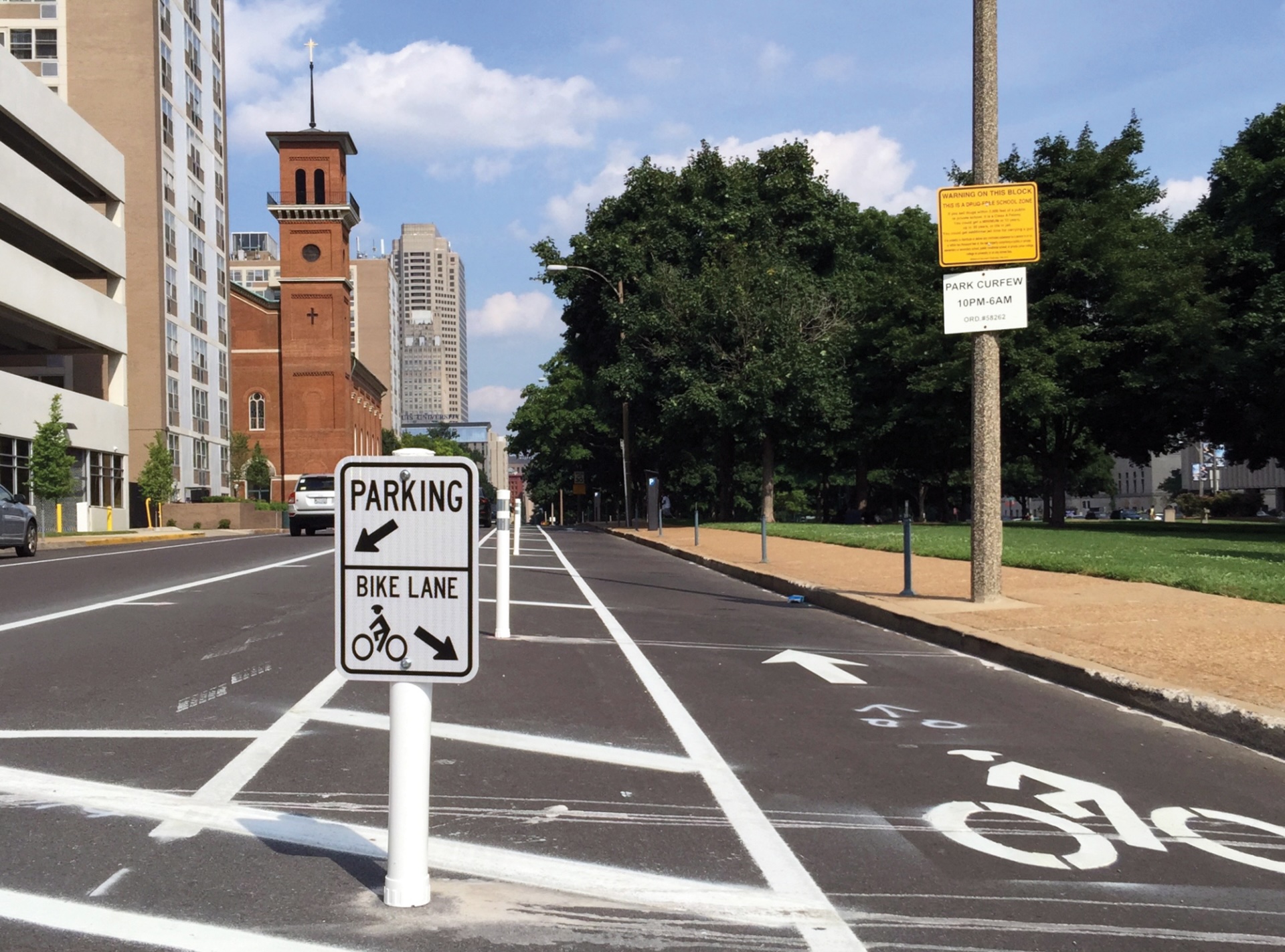
Credit: Alex Ihnen, nextSTL.com
One-Way Protected Bike Lanes Design Guidance


Dimensions
Protected bike lanes always include both a bike lane and a buffer to the street. Protected bike lanes should accommodate comfortable side-by-side bike riding, platooning, or passing using the bike lane and a portion of the buffer.
Protected bike lanes will attract more users because of their high comfort level. On streets without protected bike lanes, the existing bike volumes do not reflect potential demand. Design for the future, considering the existing and potential land use and transportation needs along the bikeway. Protected bike lanes designed to current volumes will likely reach capacity in the near future.
Design protected bike lanes with enough rideable width for all expected users to operate comfortably, ride side-by-side, or pass one another. Rideable width is the usable width of a bikeway for riding, excluding any shy distance, gutter pans, or other unrideable areas. Rideable width can extend beyond the marked bikeway to include parts of the buffer at the same level as the bikeway.
The minimum rideable width for one-way protected bike lanes is 6.5-7 ft (2-2.1 m) and the preferred width for one-way protected bike lanes is 8-12.5 ft (2.5-3.8).
Appropriate buffer widths vary widely, depending on the means of vertical separation, adjacent travel lane speeds, and right-of-way widths. Ensure proper shy distance is provided from all types of vertical separation within the buffer area. Shy distance should not extend into the bike lane. (See Design Controls – Rideable Width.)
Parking-protected bike lanes must have a 3 ft (0.9 m) buffer to accommodate the full swing of a car door and mitigate the potential for injurious crashes, commonly known as “doorings.” (See Separating Protected Bike Lanes.)
Unidirectional Protected Bike Lane Widths
|
Minimum Width: One-Way Protected Bike Lanes |
Preferred Width:
One-Way Protected Bike Lanes |
|||
| Rideable Width | 6.5-7 ft | 2-2.1 m | 8-12.5 ft | 2.5-3.8 m |
| Bike Lane | 5 ft | 1.5 m | 6-9 ft | 1.8-2.8 m |
| Buffer | 2 ft | 0.6 m | 2-5+ ft | 0.6-1.5+ m |
|
Buffer adjacent to parking |
3 ft | 0.9 m | 3-5 ft | 0.9-1.5 m |

In many cities, the rideable width also accommodates maintenance vehicles necessary for sweeping, snow plowing, and snow removal. Maintenance vehicles designed to sweep or clear snow range in widths from 4 ft (1.2m) to over 8 ft (2.4 m). Cities relying on these vehicles for maintenance needs typically have a minimum clear distance of 7-8ft (2.1-2.4 m) on protected bike lanes.
Motor vehicle lanes should be narrowed1 to support the widest feasible bike lanes. At posted speeds of 35 mph (60 km/h) or less, general-purpose travel lanes can be 10 ft (3 m) wide and still support transit and truck uses. Where transit or heavy trucks are rare, a travel lane of 9 ft (2.7 m) is an acceptable width for general-purpose travel lanes.
Consider allowing emergency vehicles, such as ambulances, to drive in wide protected bike lanes rather than maintaining wide vehicular travel lanes. Design the vertical means of separation to dissuade most drivers while still being semi-permeable to emergency vehicles.
Parking lane widths should be minimized, typically to 7 ft (2.1m), in favor of increased rideable width.

Markings
Bike lane symbols or BIKE LANE word markings (MUTCD Figure 9E-1) should be applied at the beginning of a bike lane.2
Bike lane markings should be applied after major driveways, intersections, and at least every 500 ft (150 m) along the bike lane.
Wide protected bike lanes can be marked in a number of ways. Two side-by-side lanes of at least 4 ft (1.2 m) each may be marked with a dotted white lane, though this may unnecessarily restrict side-by-side riding or natural platooning patterns. Alternatively, install bike lane markings approximately 2.5 ft (0.8 m) from the curb to encourage bikeway users to leave space for others to ride or roll closer to the buffer. The buffer area may be widened into the bikeway to provide the illusion of a narrower lane while still maintaining the full rideable width of the bike lane; this may help deter confused drivers. Only where necessary, install a single white flexible delineator in the middle of a wide protected bike lane to deter drivers; this post could cause discomfort for people on wider bikes or those riding alongside children.
Green surface treatments may be added to protected bike lanes to improve conspicuity.3 Use of a consistent green color within a city or region helps reinforce the expectation that people will be riding bikes in these spaces. Municipalities should adopt practices that ensure consistent use of green surfacing across all projects.
Green surface treatments should be high-friction to reduce loss of traction. Retroreflectivity is not required nor recommended. In the United States, use the chromaticity coordinates for green pavement color as established by the Federal Highway Administration.4
Green surfacing may be used along the full length of a bike lane.
Green surfacing may also be used to increase the conspicuity of the bike lane approaching or departing intersections and driveways. In these locations, apply green surfacing for 20-50 ft (6-15 m).
Street-level protected bike lanes must use buffers with a solid white line along both edges.5 Diagonal markings or chevrons should be used if the buffer is 2 ft (0.6 m) wide or wider and are required for buffers of 3 ft (0.9 m) or wider. Where used, the spacing of chevrons or diagonal markings should be 10 ft (2 m) or greater. Diagonal markings slant away from the direction of travel in the adjacent motor vehicle travel lane. Chevron markings point toward approaching traffic in the adjacent motor vehicle lane.6
Buffer markings are typically impractical along buffers narrower than 2 ft (0.6 m). Instead, use two parallel 4-6 in (100-150 mm) white lane lines.
Chromaticity Coordinates for Non-Reflective Green Colored Pavements
| 1 | 2 | 3 | 4 | ||||
| X | Y | X | Y | X | Y | X | Y |
| 0.23 | 0.714 | 0.266 | 0.460 | 0.367 | 0.480 | 0.367 | 0.584 |

Signs
Place signs along the sidewalk curb in most cases. Signs may be placed in raised median or curb buffer areas that are at least 3 ft (0.9 m) wide. Signs should not overhang the rideable area of the bike lane. If they must, ensure the bottom of the sign is at least 8 ft (2.4 m), preferably 10 ft (3 m) above the bike lane surface.
BIKE LANE (MUTCD R3-17) signs may be posted at the beginning of the bike lane and may be used periodically along the bike lane to supplement pavement markings.
Custom or standard no parking signage (e.g., NO PARKING BIKE LANE (MUTCD R7-9 or R7-9a), NO STOPPING ANYTIME (MUTCD R7-4a), or similar signs) should be posted along blocks where on-street parking is prohibited. This may be the entire length of a block or may be limited to visibility zones at intersections and driveways or around midblock fire hydrants or utilities that require all-day access.
Wayfinding signs used along a constrained bike lane should be integrated into a citywide concept for wayfinding throughout the bike network. (See Bike Route Wayfinding.)
When protected bike lanes are first installed, temporary informational signs may be posted to help all street users understand how the design operates. Where parking is provided alongside protected bike lanes, informational signs at the curb or within the buffer can show riders and drivers how the street is used.

Curbside Uses
Accessible parking spaces should be planned alongside any protected bike lane project. This may require reducing the bike lane to 4 ft (1.2 m) in order to provide the 13 ft (3.9 m) of width required for accessible parking spaces. Widen the bike lane to standard width immediately after the accessible parking space. (See Curbside Activity – Accessible Parking.)
To maintain separation between transit operations and bikeway operations along high- or medium-frequency bus routes, create in-lane bus stops by implementing transit boarding islands or shared boarding areas. Where space or project scope does not allow these uses, use constrained bus stop designs to ensure the legibility of the bike lane. (See Transit Stops.)
Curbside loading is compatible with protected bike lanes. Where possible, locate loading zones at the start or end of blocks. These spaces are easier to maneuver into and out of and are better suited to high-turnover uses, such as loading or deliveries, than midblock spaces. Where parking is not present adjacent to a protected bike lane, consider loading zones on the opposite curb or on cross-street approaches to the bikeway. (See Curbside Activity – Passenger and Commercial Loading Zones.) It is not inherently more dangerous for delivery people nor passengers to cross a street or walk further to their final destination.
Consider complementary curbside uses, such as bike parking and shared micromobility stations or corrals.
Where possible within the right-of-way, bend the protected bike lane around streeteries and parklets. Doing so reduces the potential for conflict between bikeway users and people crossing the bikeway to access these uses. It also improves accessibility by allowing direct access from the sidewalk. Taper the bikeway using a 3:1 ratio. Use durable materials along the bikeway, such as mid-height barriers or water-filled barriers, to prevent drivers from entering the bikeway.

Intersections
Protected bike lanes should continue through intersections and driveways. Avoid situations that mix or merge bicycle and motor vehicle traffic into the same lane, such as designs that drop the bike lane buffer or allow turning cars and trucks into the bike lane on the intersection approach. (See Don’t Give Up at the Intersection.)
Use crossbikes through all intersections, including driveways, alleys, minor cross-streets, and major cross-streets.
Consider geometric changes, including corner islands, turn wedges, or medians to slow vehicular turns across protected bike lanes. (See Slow Turns are Safe Turns.)
Improve intersection visibility alongside parking-protected bike lanes at intersections by implementing appropriate visibility zones. (See Improve Visibility at Turn Conflicts.)

Credit: New York City Department of Transportation
Contraflow and Two-Way Protected Bike Lanes
Accommodating two-way biking on a street that was previously used for one-way operations can greatly expand the reach of the bike network. Contraflow and bidirectional protected bike lanes are commonly used and effective across North America.
Designing Contraflow and Two-Way Protected Bike Lanes for All Ages & Abilities
When well-designed and maintained, contraflow and two-way protected bike lanes can provide AA&A comfort regardless of vehicular traffic and speeds. In particular, intersection design requires specific attention, as other street users are unlikely to expect contraflow or bidirectional bike traffic.
Contraflow and Two-Way Protected Bike Lanes Design Guidance

Dimensions
Two-way bike lanes should be at least 13 ft (3.9m) wide to accommodate all types of bicycles, side-by-side riding, platooning, and passing. The absolute minimum width is 8 ft (2.4 m) and should be avoided except on short street segments.
Motor vehicle lanes should be narrowed7 to support the widest feasible bike lanes. At posted speeds of 35 mph (60 km/h) or less, general-purpose travel lanes can be 10 ft (3 m) wide and still support transit and truck uses. Where transit or heavy trucks are rare, a travel lane of 9 ft (2.7 m) is an acceptable width for general-purpose travel lanes.
Consider allowing emergency vehicles, such as ambulances, to drive in bidirectional protected bike lanes rather than maintaining wide vehicular travel lanes. Design the vertical means of separation to dissuade most drivers while still being semi-permeable to emergency vehicles.
Parking lane widths should be minimized, typically to 7 ft (2.1m), in favor of increased rideable width.
Markings
In contraflow and bidirectional protected bike lanes, install BIKE LANE symbols or “BIKE LANE” markings (MUTCD Figure 9E-1) after driveways, intersections, and at least every 500 ft (150 m) along the bike lane.
Use dotted yellow centerlines along bidirectional bike lanes and in the associated crossbikes.
Green surfacing may be used in contraflow and bidirectional bike lanes in a similar manner to unidirectional protected bike lanes.
Signs
In addition to the signs required along directional constrained bike lanes, contraflow and two-way bikeways require additional regulatory and warning signage.
Along streets with one-way motor vehicle traffic and two-way biking, install EXCEPT BIKES (R3-7bP) plaques under DO NOT ENTER (R5-1) signs.
In the U.S., ONE-WAY (R6-1 or R6-2) signs are prohibited along streets with two-way biking. To emphasize that the street has two-way bike traffic, warning signage should be used at any T intersection or major driveway and may be used periodically along the route. Consider a modified TWO-WAY sign (modified MUTCD W6-3) or custom sign to clarify operations.
Intersections
Bidirectional protected bike lanes introduce additional conflict points at intersections and driveways. Additional measures to separate vehicular turns from the bikeway movement are often necessary. (See Signal Phasing and Timing Strategies – Contextual Guidance for Phase Separation.)
Contraflow and bidirectional protected bike lanes must continue through intersections and driveways. They cannot be merged into general traffic, as this would require people riding bikes to travel in the direction opposite of regular traffic.
Use crossbikes through all intersections, including driveways, alleys, minor cross-streets, and major cross-streets.
Consider geometric changes, including corner islands, turn wedges, or medians to slow vehicular turns across protected bike lanes. (See Designing Safe Intersections.)
Improve intersection visibility alongside parking-protected bike lanes at intersections by implementing appropriate visibility zones. (See Improve Visibility at Turn Conflicts.)

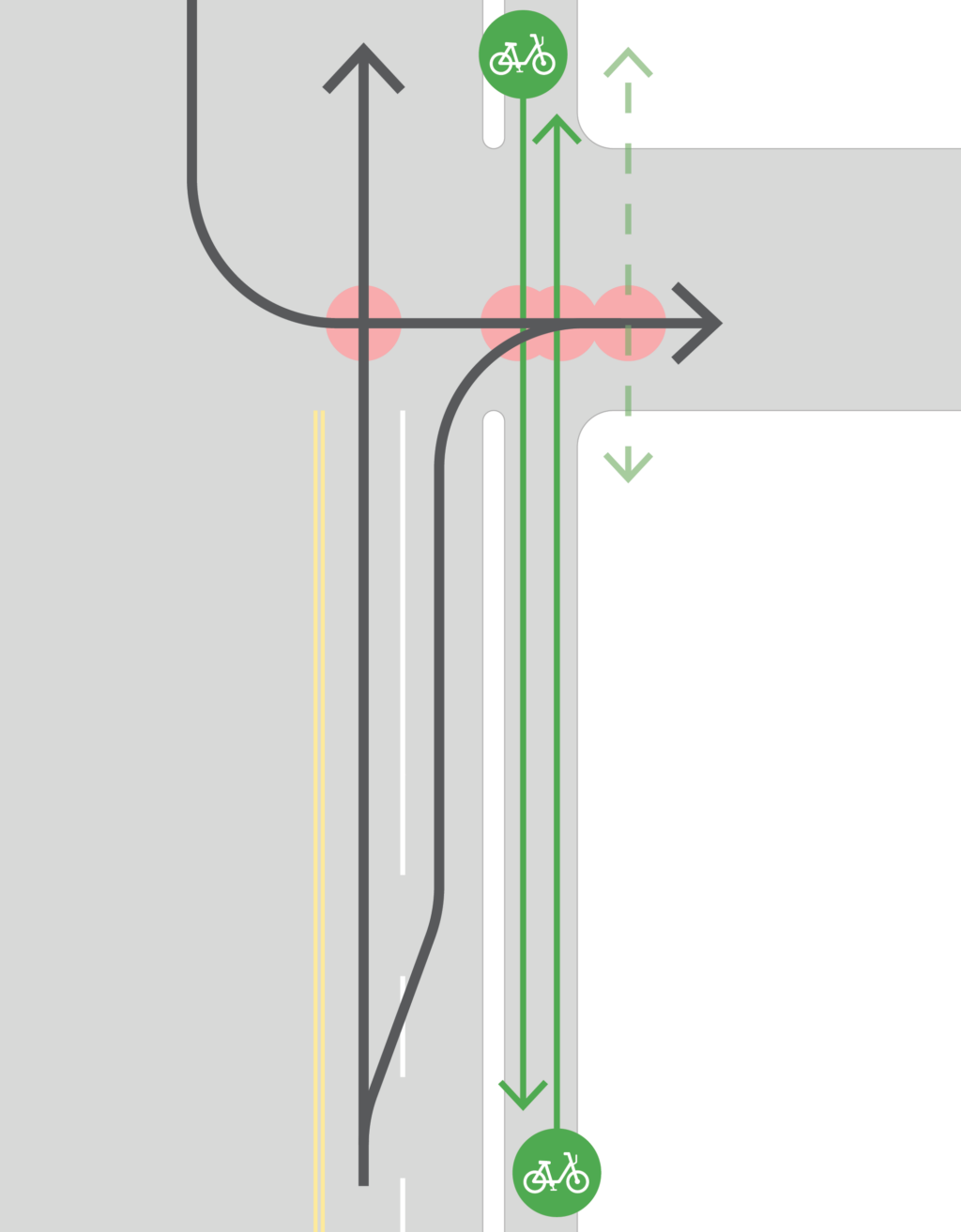
Turning drivers must observe and navigate multiple conflict points, marked with red circles.
Protected Bike Lanes and Transit Lanes

Street design solutions that incorporate both bus and bike infrastructure are one of the highest-capacity uses for an urban right-of-way.
Transit lanes support reliable and robust transit service by accommodating high volumes of transit vehicles separately from motor vehicle traffic. Transit lanes are an especially important tool for high-frequency routes where transit headways are 4 minutes or less.
Where transit service is provided by trolleys, light rail, or other vehicles using tracks, people on bikes cannot share the same space as the transit vehicles. Tracks pose a real safety hazard for bicycling.
Consider center-running transit lanes on streets that will also have protected bike lanes to improve transit operations and reduce the likelihood of conflict between transit vehicles and people riding bikes and other micromobility devices.
Where on-street light rail is present, consider placing buses in the same lane as light rail to maximize existing station infrastructure and provide more space for the bike lanes.
To accommodate bikes alongside a transit lane, implement a protected bike lane to the right of a transit lane. The vertical means of separation used along the protected bike lane should permit people on bikes to move into and out of the bus lane to avoid blockages or debris.
Where protected bike lanes are provided adjacent to transit lanes, install boarding islands or shared boarding areas. (See Transit Stops.) On one-way streets, protected bike lanes may be placed on the left side to minimize the need to separate transit vehicles, transit users, and people riding bikes.
In constrained rights-of-way, reduce the width of transit lanes adjacent to protected bike lanes to 10 ft (3 m). The safety benefits of protected bike lanes, which are experienced by all street users,8 outweigh the slight risk of a clipped bus mirror.
- “Overall, this study found no evidence that narrower lanes are associated with the higher number of crashes and that narrow lanes (9-foot and 10-foot) increase the risk of vehicle accidents, after controlling for cross-sectional street design characteristics and other confounding variables.”
Hamidi, S, and R. Ewing. A National Investigation on the Impacts of Lane Width on Traffic Safety. Johns Hopkins Bloomberg School of Public Health, November 2023: 3. https://narrowlanes.americanhealth.jhu.edu/report/JHU-2023-Narrowing-Travel-Lanes-Report.pdf. ↩︎ - “The first symbol or word marking in a bicycle lane should be placed at the beginning of the bicycle lane and downstream symbol or word markings should be placed after major intersections. Additional symbol or word markings should be placed at periodic intervals along the bicycle lane based on engineering judgment.”
Federal Highway Administration. Manual on Uniform Traffic Control Devices, 11th Edition. USDOT, 2023: 9E.01, paragraph 3. https://mutcd.fhwa.dot.gov/pdfs/11th_Edition/part9.pdf. ↩︎ - “Green-colored pavement is used to enhance the conspicuity of locations where bicyclists are expected to operate, and areas where bicyclists and other traffic might have potentially conflicting, weaving, or crossing movements. Green-colored pavement is also used to enhance the conspicuity of word, symbol, and/or arrow pavement markings when these markings are used in certain bicycle facilities.”
Federal Highway Administration. Manual on Uniform Traffic Control Devices, 11th Edition. USDOT, 2023: Section 3H.05, paragraph 1. https://mutcd.fhwa.dot.gov/pdfs/11th_Edition/part3.pdf. ↩︎ - 23 CFR Chapter 1 Subchapter G Part 655 Subpart F. https://www.ecfr.gov/current/title-23/chapter-I/subchapter-G/part-655/subpart-F. ↩︎
- Federal Highway Administration. Manual on Uniform Traffic Control Devices, 11th Edition. USDOT, 2023: 9E.06. https://mutcd.fhwa.dot.gov/pdfs/11th_Edition/part9.pdf. ↩︎
- Federal Highway Administration. Manual on Uniform Traffic Control Devices, 11th Edition. USDOT, 2023: Section 3B.25. https://mutcd.fhwa.dot.gov/pdfs/11th_Edition/part3.pdf. ↩︎
- “Overall, this study found no evidence that narrower lanes are associated with the higher number of crashes and that narrow lanes (9-foot and 10-foot) increase the risk of vehicle accidents, after controlling for cross-sectional street design characteristics and other confounding variables.”
Hamidi, S, and R. Ewing. A National Investigation on the Impacts of Lane Width on Traffic Safety. Johns Hopkins Bloomberg School of Public Health, November 2023: 3. https://narrowlanes.americanhealth.jhu.edu/report/JHU-2023-Narrowing-Travel-Lanes-Report.pdf. ↩︎ - Marshall, Wesley E., and Nicholas N. Ferenchak. “Why cities with high bicycling rates are safer for all road users.” Journal of Transport & Health 13 (June 2019). https://doi.org/10.1016/j.jth.2019.03.004. ↩︎