Coordinating the use of the sidewalk curb is a required aspect of any street project. Effectively managing this activity is critical to the success of bikeways. Anticipate and mitigate the need for curbside access with clear policy direction and appropriate design.
Accessible Parking

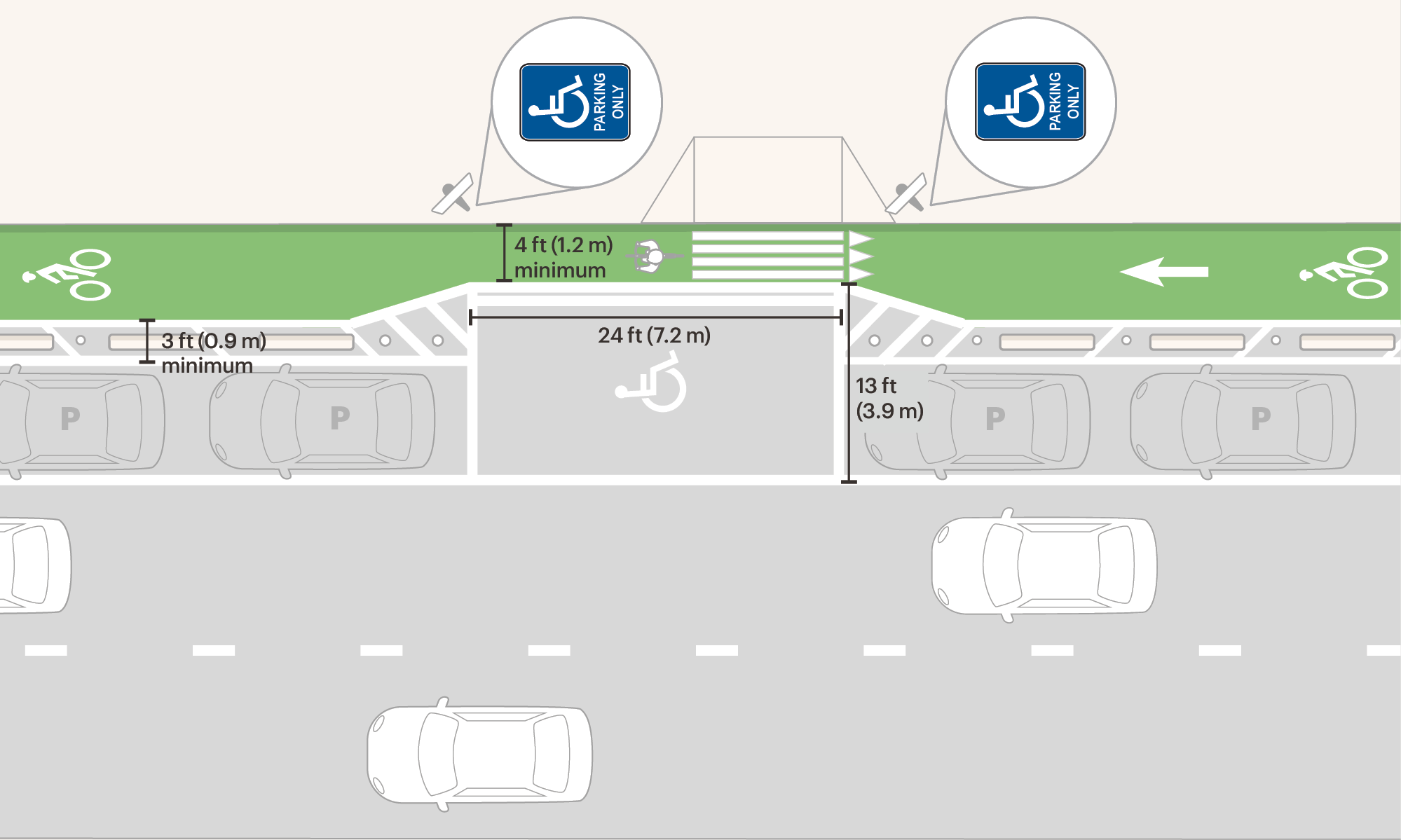
Accessible parking spaces should be planned alongside any bike facility project. Accessible parking spaces can be accommodated along all types of bikeways, including protected bikeways.
The Public Right-of-Way Accessibility Guidelines clarify where accessible parking is required.1 If designated exclusively for residential, commercial, or law enforcement use, there are no requirements for accessible parking.2 On-street parking spaces that are metered or otherwise designated for public use must include a minimum number of spaces.
Locate accessible parking spaces near a crosswalk at an intersection or adjacent to a midblock crosswalk wherever possible. Provide a curb ramp or blended transition to enable access to the crosswalk. Detectable warning surfaces are not required for curb ramps that serve only accessible parking spaces.3
If accessible parking spaces are not provided near an existing crosswalk, a new ramp or blended transition is required for access to the sidewalk. Do not expect pedestrians with disabilities to use the bikeway to travel the length of the block.
Accessible parking spaces must be 13 ft (3.9 m) wide and 24 ft (7.2 m) long.4 Channelize the bike lane at the approach to an accessible parking space to a minimum of 4 ft (1.2 m) wide.
Where accessible parking cannot be placed alongside the bikeway, provide such parking elsewhere on the blockface, including on side streets close to the intersection.
| Total number of metered or designated parking spaces | Minimum required number of accessible parking spaces |
| 1 - 25 | 1 |
| 26 - 50 | 2 |
| 51 - 75 | 3 |
| 76 - 100 | 4 |
| 101 - 150 | 5 |
| 151 - 200 | 6 |
| 201 and over | 4% of total |
Passenger and Commercial Loading Zones

Designated areas for passenger and commercial loading help to mitigate conflicting needs where the bikeway is between the sidewalk and a parking or general-purpose lane.
Bikeways can be narrowed to a minimum of 4 ft (1.2 m) per direction of bike travel, so long as a buffer of at least 5 ft (1.5 m) is provided and there are no vertical obstructions next to the bikeway. This buffer zone should be used to temporarily place packages or for deliveries to be rolled down. Such minimum dimensions should be used only at high-need locations along the bikeway. Continuous facilities of this width do not accommodate wider bikes comfortably and do not allow for growth in bike use.
Where possible, locate loading zones at the start or end of blocks. These spaces are easier to maneuver into and out of and are better suited to high-turnover uses, such as loading or deliveries, than midblock spaces.
For passenger loading from one vehicle, provide at least 20 ft (6 m) for a far-side space, 40 ft (12 m) for a near-side space, and 60 ft (18 m) for a midblock space. Midblock passenger loading areas need to be longer to accommodate entering, exiting, and standing space. Do not expect drivers to parallel park. Add an additional 20 ft (6 m) for each additional vehicle anticipated in the passenger loading area.
For commercial loading from vehicles such as vans and box trucks, provide up to 50 ft (15 m) to accommodate entering, exiting, and standing space.
Consider using small islands to accommodate locations with higher volumes of pedestrian traffic, such as outside hotels and large residential buildings.
Additional Curbside Uses
Everyday activities such as mail delivery and waste management are compatible with all types of bikeways. Protected bike lanes, which separate the curb from the road, may require new practices and understanding. This will take time to get right but is not a reason to stop a bikeway project or to diminish an All Ages & Abilities design.
Regular collaboration during design, coupled with a willingness to change some operational practices, will result in workable conditions for everyone. Every answer won’t be available at the design stage or even after implementation.
Waste Collection
Conversations with waste collection teams can reveal the right local strategies.
When waste collection is provided at the curb, the preferred solution may be a concrete median wide enough for waste bins. Typical residential bins can be accommodated on a curb width of 3 ft ( 0.9 m). Smaller bins may be part of the solution.
A bike lane buffer may be wide enough to accommodate bins where constructed medians are not feasible. If bins or bags are placed on the sidewalk, provide regular gaps between bike lane barriers to allow access to the curb. Continuous narrow curbs or barriers may prevent waste collection teams from moving waste to the truck.
Consolidating collection points to locations that are wider may also be a solution. Some cities require trash bins and bags to be placed in a designated area within the parking lane or in areas adjacent to intersections where parking is not permitted. Doing so means more space is available for bins and bags and reduces the number of stops for collection teams.
Cities can require new building developments to provide space for trash collection on-site, rather than in the street.
Mail Delivery
As with waste collection, conversations with the local post office can reveal the best way to accommodate mail delivery. In some cases, the route could be converted to a walking route.
Where driving routes must stop at multiple mailboxes, consider moving the mailboxes to a constructed median along the bikeway. Additional parking restrictions may be necessary to ensure access for the mail vehicle.
For package deliveries arriving by van or small truck, provide designated areas for short-term parking on each block. Up to 50 ft (15 m) may be necessary to accommodate entering, exiting, and standing space.
- US Access Board. Public Right-of-Way Accessibility Guidelines. US Access Board, 2023: Section R211 On-Street Parking Spaces. https://www.access-board.gov/prowag/scoping.html#r211-on-street-parking-spaces. ↩︎
- US Access Board. Public Right-of-Way Accessibility Guidelines. US Access Board, 2023: Section R211.1 General. https://www.access-board.gov/prowag/scoping.html#r2111-general. ↩︎
- US Access Board. Public Right-of-Way Accessibility Guidelines. US Access Board, 2023: Section R310.2.2. Pedestrian Access Route Connection. https://www.access-board.gov/prowag/technical.html#r31022-pedestrian-access-route-connection ↩︎
- US Access Board. Public Right-of-Way Accessibility Guidelines. US Access Board, 2023: Section R310.2.1 Dimensions. https://www.access-board.gov/prowag/technical.html#r31021-dimensions ↩︎