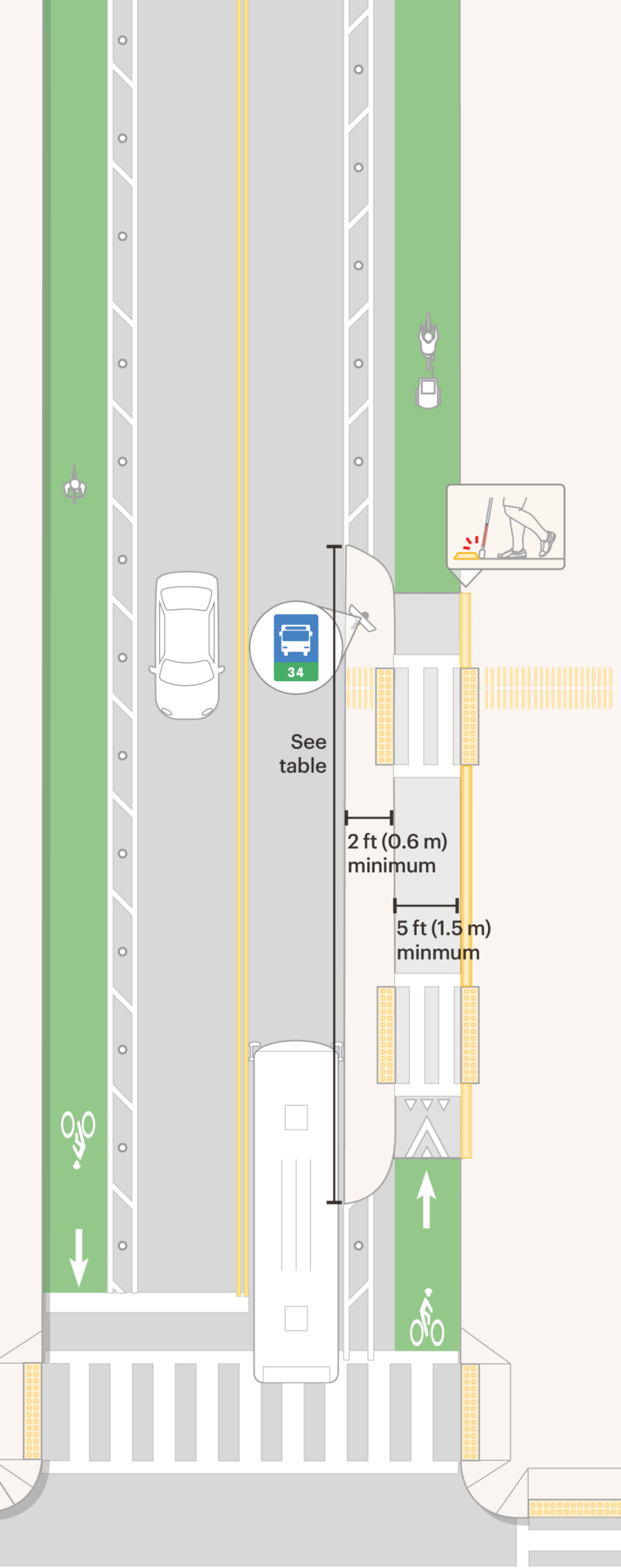
At shared boarding areas, the bike lane runs at sidewalk level through the boarding area. People can bike through the boarding area when no transit vehicles are present but must yield to boarding and alighting passengers. Transit passengers wait on the sidewalk and only cross the platform when the transit vehicle arrives. This pattern of operation is similar to marked crosswalks and is similarly designed to ensure yielding behavior.
Benefits:

Where the available right-of-way precludes the construction of boarding islands, shared boarding areas are a retrofit option that provides many benefits to transit operations, transit passengers, and people on bikes.
Boarding islands allow for in-lane transit stops that improve overall service for transit users, reduce transit delays caused by pulling out and re-entering traffic, and ensure that transit vehicles can reach the curb so transit riders can board and alight from an accessible area.
Shared boarding areas allow for continuously separated bike facilities at all times and prevent motor vehicle drivers from blocking transit stops.
Considerations
Boarding and alighting passengers share the same space as people riding bikes through the transit stop. Because of the potential for conflict between these users, shared boarding islands are most appropriate for one-way bike facilities along transit stops with low to moderate numbers of boardings and alightings.
People on bikes must not pass stopped transit vehicles to avoid conflict with transit riders. People on bikes may not see alighting passengers and are at risk of crashing into those riders. In addition, if a ramp has been deployed for passengers with mobility issues, the bikeway will be blocked; people on bikes may not see that ramp if they continue riding past stopped transit vehicles.
Shared boarding areas may not be appropriate where the bikeway is downhill. People biking may be traveling too fast to comfortably stop for passengers boarding or alighting the transit vehicle. At grades over 5%, consider the overall frequency of transit service and the number of people using the specific stop before implementing a shared boarding area. High-frequency service and/or high boarding and alighting volumes may be incompatible with a downhill shared boarding area.
Shared boarding islands are constructed features, making them a more expensive item. Drainage must be carefully considered to prevent ponding on the boarding area as well as the bike ramps before and after it. Cities may use less expensive modular options; regrading parts of the sidewalk or roadbed may be necessary to achieve accessible cross-slopes.
Education and outreach programming should accompany any new shared boarding areas as this is a newer type of design in North America. The local disability community should be primary in those discussions. Additional outreach is necessary to help people on bikes understand the need to stop when transit vehicles have stopped.

Credit: Ana Bercovich
Design Guidance

Bikeway Width
Bikeways should be reduced to 5-6 ft (1.5-1.8 m) at shared boarding islands to accommodate only single-file riding.
The bike lane alignment may shift laterally when approaching and departing the boarding area. Use a taper width of 3:1. Avoid tapering the bikeway at the same time as any grade transitions.
Boarding Area Dimensions
Shared boarding areas are at least the width of the bikeway, often a minimum of 5-6 ft (1.5-1.8m).
Any available additional width, such as from a buffer area, should be allocated to a step-out zone. Step-out zones are located to the left of bikeways and provide space for transit passengers to alight outside of the bikeway. The total width of the bikeway and step-out area should be no larger than 12 ft (3.6 m). If additional space is available, use a boarding island design.
The cross-slope of shared boarding areas must be less than 2.1%.1
At in-lane stops, shared boarding areas can be sized to the transit vehicle, making them much shorter than stops that also have to accommodate transit merging into and out of traffic.
Shared boarding areas must accommodate boarding and alighting from all doors of transit vehicles.
Shared boarding areas can traverse driveways, as long as driveways are raised to the level of the boarding area and bikeway. Design and construction can be complex due to potential slope issues between driveways and the cross-slopes of boarding islands.
Shared boarding areas should be the same height as sidewalks, typically 3-6 in (75-150 mm).
Detectable warning surfaces should be located along the sidewalk curb.
Typical Minimum Length By Bus Size2
| Stop position | 40 ft | 12.2 m bus | 60 ft | 18.3 m bus | 80 ft | 24 m bus | 120 ft | 36 m bus |
|---|---|---|---|---|
| Near-side | 35 ft | 10.5 m | 55 ft | 16.5 m | 80 ft | 24 m | 115 ft | 34.5 m |
| Midblock | 45 ft | 13.5 m | 65 ft | 19.5 m | 90 ft | 27 m | 130 ft | 39 m |
| Far-side | 35 ft | 10.5 m | 55 ft | 16.5 m | 80 ft | 24 m | 115 ft | 34.5 m |


Furnishings
Shelters, seating, passenger information, and any other amenities must be located on the sidewalk. Transit shelters with open sides can help improve visibility and accessibility in constrained spaces.
Railings may help channel pedestrian crossings but should only be used where the boarding area is more than 6 ft (1.8 m) wide to enable appropriate lateral clearance for people on bikes.
Consider installing braille signs or tactile maps on sidewalk poles to provide information about available transit services and the layout of the boarding island.
Supplemental signs and markings can help reinforce that pedestrians should not wait in or enter the bikeway until the transit vehicle arrives.
Object markers and transit stop signs may be placed at the front and rear of the boarding area where lateral clearance to both the roadway and bikeway is possible. Such signs can help drivers avoid the shared boarding island and indicate its presence to maintenance teams.
Accessing Shared Boarding Islands
- Marked crosswalks are optional but recommended to increase awareness of pedestrian activity over the bikeway. Use longitudinal bars or ladder crosswalks.
- Consider using signs or bike-facing pavement markings to indicate that people in the bikeway must stop for pedestrians.
- Differentiate the bike path of travel from the sidewalk with a different material (e.g., bituminous concrete) or a different color (e.g., green high-friction surfacing).
- Provide detectable warning surfaces between the bike lane and sidewalk and between the boarding area and roadway for the length of the transit stop. Add detectable warning surfaces across the tops of the bike ramps at each end of the transit stop.
- Add tactile directional indicators to help pedestrians who are blind or have low vision navigate to and from the front door of the transit vehicle. Install TDI perpendicular to the path of travel. TDI should be 24 in (600 mm) wide and extend across the sidewalk. At the location of the front door, apply a rectangle of TDI that is 24 in (600 mm) wide and at least 36 in (900 mm) long.
- US Access Board. Public Right-of-Way Accessibility Guidelines. US Access Board, 2023: Section R309.1.2.2 Slope. https://www.access-board.gov/prowag/technical.html#r309122-slope. ↩︎
- Cities determine preferred stop length based on available right-of-way, target speed, and agency experience. These charts reflect a range that exists across different U.S. cities. ↩︎