Cities are defined by water. Waterways define city edges and boundaries, shape growth and development, and provide essential resources for human populations and the built environment. However, development patterns have too often removed water from urban places, channeling stormwater out of the human environment and therefore restricting natural functions and ecosystem services at great economic expense.
In the past, stormwater has been treated as waste, and stormwater management has meant dispensing of runoff as quickly as possible after a rainfall. This approach has required expensive “graywater” infrastructure: concrete and metal pipes, gutters, tanks, and treatment plants to convey, detain, and treat stormwater before discharging it into local water bodies. In many cities, intense storms overwhelm the gray infrastructure system, resulting in an outfall of polluted water into nearby streams and rivers, and potentially causing impassable streets and flooded homes and businesses. In cities across the country, gray infrastructure systems are under-maintained and reaching the end of their useful lives. Replacing this aging infrastructure can be a prohibitively expensive proposition.1
Such a singular approach to stormwater management is no longer possible or desirable. In an age of climate change, urbanization, and increasingly frequent, and intense storms and prolonged, devastating droughts, cities are now treating stormwater as a resource to be valued, not waste to be managed.
Green stormwater infrastructure (GSI) reintroduces ecological functions back into the built environment. Soil-water-plant systems—including biofiltration planters, bioretention swales, trees, and permeable pavements—intercept stormwater before it reaches gray infrastructure. Some water is infiltrated into the ground, some is evaporated into the air, and some is temporarily stored before being slowly released into the sewer system. Green stormwater infrastructure helps to reduce runoff volume to gray infrastructure and filter pollutants, protecting water quality and mitigating risks of flooding. Investments in green stormwater infrastructure complement gray infrastructure and may extend the useful life of major capital street and sewer projects. In addition to its hydrological role, green stormwater infrastructure can offer valuable co-benefits, like calming traffic and beautifying the urban landscape.
An integrated approach to green stormwater management in the public right-of-way is central to the design of resilient urban landscapes.
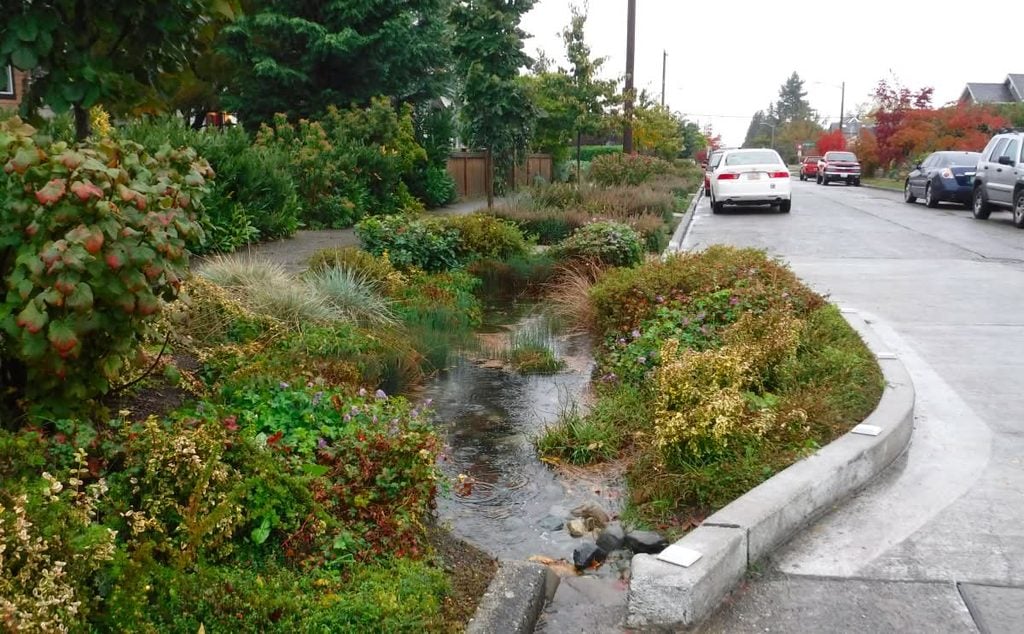
Shanti Colwell
The High Cost of Conventional Infrastructure
In 2010, New York City estimated that updating the city’s stormwater system to control combined sewer overflows using only gray infrastructure would cost the city $6.8 billion of capital investment over twenty years. By blending gray and green strategies, the city reduced its estimated cost by $1.5 billion.2
Economic Losses from Storms
In 2016, four flooding events and eight severe storms have each incurred damages exceeding $1 billion across the United States.3
Public Health Risks
860 municipalities across the US with a total population of 40 million people, have combined sewer systems.4 During heavy rainfall events that overburden the gray infrastructure system, untreated stormwater and sewage flows directly into local water bodies, causing serious public health risks and environmental pollution.
Prevalence of Urban Flooding
Storms of all magnitudes can cause flooding of homes and businesses, disrupting lives and damaging property. A study of Cook County, Illinois, found that urban flooding is chronic and systemic; property owners suffered an average of $6,000 in damages per flooding event, and 87% of homeowners surveyed had experienced multiple flooding events.5 In addition to damaging buildings, flooding can disrupt street operations and prevent safe transportation.
Frequency of Storm Surges
Climate change is causing temperature increases and sea level rise, which combine to create increasingly frequent and dramatic storm surges that threaten low-lying parts of the city. In many coastal cities, “once-in-a-century” storm surges may occur once a decade in the future.6
- American Society of Civil Engineers, 2013 Report Card for America’s Infrastructure: Wastewater, accessed November 2016, www.infrastructurereportcard.org ↩︎
- City of New York Department of Environmental Protection, NYC Green Infrastructure Plan: A Sustainable Strategy for Clean Waterways (New York: City of New York, 2010), accessed November 2016, http://www.nyc.gov/html/dep/pdf/green_infrastructure/NYCGreenInfrastructurePlan_LowRes.pdf. ↩︎
- NOAA National Centers for Environmental Information, Billion-Dollar Weather and Climate Disasters: Overview, accessed November 2016, https://www.ncdc.noaa.gov/billions/overview. ↩︎
- United States Environmental Protection Agency, “National Pollutant Discharge Elimination System (NPDES): Combined Sewer Overflows (CSOs),” accessed Nov. 2016, https://www.epa.gov/npdes/combined-sewer-overflows-csos. ↩︎
- Harriet Festing et al., A RainReady Nation: Protecting American Homes and Businesses in a Changing Climate (Center for Neighborhood Technology, 2014). ↩︎
- Claudia Tebaldi, Benjamin H. Strauss, and Chris E. Zervas, “Modeling sea level rise impacts on storm surges along US coasts,” Environmental Research Letters 7, no. 1 (2012):014032. ↩︎