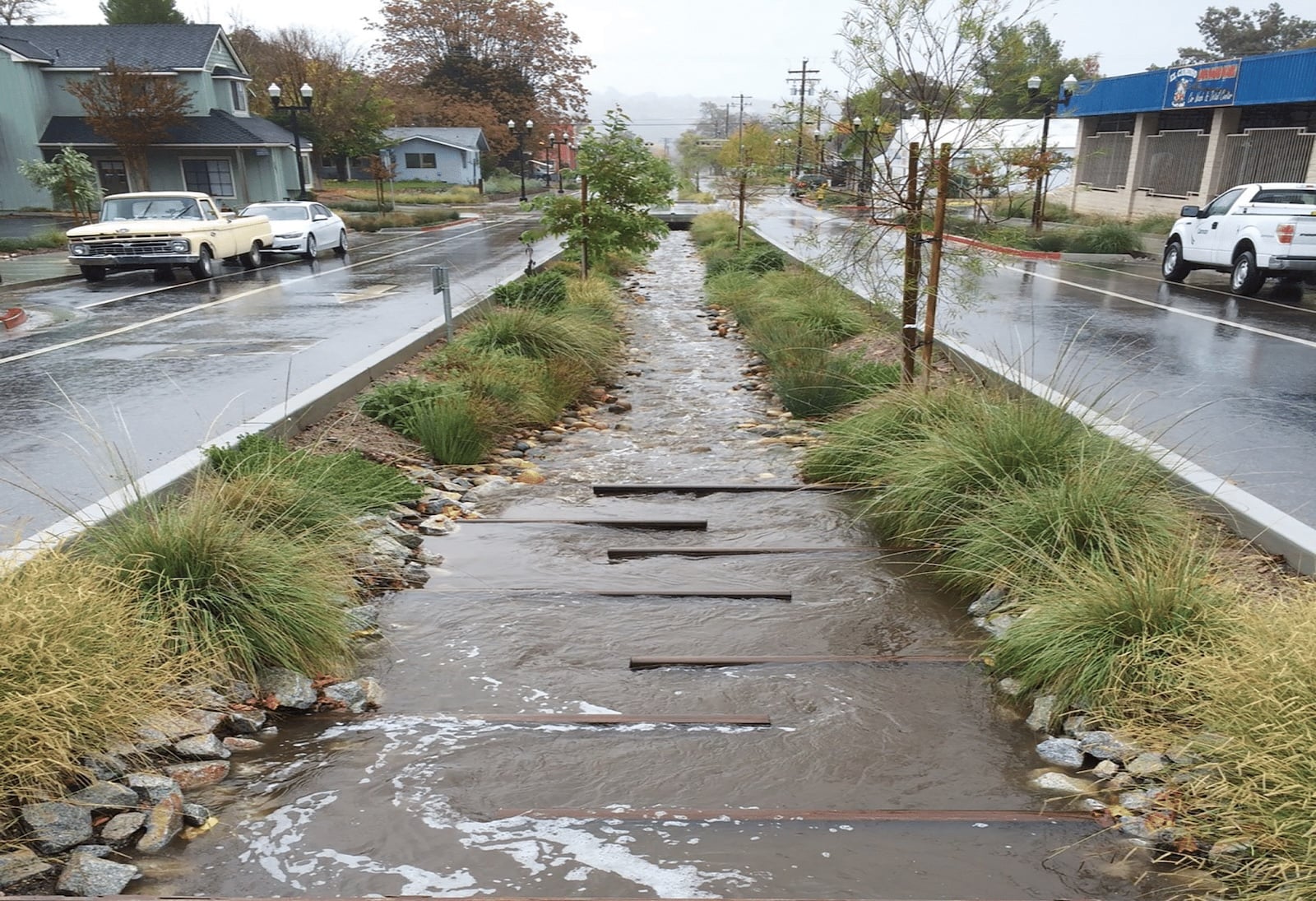
Wide medians used to separate traffic directions may be utilized for large amounts of water conveyance and infiltration. On very wide streets and parkways, green stormwater infrastructure can be coupled with greenways for bicycling and walking, providing attractive public space adjacent to stormwater management.
MIG | SvR
Application
Bioretention swales, planters, and biofiltration planters can be integrated into medians where width allows.
Uninterrupted linear street space may manage large volumes of runoff from adjacent pavement or areas upstream collected from multiple blocks.
Benefits
Median bioretention facilities utilize potentially unused space in the right-of-way, and can repurpose that space into multi-functional street space by providing greenscape and stormwater infrastructure.
Median cells may be very high capacity stormwater facilities (depending upon right-of-way space), as access is more easily limited.
Considerations
Medians tend to be at the high point of a road’s cross slope; thus, street runoff is typically not sheet flowing to a median. As a result, bioretention facilities sited in medians may require reversing a street’s cross slope in order to intercept the adjacent street’s runoff.
If the street’s cross section can not be modified, review opportunities to intercept stormwater collected in an upstream conveyance system (from other street) and having it daylight into a series of bioretention facilities in the median.
Sewer mains and other underground utilities tend to be located in the middle of a roadway and may need to be relocated.
Consider street sweeping, plowing, and snow storage in colder climates. Snow that is not removed may be stored in the median, which can impact plant health and facility durability. De-icing chemicals, salt, and sand may also impact tree and vegetation health, especially if over-applied.
Critical
Use low plantings in bioretention facilities and landscaped medians near intersections and at pedestrian crossings through the median to maintain sight clearance; plants should grow no higher than 24 inches above the pavement surface where pedestrians will gather or cross the intersection.
Recommended
Design the roadway to slope toward the median bioretention facility. This may include either a street with an inverted crown (all runoff flows to the center) or a “thrown” street, where roadbed slope in one direction, and the median intercepts half of the runoff.
Review maintenance operations during the design phase. Determine if lanes will need to be closed for maintenance crews to safely work within the median and clean inflow points into the facility, or if refuge areas can be designed into the median for maintenance access.
Provide an 18–24 inch wide level area to ease maintenance access along either edge.
Trees can be planted in median stormwater facilities to manage runoff. Ensure that tree trunks and root structures are not submerged in water longer than the species is able to tolerate. Trees may be planted on berms to limit ponding around the base. Select species and place trees such that they do not impact visibility or street lighting.
Optional
Pedestrian walkways built around bioretention may provide an inviting or distinctive public space anchored by greenscape, especially on wide boulevards and parkways where large medians define the street context and where green infrastructure provides a visual cue to drivers to reduce speeds.