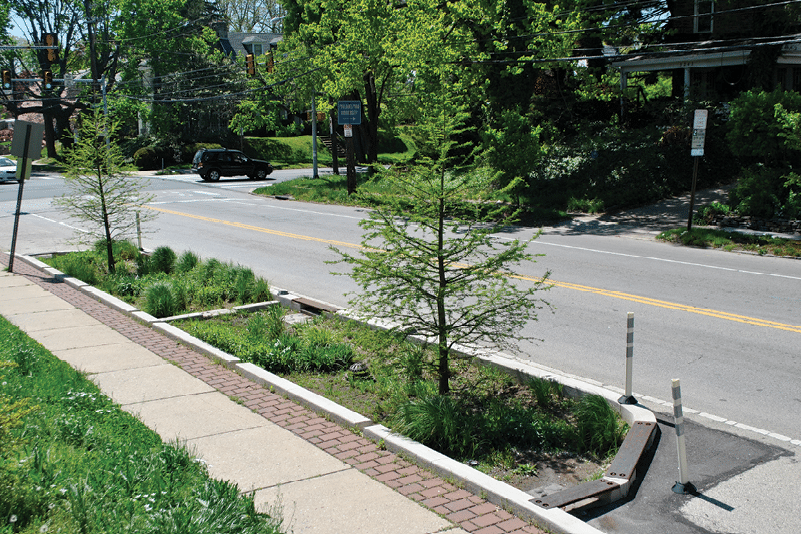
Curb extensions visually and physically narrow the roadway width, creating safer and shorter crossings for pedestrians and providing traffic calming on low-speed neighborhood streets and commercial corridors. The available space generated by curb extensions can be used for bioretention, plantings, street furniture, benches, and street trees.
Philadelphia Water Department
Application
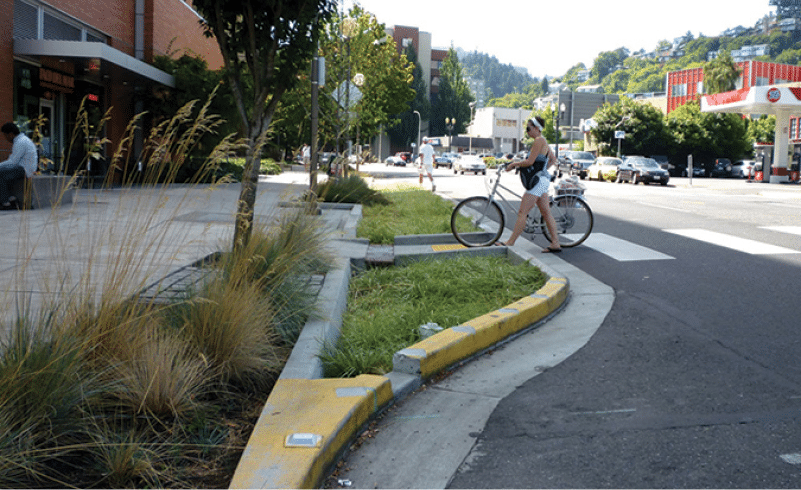
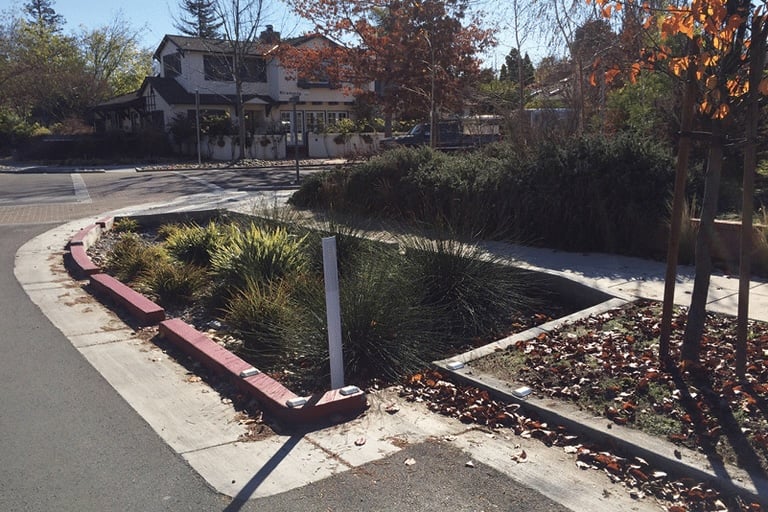
Curb extensions—sometimes called “bulbs,” “bump-outs,” or “neckdowns”—can be sited at intersections to narrow the crossing distance for pedestrians and decrease curb radii, encouraging drivers to make slower turns. Bioretention cells can be integrated into intersection curb extensions depending upon drainage patterns. Plantings can be used at corners to visually connect crossings, with or without bioretention.
Mid-block curb extensions can be used to intercept and infiltrate gutter flow while providing traffic calming benefits; mid-block bioretention bulbs can be combined with mid-block pedestrian crossings.
Curb extension bioretention facilities are typically applied as walled cells, though hybrid cells (see Hybrid Bioretention Planter) with the graded side along the sidewalk edge can provide a gentle transition.
Benefits
Curb extensions are relatively simple to direct gutter flow into, especially when sited at the downstream end of the flow path.
Installation of stormwater curb extensions at intersections can create opportunities to improve accessibility and pedestrian safety. Shortening crossing distance, tightening corner radii, upgrading curb ramps, and relocating obstructions such as signal poles and utility boxes can improve pedestrian mobility and reallocate impermeable space for green infrastructure.
Mid-block and intersection curb extensions that pinch traffic can reduce motor vehicle speeds, increase pedestrian prominence at crossings, and improve safety and comfort.
Considerations
Stormwater curb extensions should be sited to intercept runoff before it reaches gray drainage infrastructure. Location of existing catch basins may dictate placement or ability to implement intersection curb bulbs, especially if the catch basin is located at a corner apex or in close proximity to a pedestrian curb ramp. If catch basins cannot be moved and preclude placement of a stormwater curb extension at the intersection, mid-block curb extensions can be sited immediately upstream of storm structures to intercept as much runoff as is possible.
On streets with minimal slope, the low point along the curb bulb may not be in line with the gutter. Review the street’s longitudinal slope and cross-slope to site inflow points.
If runoff exceeds bioretention cell capacity during large storm events, overflow (or gutter spread) from the curb extension may extend into the roadway, reducing visibility and creating hazards from street users.
Critical
Use low plantings in bioretention facilities and landscaped curb extensions near intersections to maintain sight clearance; plants should grow no higher than 24 inches above the sidewalk grade.
Recommended
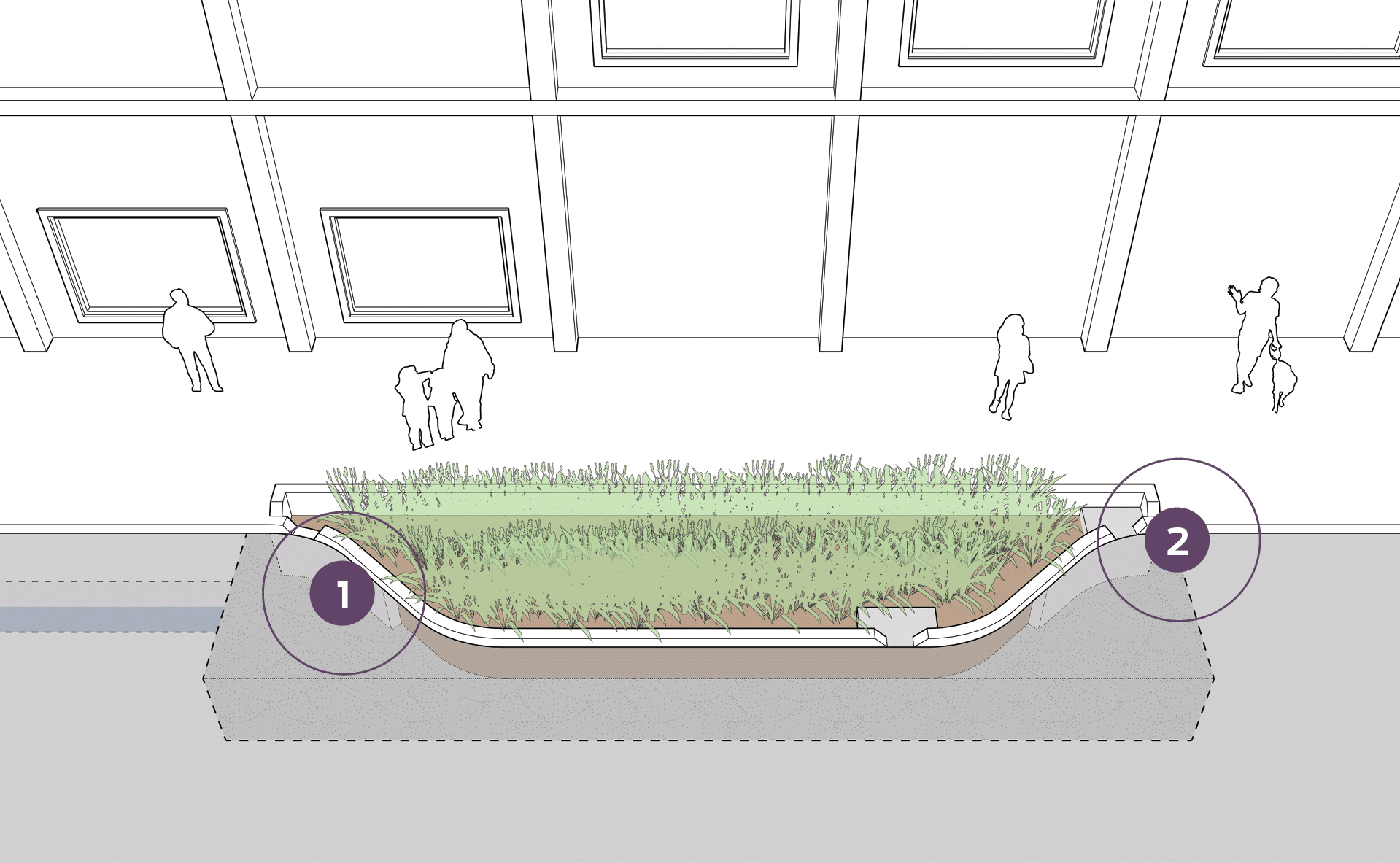
The width of a curb extension varies with street type. Curb extensions are typically recessed 1–2 feet from the outside edge of the right-most travel lane, though width may be tailored to accommodate emergency or large vehicle access, or other existing conditions.
1The curb return from bump-out edge to original curbline should be designed to enable street sweeping along the curb edge, typically angled between 30 and 60 degrees relative to the curbline. Steeper return angles will usually require hand-sweeping.
2Design inlets and outlets to resist incursions by vehicles and bicycles, as motor vehicle wheels may be prone to enter, especially during parking maneuvers. Metal lids are an effective design strategy to block vehicle entry.
Inlets should include a presettlement treatment, especially along the curbline where runoff flows straight from the gutter (see Presettling Zone).
No lateral offset distance is required along the edge between the curb and bioretention area, as parking is not permitted adjacent to the curb extension. An 18 to 24-inch level area may be included along the curb to ease maintenance access from the street.
Optional
Utility corridors often determine where cells can be installed. Utilities may be sleeved, bioretention cells can be set back, or curtain liners may be integrated into design to prevent loading of infiltrated runoff onto subsurface infrastructure.
The intersection corner area may be used for plantings or even bioretention area, though designers must carefully balance project goals and uses. Corner plantings increase the lateral offset of crosswalks, directing pedestrian paths around planted area and potentially decreasing visibility for turning vehicles.
Locating curb extensions in areas where on-street parking is already prohibited, such as near fire hydrants or driveway setbacks, can enable GSI implementation without affecting parking or curbside access. Ensure emergency responders have necessary access to utilities at all times.
Walled bioretention cells may incorporate seating and furniture around edges.
Aaron Villere
Cherie Walkowiak, Safe Mountain View