Once built, city streets are generally not reconstructed for many decades. When a reconstruction opportunity arises, it is critical to carefully consider future needs and fully capitalize on the opportunity.
To extend the street’s useful life, account for the expected future changes in mobility patterns and travel behavior, local climate and precipitation, and land use or development.
Full reconstruction of an existing street typically offers more flexibility for identifying opportunities for bioretention and reallocating underutilized space to bioretention areas.
Eric Wheeler
Coordinate Throughout Design
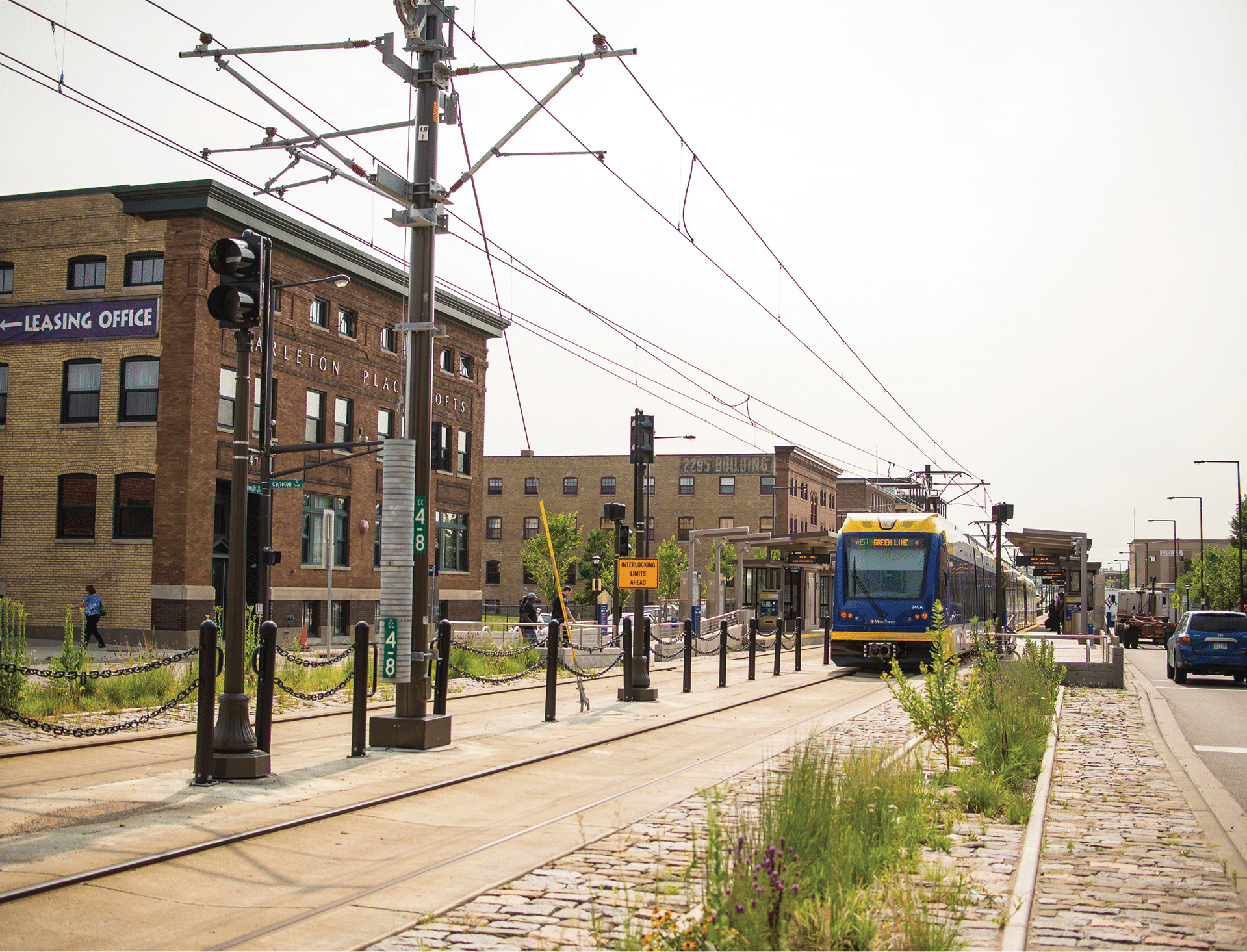
Full reconstruction provides the opportunity to intentionally coordinate bioretention facilities with other infrastructure in the right-of-way, including utilities, sidewalks and curb extensions, transit stops, bikeways, bike share stations, curb cuts, and crosswalks.
Optimize the benefits of green infrastructure. Look for opportunities to co-locate bioretention facilities with other livable street design strategies, such as curb extensions or bike lane buffers.
Consider opportunities to fully regrade the roadbed to more efficiently collect and direct runoff to bioretention facilities. Reversing the street crown to flow toward median bioretention, or grading the roadbed to slope to only one side of the street (a “thrown” street) can maximize the amount of right-of-way available to bioretention, and/or provide more area to treat offsite water from upstream blocks. Regrading depends upon existing development and whether there is flexibility in adjusting grades at the property line.
Organize the Sub-Surface
Overhead or underground utilities, including power and communication lines, can be sited separately from the bioretention facility to maintain easy access to both infrastructure systems and prevent conflicts.
The location of service and franchise utilities is important to confirm that future connections and maintenance will not be limited by the location of the bioretention facilities. The utilities have setback and clearance requirements that will need to be accommodated during installation of bioretention. Depending upon the utility purveyor, service utilities may be able to sleeve under a bioretention facility or be required to be relocated around the facility. It is important to discuss requirements with utility purveyors during the initial project planning phase.
Plan for the Future
Plan for the mobility future; design walking, bicycling, and transit facilities to encourage and accommodate growth in these modes and activity in public space, and seize opportunities to integrate multi-modal street design and sustainable stormwater infrastructure into cohesive urban design.
Install empty utility sleeves and electrical conduit under the surface, and clear of bioretention facilities, to allow for future utility connections and transportation facilities requiring power (such as transit shelters and curbside kiosks). Proactive accommodation of subsurface space can save reconstruction or retrofit costs as streets evolve over time.