A flooded street is not a complete street. During storm events, people walking, bicycling, and using transit are the first users to encounter barriers and lose access to the street, and are the last to regain it.
Green street design tools, which integrate stormwater control and management within the right-of-way, are a critical component of complete street design, ensuring the street remains usable and safe for all people during storm events, regardless of mode.
Take into consideration both the impacts of stormwater on multi-modal travel and the potential for green street investments to transform the public realm and create economic, social, and environmental benefits for all street users.
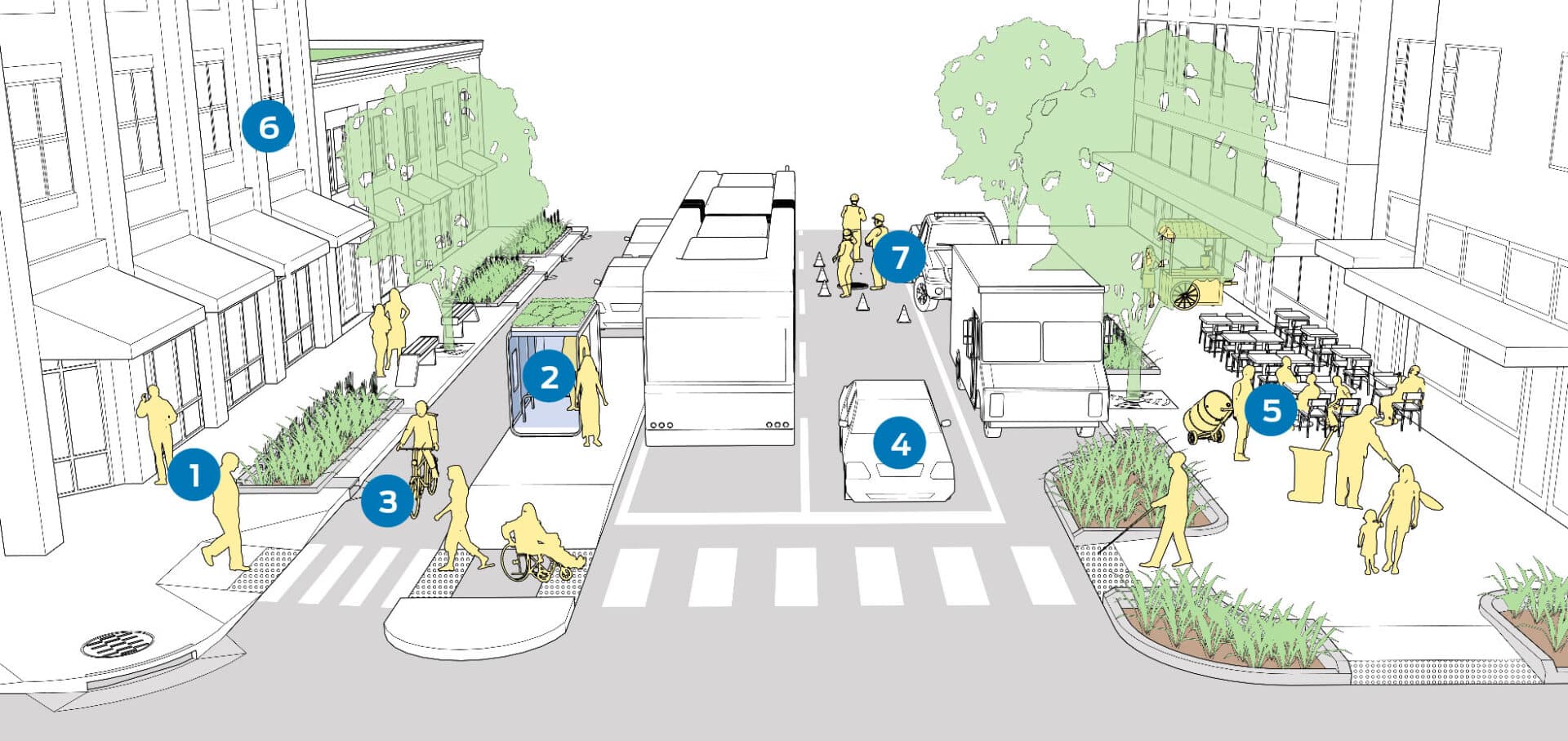
Street User
1People Walking
User Considerations
- Ponding of stormwater, especially near intersection crossings and ramps, creates barriers, especially for people using mobility devices. Ponding may result from blocked drains and basins, wear over time to roadway slope and pavement quality, or improperly designed stormwater drainage systems. For people using mobility devices, stormwater on the street functionally and significantly prevents access.
- Large or fast runoff streams also create barriers and degrade walking comfort.
- Drainage grates, lips, high storm drains, and large seams sited in or near pedestrian crossings introduce hazards.
GSI Benefits & Solutions
- Greenery and trees—especially those that introduce shade canopy—make the walking environment more inviting and pleasant by reducing temperature, attenuating noise, and improving air quality.
- Green infrastructure can be used to calm traffic and improve safety conditions.
- High-quality public gathering spaces with natural features improve mental health, and create opportunities for community development and social cohesion.
Street User
2People Using Transit
User Considerations
- People riding transit are also pedestrians and interact similarly with stormwater. Puddles or streams can impede walking and wheelchair access to transit stations and bus stops.
- Rider comfort is enhanced by shelter, shade, and greenscape at the transit stop. Improvingrider comfort and experience is critical to growing transit as a mode.
GSI Benefits & Solutions
- GSI can be integrated into transit facilities, including boarding bulbs and islands, to improve passenger comfort and natural drainage near stops.
- Transit shelter and facility roofs—usually owned or overseen by public agencies—can incorporate green features.
Street User
3People Bicycling
User Considerations
- Puddling or ponding of stormwater impedes safe and enjoyable bicycling where drainage is insufficient or ineffective.
- Wet pavement may discourage some potential riders who are concerned about mud and spray. An extended drying or drainage period may displace bicycle trips into other transportation modes.
- The details of stormwater infrastructure design are safety-critical: poorly placed or antiquated drainage grates and storm drains can pose hazards to people biking, including slick surfaces, debris around grates, and the potential for wheels to become stuck in grates.
GSI Benefits & Solutions
- Green stormwater infrastructure can be incorporated alongside bikeways to improve drainage and increase bicycling comfort and access during and after storms of any size.
- Permeable pavements can be implemented on bikeways and raised cycle tracks to reduce the period of time required for pavement to dry.
- Planters or vegetation may be incorporated into protected bikeway buffer elements to increase rider comfort and reduce stress.
Street User
4People Driving Motor Vehicles
User Considerations
- Flooded streets can become impassable for motor vehicles. Puddles and pooled water can create poor or dangerous driving conditions, with splashing, poor visibility due to reflections, and unpredictable swerving to avoid water.
- Poorly draining streets hinder curbside access for vehicle entry and loading.
GSI Benefits & Solutions
- Green infrastructure facilities that capture runoff and reduce flooding and ponding promote safer driving conditions.
- Design and site green infrastructure with sensitivity to context, and implement GSI with other geometric changes that reduce vehicle speed and improve visibility. People driving cars, especially in adverse weather, at night, or when driving at an unsafe speed, may drive their vehicle into a stormwater facility. Incursions that damage stormwater infrastructure are costly to repair.
Street User
5People Conducting Business
User Considerations
- Curbside access is universally critical, regardless of travel mode or trip purpose; people making freight deliveries or doing business by foot, bike, handtruck, transit, or motor vehicle all need to access the curb in order to reach their destinations.
- Freight movement and deliveries are essential to businesses and cities’ economies, requiring thoughtful integration into street design and urban life. Flooded streets that impede freight movement take an economic toll.
GSI Benefits & Solutions
- The success and vitality of commercial districts and neighborhood storefronts depend upon the ability of workers, visitors, and essential services to be able to access and use streets comfortably.
- Economic performance is tied to the comfort and attractiveness of streets—urban environments with green expressions, from planters to street trees to stormwater infrastructure, perform better than streets without green improvements.
Street User
6People Residing
User Considerations
- Insufficient stormwater management on streets can cause flooding in homes and businesses. Property owners incur financial losses from flooded buildings, and insurance rates can rise after repeated claims.
- Chronically wet houses and basements can reduce property values and deter potential buyers. Frequent flooding can cause mold, which can lead to an increase in respiratory problems
- People may use downstream water bodies for recreational activities. Poor water quality in lakes, rivers, and streams poses a public health risk and limits opportunities to use waterfronts for recreation.
GSI Benefits & Solutions
- The presence of green stormwater infrastructure can be an asset to property owners. Green stormwater networks work with gray infrastructure to mitigate flood risk, especially with careful siting guidelines and design strategies near basements and subsurface structures.1
- Street trees and greenscape have been shown to increase property values.2
- Green infrastructure can be implemented in collaboration with private properties to direct right-of-way runoff to bioretention areas beyond the right-of-way.
- Runoff from buildings and structures can be captured and infiltrated into right-of-way green infrastructure.
Street User
7People Working /
Performing Maintenance
User Considerations
- City crews and utility companies require periodic access to elements within the street to perform routine or emergency maintenance, such as sewers, cleanouts, and subsurface utility lines.
- Pavements cuts impact drainage and accessibility.
- Snow clearance and storage during winter months impact street operations.
GSI Benefits & Solutions
- Green infrastructure must be designed with maintenance in mind; crews must be able to access and navigate equipment around green elements.
- Green infrastructure must be implemented with consideration for existing or planned subsurface lines.
- Vegetated strips provide linear space for snow storage.
- Wen Liu, Chen Weiping, and Peng Chi, “Assessing the effectiveness of green infrastructures on urban flooding reduction: A community scale study,” Ecological Modelling 291 (2014): 6–14. ↩︎
- Noelwah R. Netusil, Zachary Levin, Vivek Shandas, and Ted Hart, “Valuing green infrastructure in Portland, Oregon,” Landscape and Urban Planning 124 (2014): 14–21. ↩︎