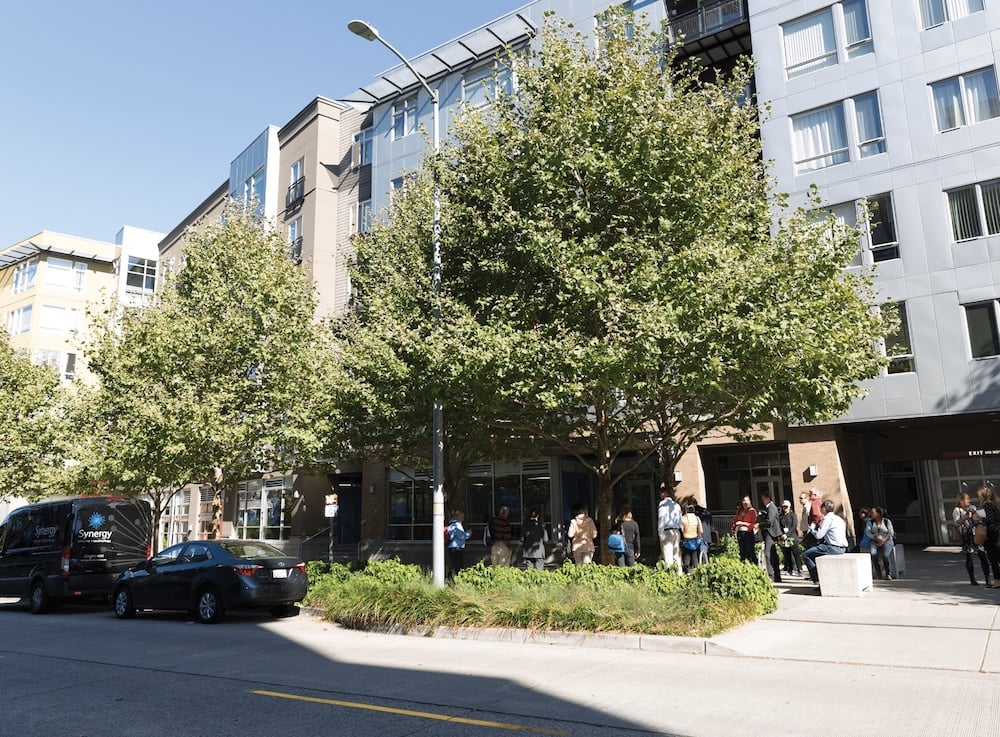
In addition to their immense social and aesthetic value, street trees provide quantifiable economic and ecological value to cities. Healthy street trees can contribute significantly to green stormwater management, with large capacity to transpire water, intercept rainfall, and treat water quality.
Mike Nakamura
Application
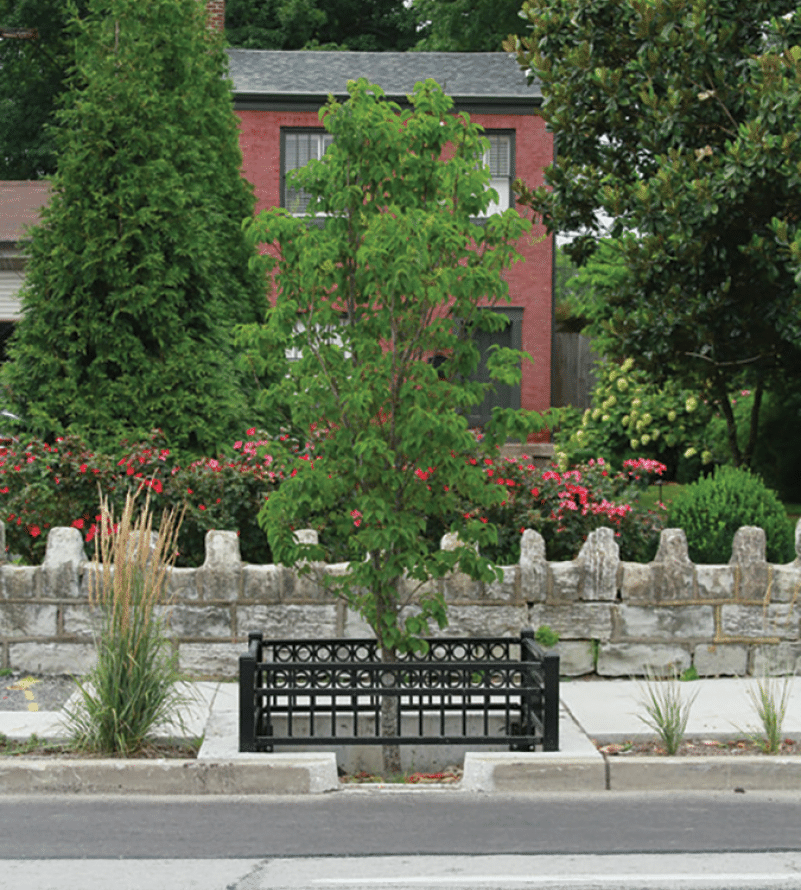
Tree wells or pits are a box housing a single tree. Wells can have walled sides or structural soil systems to protect soil from compaction and retain stormwater.
Tree trenches are connected or linear tree boxes that usually have a subsurface system for distributing runoff among a series of trees. Tree trenches are often constructed in the sidewalk furnishing zone, though may also succeed in center medians or service street medians.
Benefits
Street trees can contribute significantly to green stormwater management by absorbing rainfall, transpiring water, and controlling runoff.
In cities, the high percentage of developed land and impervious land cover, including asphalt and concrete, contributes to an urban heat island effect: temperatures in a city can be significantly higher than in surrounding rural areas. Street trees can help mitigate the urban heat island effect through evapotranspiration and shading.
Urban air pollution, largely attributable to vehicle emissions and fossil fuel combustion, poses a public health threat, exacerbating respiratory and cardiovascular disease. Street trees play an important role in improving local air quality, removing air pollutants and filtering particulate matter.
Street trees calm motor vehicle traffic by visually narrowing the street and providing a well-defined roadside edge. The presence of trees can reduce speeding and crashes, improving safety for all street users.
Street trees play an enormous role in a street’s livability, creating shade, dampening noise pollution, improving mental well being, reducing stress, adding aesthetic value, and contributing to a sense of place.
Street trees have quantifiable economic benefits. Building energy consumption (and therefore costs) are lower on streets with shade. Street trees have been shown to increase property values and sales at local businesses.1 Tree shade can slow pavement deterioration, decreasing maintenance needs and costs.
Urban forestry is an important strategy for climate change mitigation and adaptation. Street trees capture and store carbon dioxide, and by reducing temperatures and surface albedo, trees help with local adaptation to a warming climate.
Considerations
Planting street trees inside walled planters requires adequate cell width for a medium or large tree species to grow to maturity.
Smaller trees planted in depressed cells may have low branching structures that will overhang into the pedestrian path and create a barrier for people walking. Choose species based upon height clearance of branches and consider the expected need for pruning.
If the facility has an underdrain pipe, this may further inhibit the ability to place trees and provide clearance from the underdrain pipe and vertical wall. To make up for the lack of trees planted within the stormwater planter, consider widening the crossings between cells and review the overall street design.
Louisville MSD
Critical
Design tree pits and trenches with adequate root space for the tree species underneath the sidewalk or street; as trees age, inadequate root space may degrade tree health and buckle pavement or sidewalks, creating hazardous, inaccessible, and expensive-to-repair conditions. Use root barriers to direct roots to appropriate growth area.
Plant diverse, climate-appropriate tree species that will be able to withstand the likely stormwater runoff and detained ponding depth, and that will support infiltration and transpiration. Consider the regional climate and expected future climate changes when selecting tree species. In winter climates, select salt-tolerant tree species and consider the need for snow storage.
For trees planted in the sidewalk furnishing zone performing bioretention, provide an appropriate inlet to capture runoff and distribute to tree boxes. This may be a curb cut or depression, or a catch basin that circulates water through connected tree boxes using capillary action.
When trees are adjacent to the bikeway, ensure branches do not impede bicyclists; branches that overhang the bikeway or street should hang no lower than approximately 8 – 14 feet (depending on city requirements) to the bikeway or street surface.2
Recommended
Plant diverse, climate- and region-appropriate tree species. Varying trees can provide food and habitat to different species of birds and wildlife, and can increase resilience to different kinds of disease. Avoid over-specialization of a limited number of tree species, and consider using some evergreen and coniferous trees to maintain year-round benefits.
Select tree species that provide adequate shade and canopy, especially where people are expected or desired to sit or use the public realm.
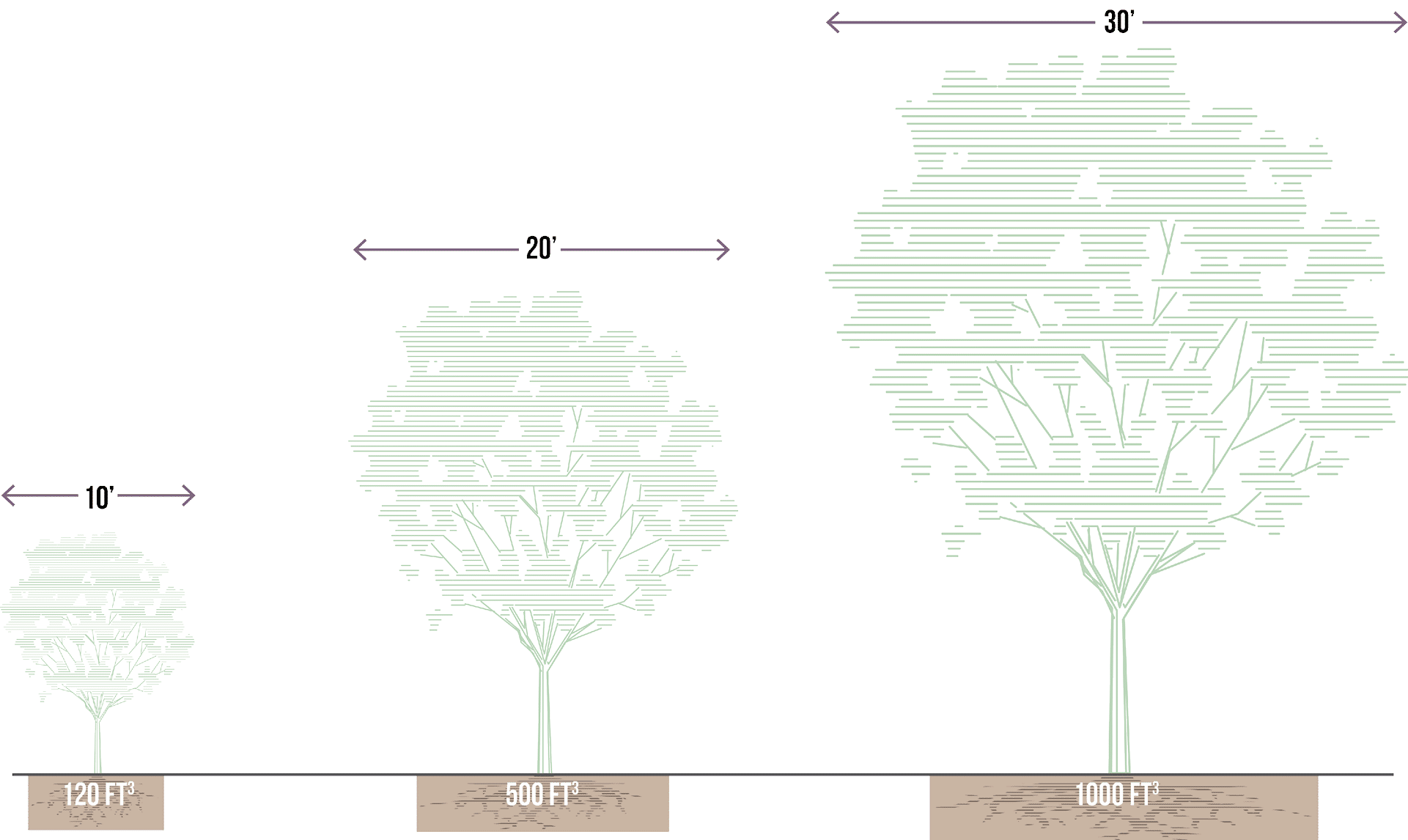
Larger trees require greater volumes of uncompacted soil space for roots to grow; though requirements vary by species, a tree with a canopy 30 feet wide needs roughly 1,000 cubic feet of root space to thrive.3
- Donovan, Geoffrey H., and David T. Butry. “Trees in the city: Valuing street trees in Portland, Oregon.” Landscape and Urban Planning 94, no. 2 (2010): 77-83. ↩︎
- Massachusetts Department of Transportation. “Chapter 3: General Design Considerations.” Separated Bike Lane Planning & Design Guide (2015). ↩︎
- United States Environmental Protection Agency. “Soak Up the Rain: Trees Help Reduce Runoff,” Accessed Nov. 2016. (https://www.epa.gov/soakuptherain/soak-rain-trees-help-reduce-runoff) ↩︎