The sidewalk is the area where people interface with one another and with businesses most directly in an urban environment. Designs that create a high-quality experience at street level will enhance the economic strength of commercial districts and the quality of life of neighborhoods.1

DOWNTOWN

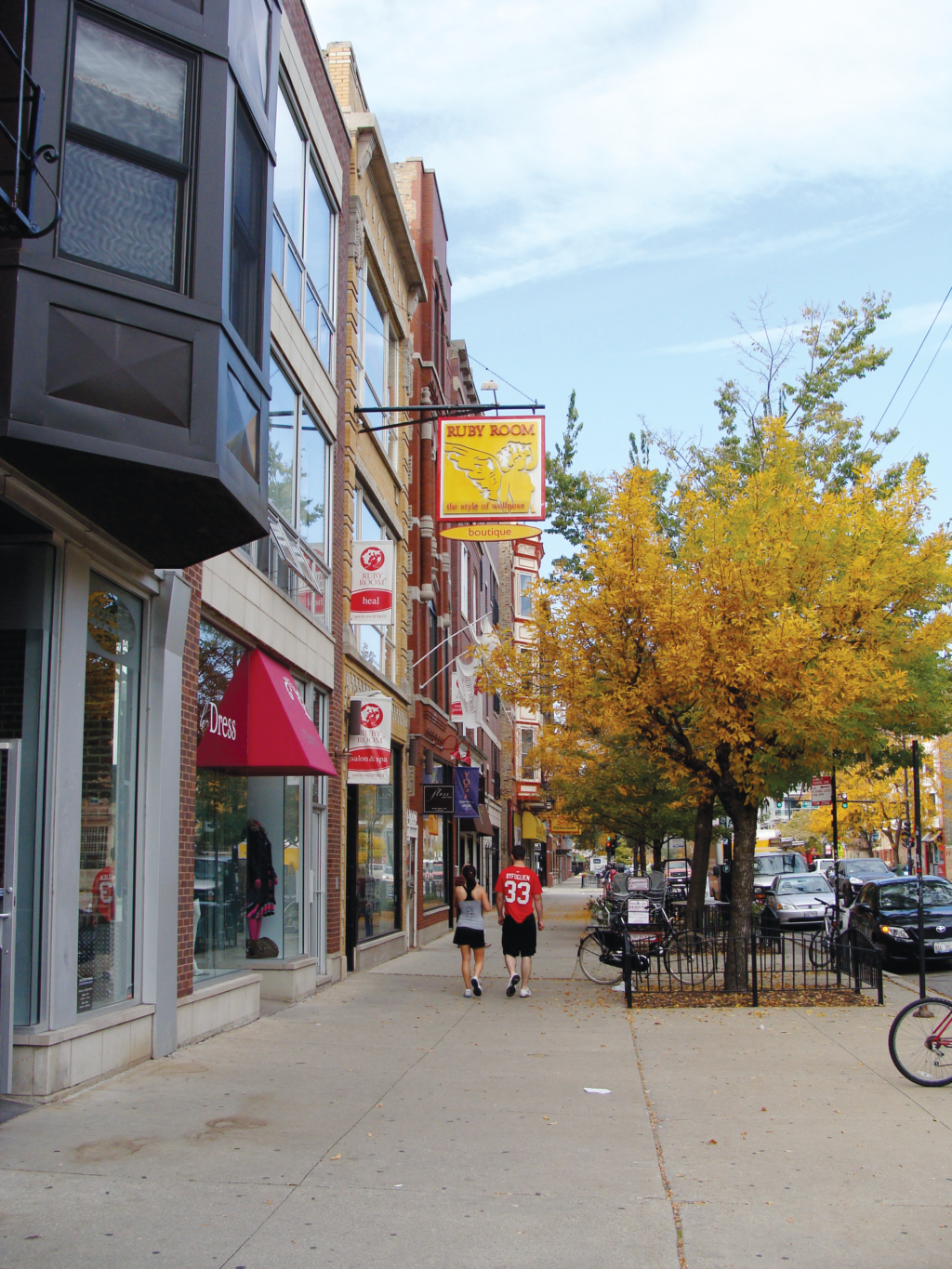
Sidewalks are central to pedestrian life. Cities can enhance the public realm by creating venues where people can observe street life and activity, especially in retail and commercial areas.
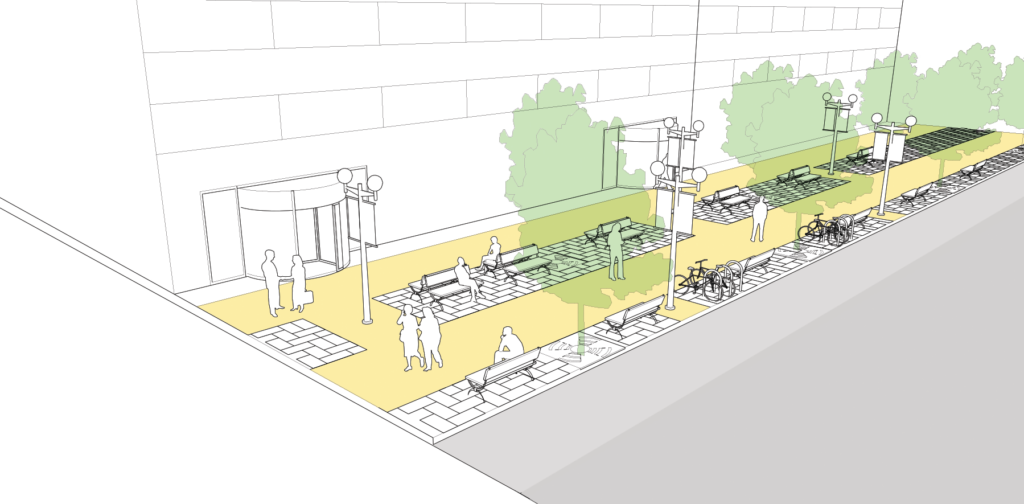
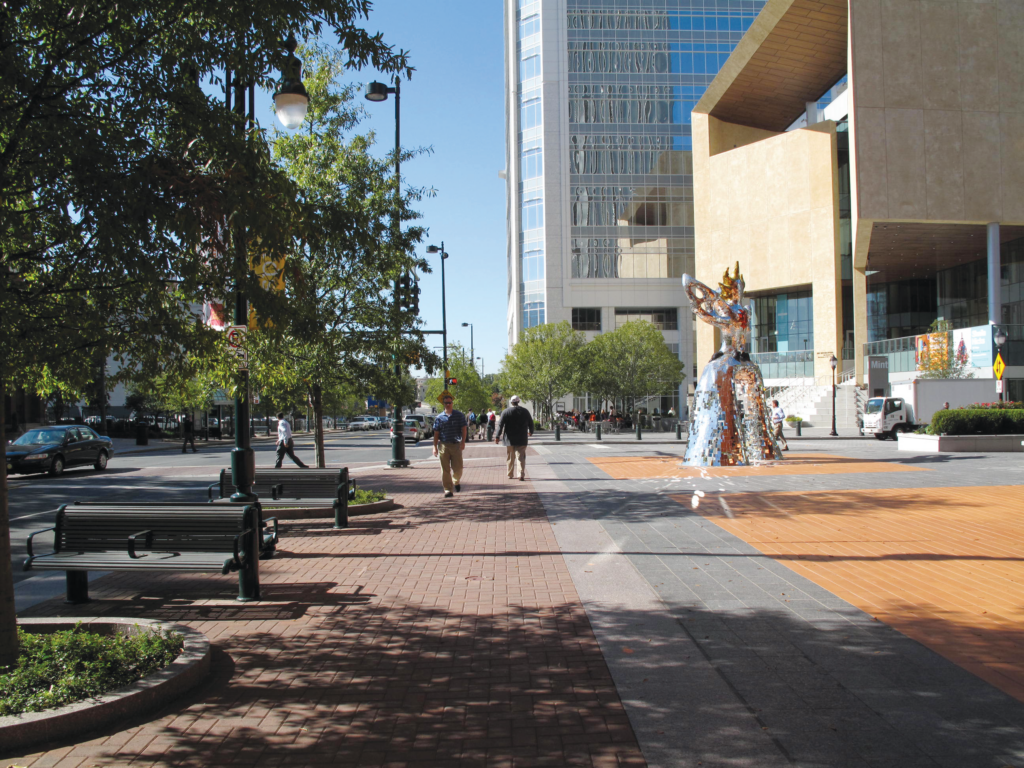
From the 1960s through 1980s, many downtown sidewalks were widened as part of new downtown office tower developments. Wide downtown sidewalks benefit from public art, music, human-scale design features, and vendors to avoid feeling empty or oversized.
Façades and storefronts should be designed to cater to the eye level of pedestrians. Strategies include:
- Lighting scaled to the pedestrian realm in addition to overhead lighting for vehicles.
- Benches and other seating platforms designed into the structure itself or placed within the frontage zone.
- Incentives to provide awnings, sidewalk cafes, and other elements that improve the comfort and appearance of the sidewalk.
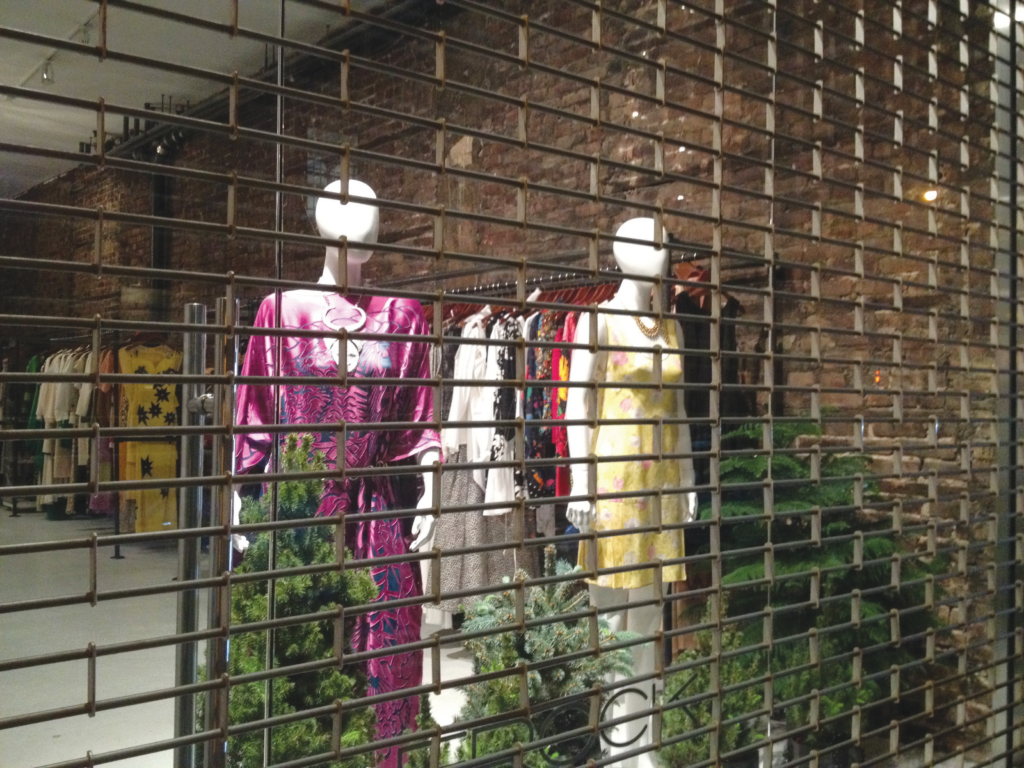
- Where security concerns are present, use of permeable, rather than closed, metal shutters on storefronts at night (left).
- Provision of adequate lighting beneath scaffolding and other construction sites.
NEIGHBORHOOD
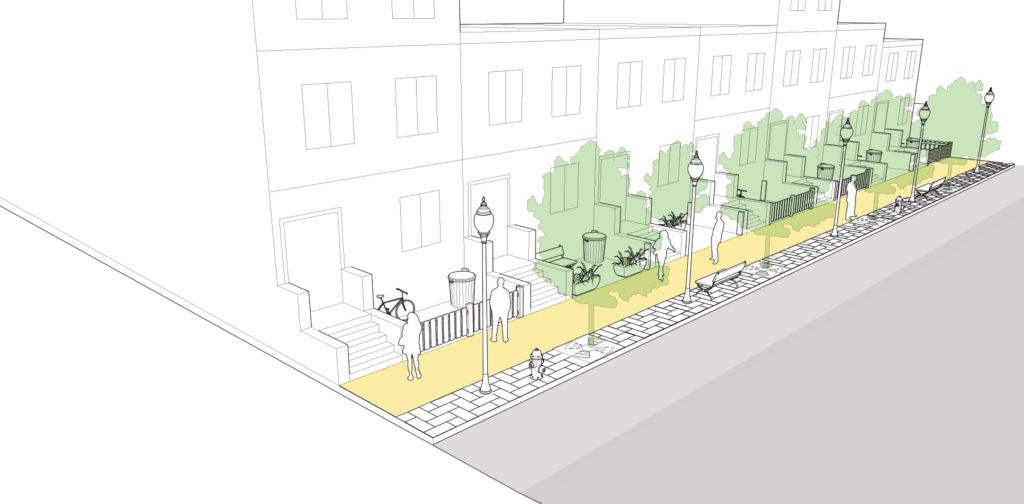

Narrow neighborhood sidewalks should be redesigned to provide a wider pedestrian through zone and street furniture zone whenever practicable.
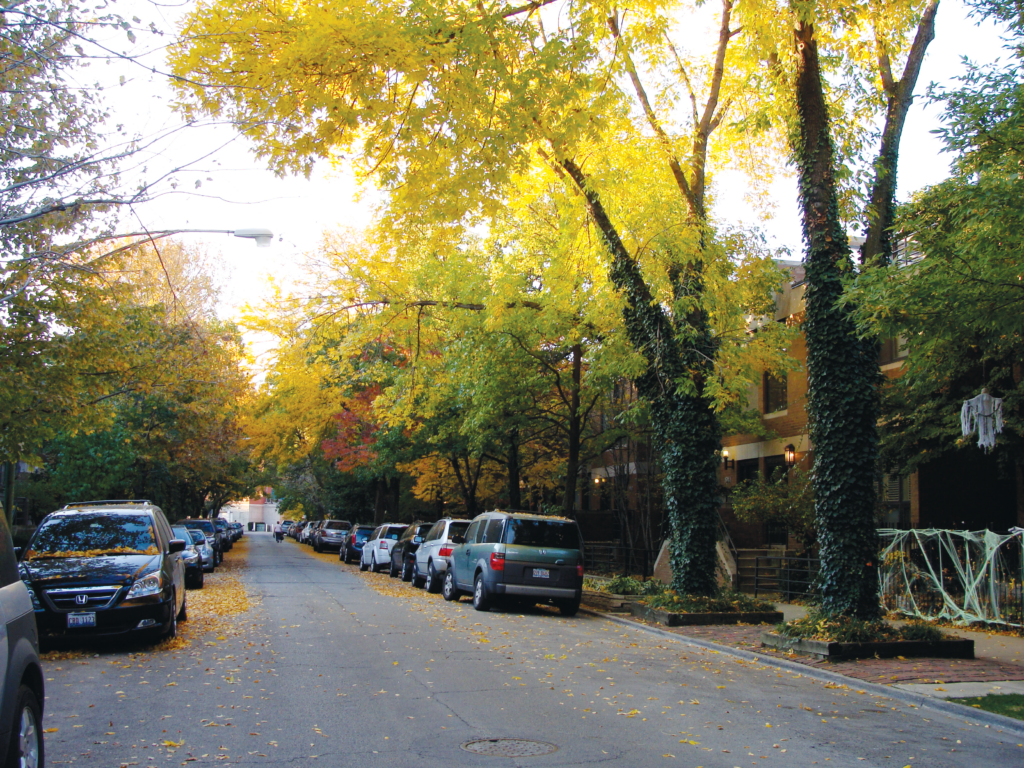
Street Trees
Street trees enhance city streets both functionally and aesthetically. Trees provide shade to homes, businesses, and pedestrians. Street trees also have the potential to slow traffic speeds, especially when placed on a curb extension in line with on-street parking, and may increase pavement life by avoiding extreme heat. Aesthetically, street trees frame the street and the sidewalk as discrete public realms, enriching each with a sense of rhythm and human scale.
Requirements for tree spacing depend upon a number of key factors and should be tailored to the chosen species, standard (or desired) tree pit size, fixed property lines, setback from curb, and integration with street lights and other furniture.
Street trees may be removed to satisfy sight distance or clear zone requirements only in extreme cases, where the installation of traffic control devices has been precluded. Larger trees protect pedestrians from errant vehicles.
RESIDENTIAL


Ribbon sidewalks are common in most residential areas. Design the pedestrian through zone to be roughly equal to the planted area, using pervious strips where applicable to help manage stormwater.
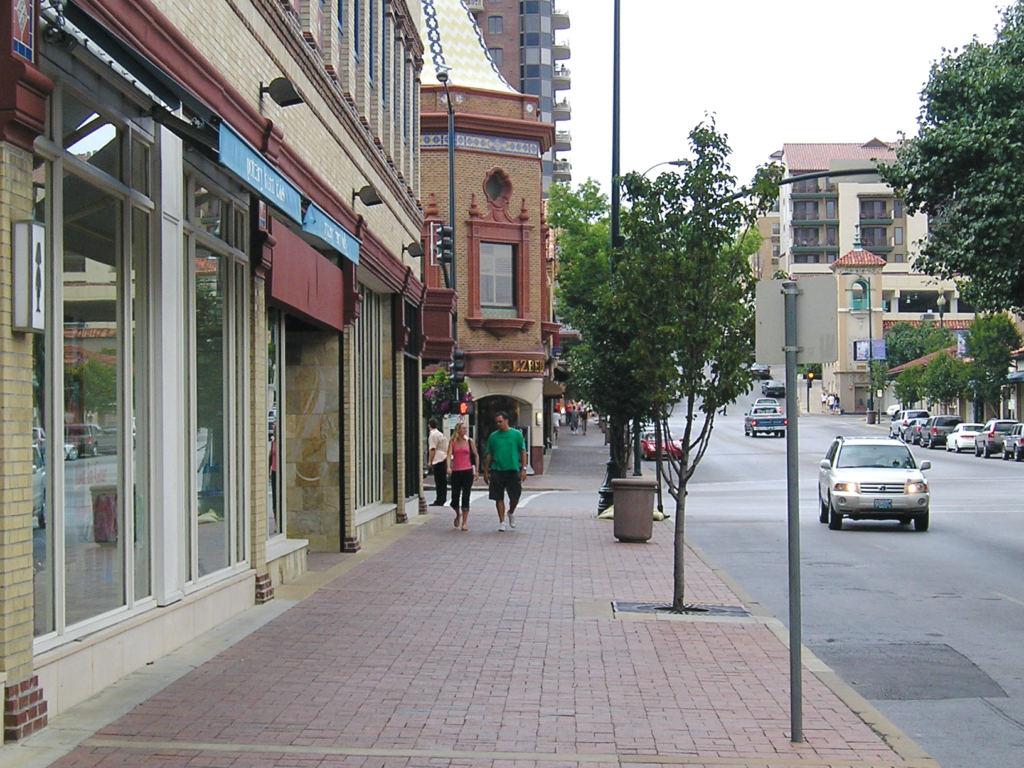
In retail districts, decorative materials and wide sidewalks support businesses.
Discussion
Sidewalks are an essential component of the urban environment and serve as key corridors for people, goods, and commerce. In accordance with ADA accessibility guidelines, sidewalks should be provided on all streets in urban areas.2
Numerous studies have shown that good pedestrian network connectivity and walkability have a positive impact on land values.3
Sidewalks have significant lifespans and can be maintained without replacement for 25 years or more, depending on the context.4

The sidewalk on Walnut Street over the Schuylkill River was widened from
8 to 12 feet to provide a wider buffer with lighting.

This design indicates that driveway users must yield to sidewalk users.
Critical
Sidewalks have a desired minimum through zone of 6 feet and an absolute minimum of 5 feet. Where a side walk is directly adjacent to moving traffic, the desired minimum is 8 feet, providing a minimum 2-foot buffer for street furniture and utilities.5
Sidewalk design should go beyond the bare minimums in both width and amenities. Pedestrians and businesses thrive where sidewalks have been designed at an appropriate scale, with sufficient lighting, shade, and street level activity. These considerations are especially important for streets with higher traffic speeds and volumes, where pedestrians may otherwise feel unsafe and avoid walking.
Sidewalks should be provided on both sides of all streets in all urban areas. On shared streets, the street itself serves as the path of travel and should be designed in accordance with accessibility recommendations outlined in the shared street section of these guidelines. In certain instances, such as on more rural or suburban roads connecting urban areas, it may be advantageous to build a shared-use path adjacent to the main roadway as a substitute for a sidewalk. In this case, the shared use path should meet the general criteria to serve adequately as a sidewalk or pathway.
The use of shoulders as a substitute for sidewalks is never justified in urban areas. Sidewalks should be delineated by a vertical and horizontal separation from moving traffic to provide an adequate buffer space and a sense of safety for pedestrians. Wide low-volume local or residential roads without sidewalks should be upgraded, but in the interim may be regulated as shared spaces or improved through the use of temporary materials where there is a potential danger to pedestrians.
Sidewalk design may be compromised by roadside design guidance that requires lateral offsets or clear zones forgiving to higher vehicle speeds. Use a lower design speed or widen the sidewalk to mitigate these impacts.
Delineation of a strict clear zone or minimum offset is not a required feature in urban environments. For the purpose of maintenance, cities should evaluate the impact of street trees, signs, and other elements on the structural integrity of the curb and access needs for parked vehicles or loading/unloading.
Where transit stops are provided, bus shelters should be placed at the left or right edge of the walkway, but never directly within the path of travel. Where insufficient space exists, consider the application of a bus bulb.
Relocation of fixed objects, such as utility poles, light fixtures, and other street furniture should not impinge on or restrict the adjacent walkway. Walkways must be clear of fixed objects in coordination with ADA accessibility guidelines.6
Ensure that sidewalks are without major gaps or deformities that would make them non-traversable for wheelchairs and other mobility devices.
At intersections with driveways, sidewalks should be maintained at-grade through the conflict zone.
Any construction project that obstructs the sidewalk should be mitigated through the provision of a temporary sidewalk that affords a safe and convenient passage or clearly directs users to an equivalent nearby detour.
Recommended
Select street trees and tree wells whose roots have a limited impact on the integrity of the sidewalk’s structure.
Sidewalk cafes foster street life and have the potential to increase business along a corridor. Where provided, sidewalk cafes should not impinge upon the accessible pedestrian pathway.
Where a city decides to repurpose a portion of the sidewalk as a raised bikeway, utilities and other furniture should be relocated (in the facility’s permanent reconstruction) to adequately separate pedestrian and bicycle traffic.
If a sidewalk is directly adjacent to the roadway, 2 feet should be added to the absolute minimum clear path width to ensure that there is sufficient space for roadside hardware and snow storage.7 Parking provides a valuable buffer between the pedestrian and vehicle realm. Urban arterials or high volume downtown streets directly abutting the pedestrian realm should be buffered in some capacity, whether through a street furniture zone, parking, cycle track, or other feature. Sidewalks of minimum dimensions directly adjacent to the traveled way should be avoided.
When pedestrian networks cross municipal boundaries, efforts should be made to ensure seamless continuity of the pedestrian infrastructure.
Optional
In newer residential areas, many streets have been constructed without sidewalks. If traffic volumes are sufficiently low in these areas, consider designating or upgrading these areas to shared streets. This requires the addition of specific traffic calming devices and regulations that offset potential conflicts with traffic accessing local properties.
Many older residential areas have trees whose roots have compromised the integrity of the sidewalk. On low-volume roads, consider the application of a curb extension that obviates the need to remove trees or the installation of a wider sidewalk during reconstruction.
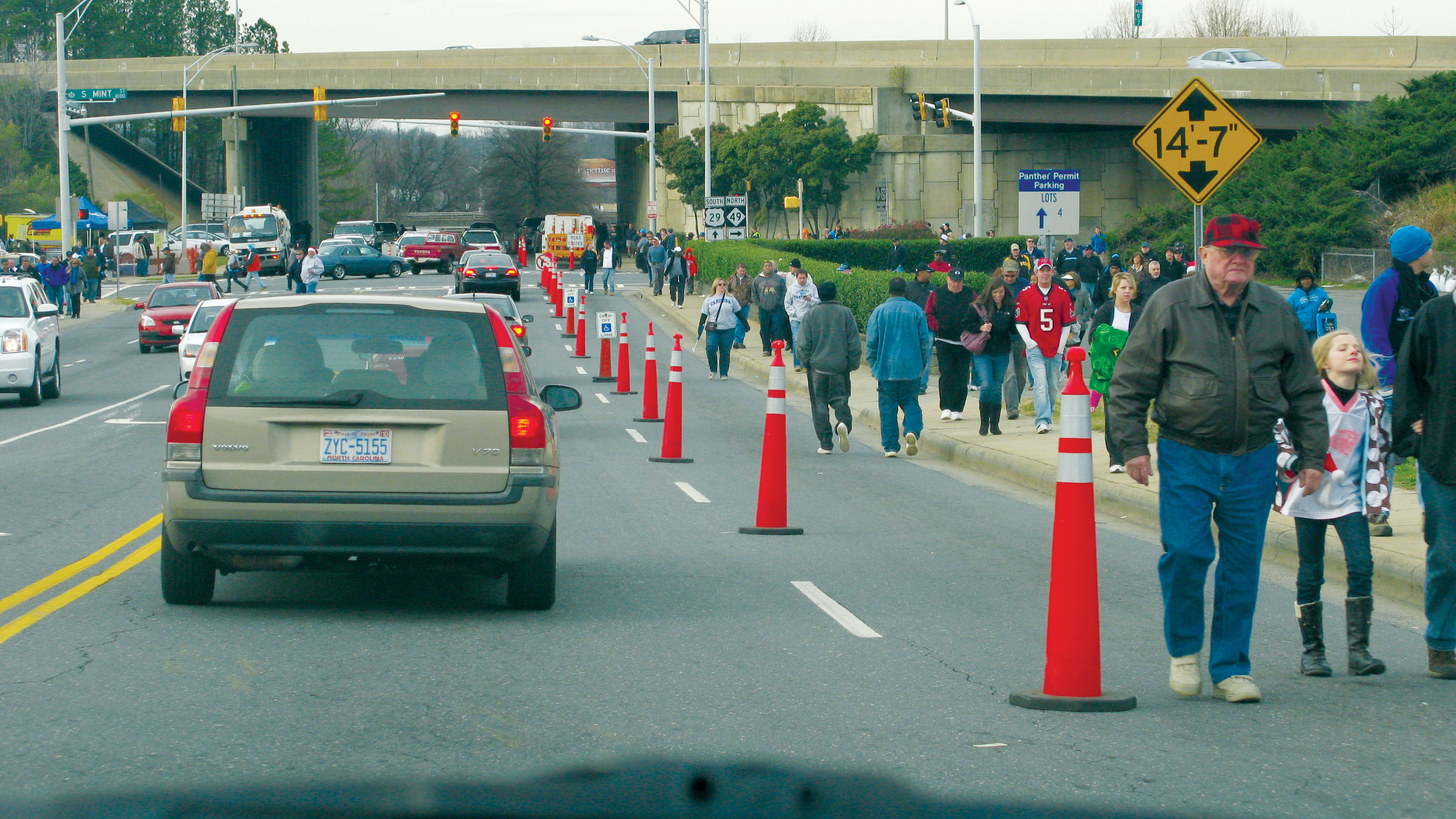
Where pedestrian volumes create congested conditions along sidewalks, cities are encouraged to pursue temporary means to ease overflow from the sidewalk onto the streets. Interim elements, such as epoxied gravel pavements or temporary lane closures, may be able to provide an interim solution until a city can widen the walkway. If special events are anticipated to significantly increase pedestrian traffic, similar strategies should be pursued to ensure pedestrians are not forced into vehicular traffic.
Clear Zones
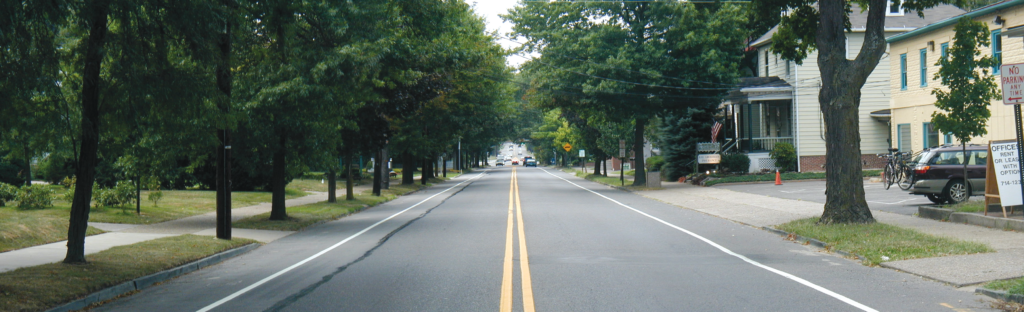
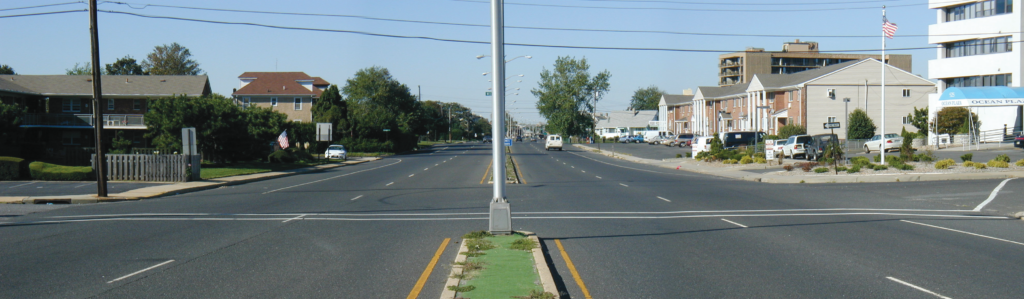
The concept of “clear zones” is sometimes cited in the highway design process. A clear zone represents an unobstructed, traversable area beyond the traveled way, often a paved or planted shoulder or a short setback on the sidewalk.8 Clear zones provide a run-off zone for errant vehicles that have deviated from the main roadway and are intended to decrease the frequency and severity of fixed-object roadside crashes, forgiving driver error.9
While clear zones are applicable as a safety parameter for the Interstate and freeway system, in urban settings, clear zones are not applicable or feasible due to right of-way limitations and potential safety hazards. To the greatest extent possible, the lateral distance between the traveled way and the sidewalk (or parking lane) should be minimized, providing ample space for sidewalks and other amenities.10
Removal of roadside impediments (trees, street furniture, etc.) has an ambiguous safety record in urban environments and is at odds with city policies striving to increase pedestrian traffic and spur economic activity. Street trees and other roadside features are superior to wide shoulders or run-off zones, as they can decrease overall speeds and encourage a more pedestrian friendly environment.
- Examples of higher standards for sidewalks include downtown Washington, D.C. (16 foot + 6 foot buffer), Chicago (varies between 10–12 feet depending on context), San Francisco (9–17 feet depending on context), Boston (target varies, but minimum is 7 feet for several street types). ↩︎
- As an example, Washington, D.C.’s Design Engineering Manual states that a sidewalk should exist on both sides of every street or roadway.
Design and Engineering Manual (Washington, D.C.: D.C. Department of Transportation, 2009): 29–3. ↩︎ - Joe Cortright, Walking the Walk: How Walkability Raises Housing Values in U.S. Cities (Chicago: CEOs for Cities, 2009). ↩︎
- Paul D. Thompson, Kevin M. Ford, Arman Mohammad, Samuel Labi, Arun Shirolé, and Kumares Siuha. NCHRP Report 713: Estimating Life Expectancies of Highway Assets. Volume 1: Guidebook. (Washington, D.C.: Transportation Research Board, 2012). ↩︎
- Federal Highway Administration, “Sidewalk Corridor Width,” Designing Sidewalks and Trails for Access (Washington, D.C.: FHWA, 2001). ↩︎
- According to the American Disabilities Act, the minimum sidewalk width at bus stop loading points should be 8 feet to ensure clear boarding and alighting. The location of a bus shelter, bench, or other permanent fixtures should ensure a 3-foot clear path for pedestrian travel. However, 3 feet is not the recommended width for sidewalks, it is the absolute minimum needed to ensure a clear path of travel when obstacles exist in the sidewalk.
Americans With Disabilities Act of 1990. ↩︎ - “Where sidewalks are placed adjacent to the curb, the widths should be approximately 6 m [2 ft.] wider than the minimum required width. This additional width provides space for roadside hardware and snow storage outside the width needed by pedestrians.”
A Policy on Geometric Design of Highways and Streets, 6th Edition (Washington, D.C.: AASHTO, 2011). ↩︎ - AASHTO’s Roadside Design Guide defines a “clear zone as the total roadside border area, starting at the edge of the traveled way, available for safe use by errant vehicles. This area may consist of a shoulder, a recoverable slope, a non-recoverable slope, and/or a clear run-out area.”
Roadside Design Guide, 4th Edition (Washington, D.C.: AASHTO, 2011). ↩︎ - In urban areas, the presence of fixed roadside objects (such as trees) is correlated with lower crash frequencies. This suggests that roadside objects in urban areas may actually enhance safety (by increasing driver caution and reducing speeds). As referenced in Eric Dumbaugh, “Safe Streets, Livable Streets,” Journal of the American Planning Association 71 (2005): 295. ↩︎
- The AASHTO Green Book suggests a minimum offset distance of 1.5 feet between the face of the curb to the nearest fixed object off the roadway.
A Policy on Geometric Design of Highways and Streets, 6th Edition (Washington, D.C.: AASHTO, 2011). ↩︎