From Our Executive Director
Dear NACTO Community,
This past year has underscored something we all feel: now more than ever, this network matters. At a time when the very idea of government and public service is under attack, the collective impact of the NACTO community has never been more essential.
Every week, I see projects and programs across our member cities and transit agencies that reaffirm the power of this collective. Transformative bus projects are expanding access to opportunity for millions. Vision Zero efforts are turning a corner, with many cities reporting real and measurable drops in traffic deaths. We counted the highest-ever shared micromobility ridership across North America, evidence that people continue to choose sustainable transportation when it’s safe, convenient, and available.
Innovation is flourishing in ways both small and large. From e-bike lending libraries to New York City’s groundbreaking congestion pricing program, cities are meeting this moment with creativity and resolve.
This was also a milestone year for NACTO itself.
We published a brand-new Urban Bikeway Design Guide, traveled the country presenting it, and launched an accompanying national training series that reached practitioners across the U.S. and Canada. Altogether, our training, learning, and peer-exchange programs engaged thousands of planners, engineers, and public servants, deepening skills and strengthening connections that will pay dividends for years to come.
We sharpened our focus on member value, reinvigorating our peer networks and creating new spaces for collaboration—from Transit Tuesdays, to members-only bike-focused trainings, to the more than 100 shared discussion spaces active across 2025. These connections—between peers solving the same problems in different contexts—remain one of the most powerful resources our network provides.
We also continued serving as a strong national voice for cities, ensuring that member agencies have clarity, support, and influence in an ever-shifting federal landscape. From helping practitioners navigate regulatory changes (including the recent seminal MUTCD update), to championing city priorities in critical federal rulemakings, NACTO remained a steady partner advancing safe, sustainable, people-centered streets.
This year also brought other major organizational milestones:
- The launch of a new NACTO.org, making our design guidance, research, and resources more accessible than ever.
- The best Designing Cities conference yet, bringing together practitioners for immersive learning and inspiration across neighborhoods and city streets—showcasing Washington, D.C. beyond the federal government.
- A strengthened emphasis on training and learning, including the graduation of another cohort of Transportation Justice Fellows, and our members-only bike guide training series.
- Continued sustainable membership growth. We were thrilled to welcome new members—including cities like Cleveland and Anchorage, as well as transit agencies like the Toronto Transit Commission—whose expertise, perspectives, and leadership strengthen the entire network of over 100 cities and transit agencies.
Across all of this work, one theme stands out: the NACTO network is strong, and getting stronger. In a year of uncertainty, the commitment of our members—to each other, to learning, and to delivering real results for the people they serve—has been nothing short of inspiring.
As we look ahead, I remain optimistic. Cities have always been the level of government most responsive and accountable to their communities. They innovate from the pavement up. And together we amplify that innovation, share it, and accelerate it.
Thank you for everything you do every day to build safer, more sustainable, and more joyful streets and cities. NACTO is here for you and because of you. I can’t wait to see what we accomplish together in the year ahead.
With gratitude,
Ryan Russo
Executive Director

Convene
NACTO convenings build community among city transportation practitioners and equip thousands of city staff with the resources, information, and skills to build safe, sustainable, and accessible streets.
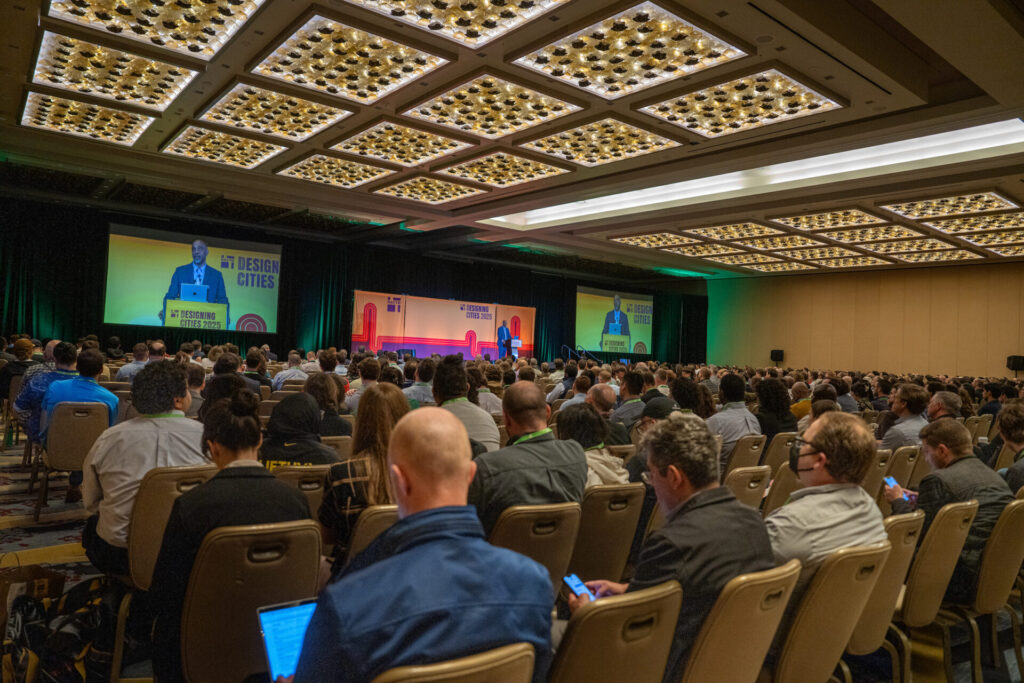
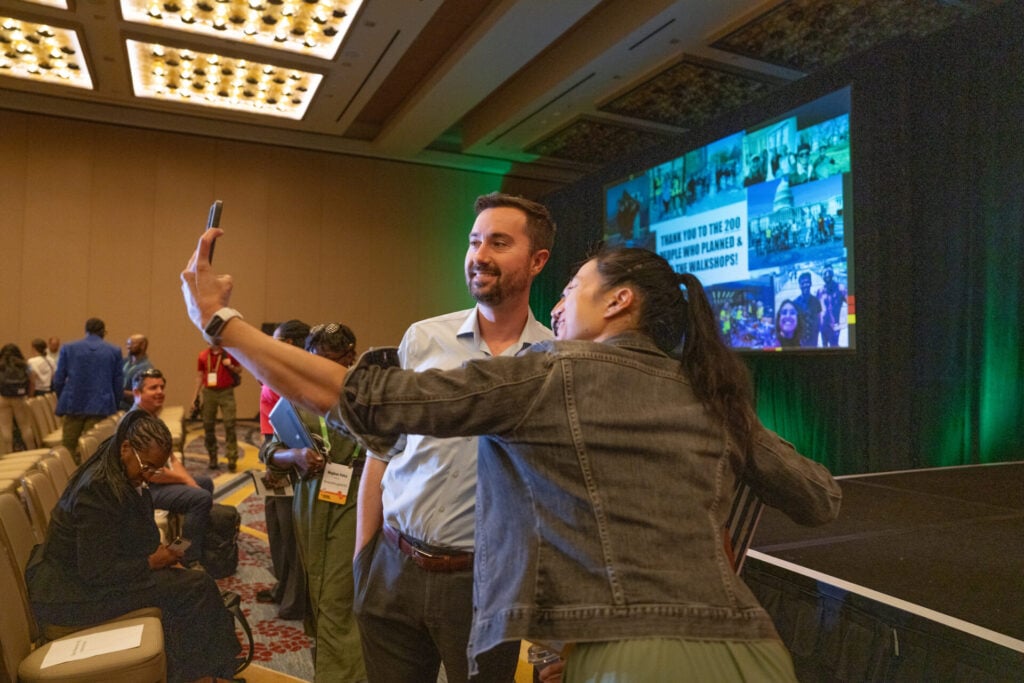
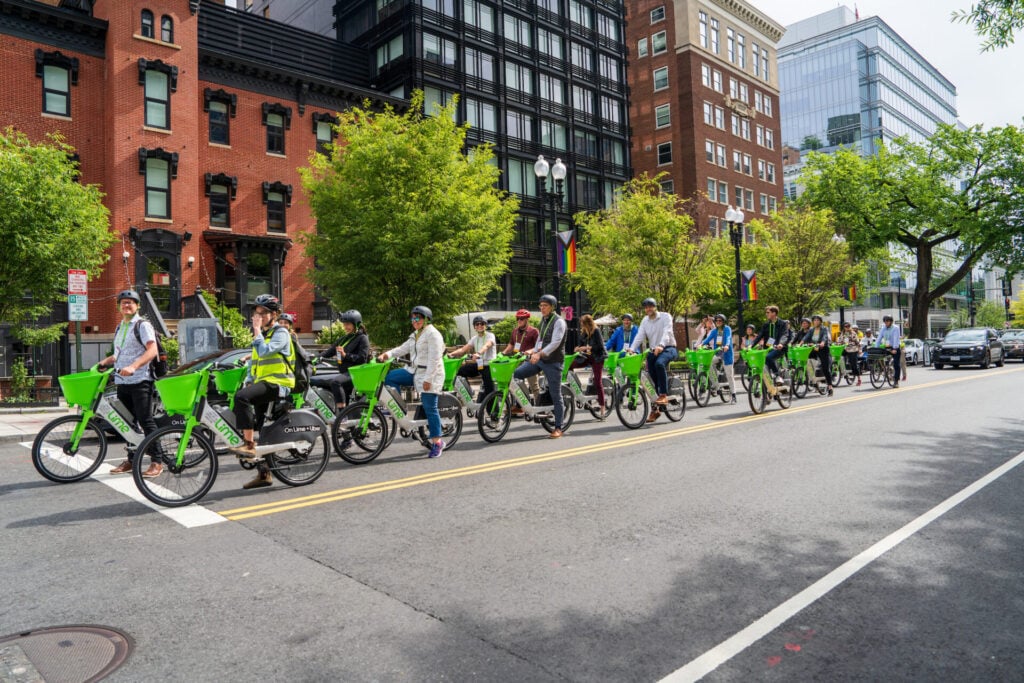
2025 Designing Cities Conference: Washington, D.C.
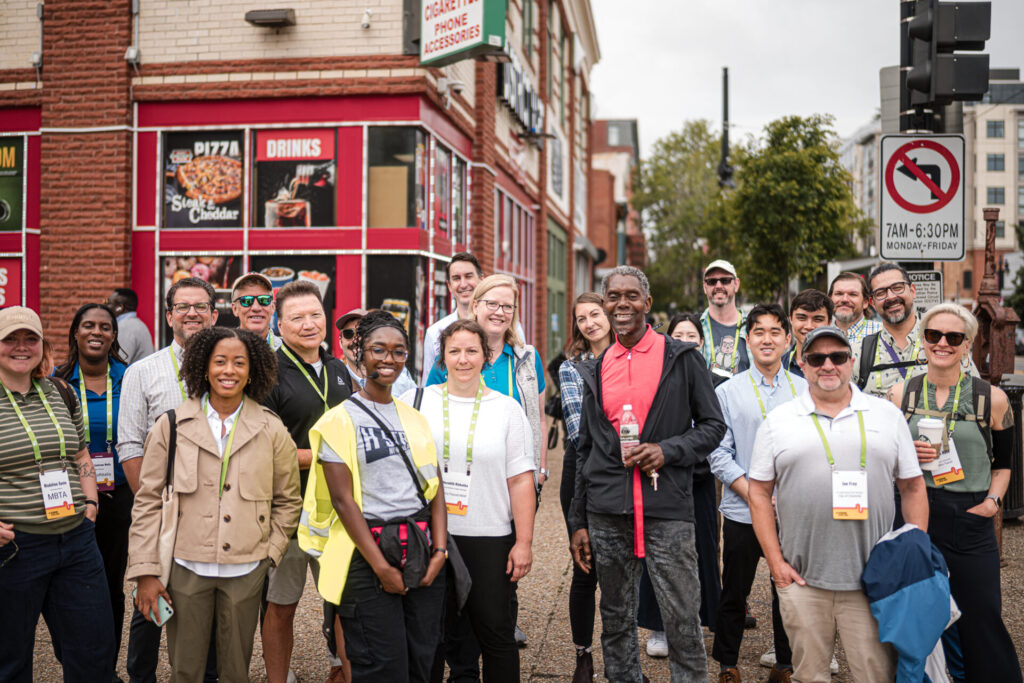
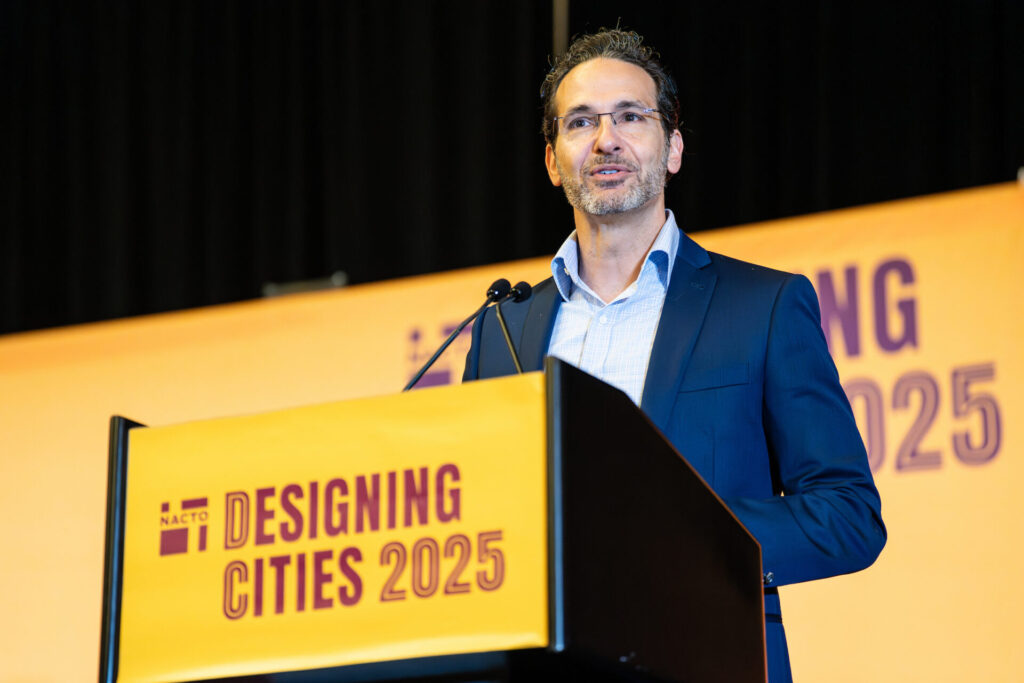
This year, NACTO headed to the nation’s capital for our 13th annual Designing Cities Conference. From May 28 to May 31, over 1,000 city transportation practitioners gathered in Washington, D.C. Learning about the great work happening across North America, forming connections with peers, and touring D.C. reminded us that cities are where the real change happens.
Our co-hosts at the District Department of Transportation (DDOT) worked with NACTO for over a year to plan the conference, including a record number of WalkShops. They also shared their city with us through neighborhood dinners, an opening reception in an old Metro car, and by sharing detailed recommendations for local restaurants and activities.
Some highlights:
- The Designing Cities Conference intentionally centers public sector staff: staff from NACTO member agencies made up 50% of attendees, and another 20% were non-member public-sector workers.
- On almost 100 WalkShops, we explored the D.C. area on foot, bikes, scooters, and transit. We toured some of the District’s 60+ mile trail network, learned about public art initiatives, explored bus priority projects, experienced the region’s growing bike network, heard about community-led projects from grassroots organizers, and much more.
- In 34 peer sessions and roundtables, practitioners shared their knowledge and facilitated discussions on everything from managing constituent requests to continuing bike lanes at bus stops. Two-thirds of our peer session speakers and facilitators were from NACTO member agencies, and nine sessions were planned by member agency staff on the Member Program Committee.
- Three workshops helped attendees build skills in designing bikable intersections, meeting facilitation, and accessible street design. Attendees mingled at our BIPOC breakfast, resilience roundtable, Better Bike Share Partnership roundtable, and NACTO peer network meetups.
- Our inspiring plenary speakers—including DC-area transportation department heads and Charles T. Brown, founder and CEO of Equitable Cities—challenged us to make streets safer and more accessible for all.
- And almost 50 sponsors made it all possible. Thank you.
Meet the Cities
At the Designing Cities Conference, 45 member cities and agencies participated in Meet the Cities and shared a poster about a project or program. Conference attendees had a chance to connect with presenters and hear about successes and lessons learned for transformative change.
NACTO reprised Meet the Cities online over the summer, when 33 member agencies presented their projects again. Over five sessions, we welcomed members to ask questions about each other’s projects and hear the latest updates.
Federal Grants Working Group
Due to the Trump administration’s policy changes, NACTO’s federal grants working group became a crucial space for candid conversation in 2025. At monthly meetings, the working group discussed discretionary grants awarded by the U.S. Department of Transportation and other federal agencies and informed NACTO’s federal funding advocacy. The group discussed and documented challenges related to inflation, grant freezes, slow communications about already-granted funds, and regulation changes.
Curb Management Roundtable
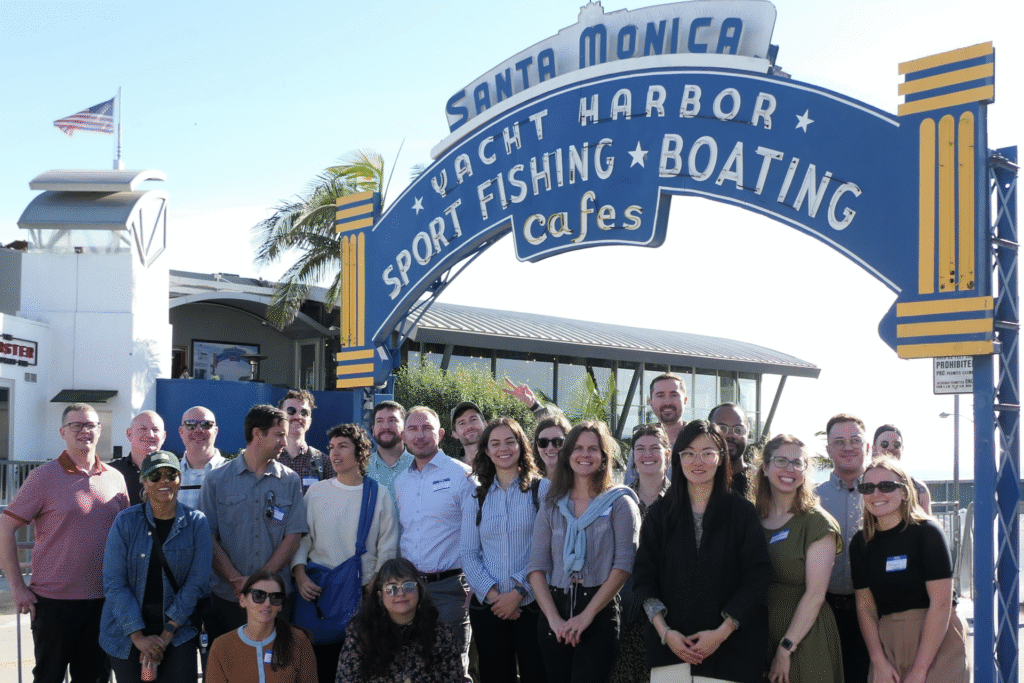
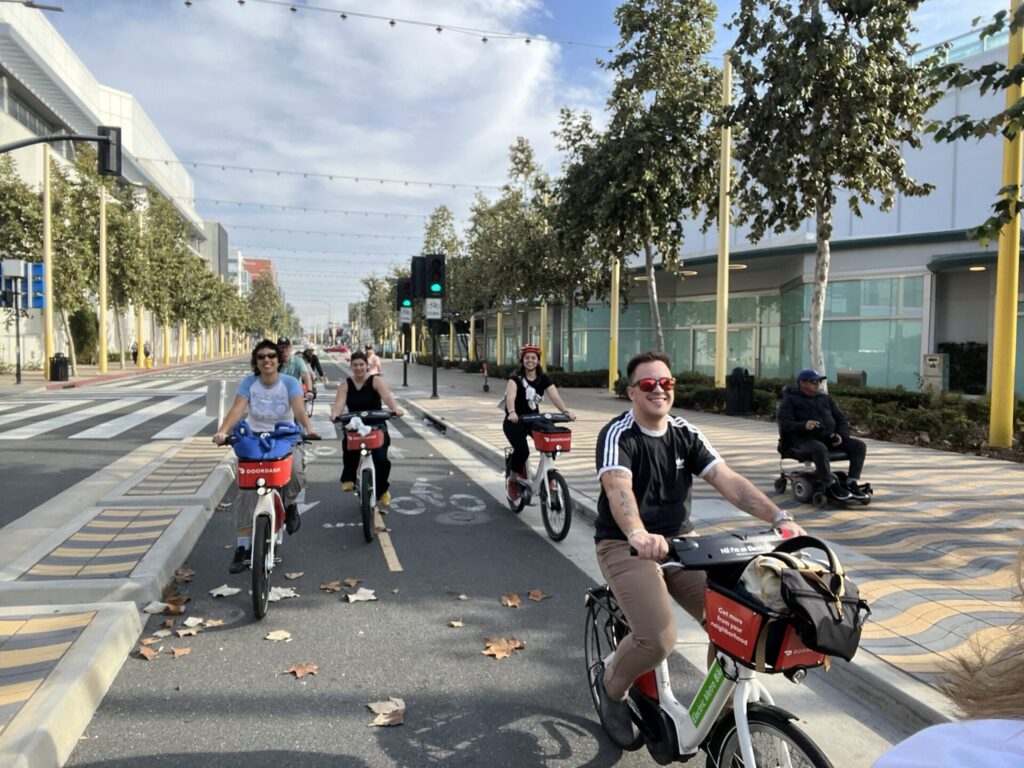
In November, NACTO convened the Best Practices at the Curb working group in Santa Monica, California, for a roundtable. Planning, design, and policy leads from 12 member agencies worked together to define curb access needs, discuss curb lane design, share regulation strategies, consider data management approaches, and discuss the disconnects between land use development and curb management.
Collaborate
NACTO helped our members form peer-to-peer connections, build professional skills, spread ideas, and advocate for city-friendly design standards.

NACTO Peer Networks and Working Groups
NACTO’s peer networks connect member agency staff working on similar issues. Organized around specific topics and areas of interest, the 10 peer networks elevate members’ skills through peer learning, resource-sharing, and intentional connections. We convene working groups within the peer networks, bringing together smaller groups of practitioners to support a specific workstream or help develop a new NACTO publication.
In 2025, NACTO recruited member staff to plan and lead regular conversations for four of our peer networks. Thanks to the member staff who have organized thought—and conversation–provoking discussions on emerging technology, public realm design, Vision Zero, and shared micromobility.
NACTO also launched two new peer networks and one new working group.
- The new Strategizing for Success peer network supports our members’ operational needs and includes discussions on working more effectively with their communities, supporting their staff, and delivering on needed projects.
- The new Curb Management peer network connects staff across NACTO member agencies working to change how the curb is used in their cities.
- The Best Practices at the Curb working group has met monthly, beginning in July, to guide NACTO’s curb management products and programs.
In 2025, we held 81 peer network and working group meetings and hosted 23 other discussion spaces addressing members’ areas of interest.
National Standards Committee
NACTO’s National Standards Committee working group meets monthly to review, comment on, and propose changes to national design and engineering standards. For the first time this year, NACTO also led two subcommittees to engage city transportation engineers on specific topics and make recommendations to the full committee:
- The Transit Pavement Markings and Signal Heads subcommittee documented issues with the current Manual on Uniform Traffic Control Devices (MUTCD) language regarding the use of red pavement for transit. They explained the problems cities face because of the language, how they are finding workarounds, and identified potential language changes to the MUTCD.
- The Bike Signals and Guiding Signs subcommittee focuses on supporting the contextual use of bike signals. The group developed materials to help explain issues with the current MUTCD.
Transit Tuesdays
Between July and October, NACTO hosted a seven-part virtual series to explore the latest in city transit work in our member cities and agencies. The Transit Tuesdays series featured discussions on bus stop accessibility, interagency collaboration, transit street design, network planning, and transit funding.
Transportation Justice Fellowship
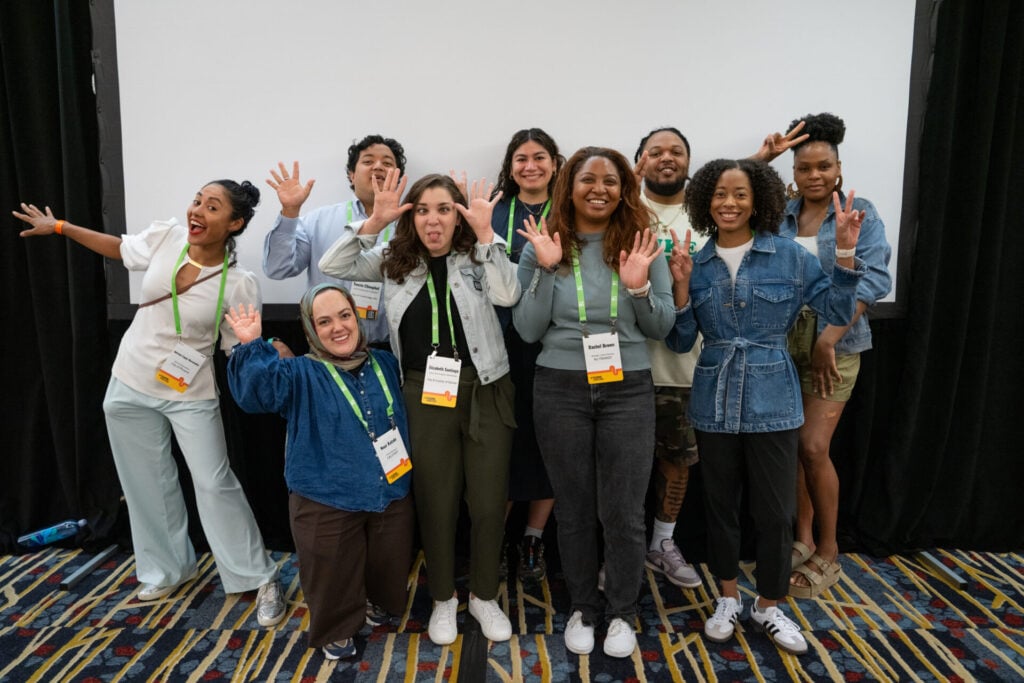
The fourth cohort of the Transportation Justice Fellowship ran from November 2024 to June 2025 and included 11 fellows whose backgrounds and skill sets reflect the diverse communities we aim to serve. The fellowship, organized by NACTO as part of the Better Bike Share Partnership (BBSP), builds community and skills among early- and mid-career people of color working to embed mobility justice in transportation.
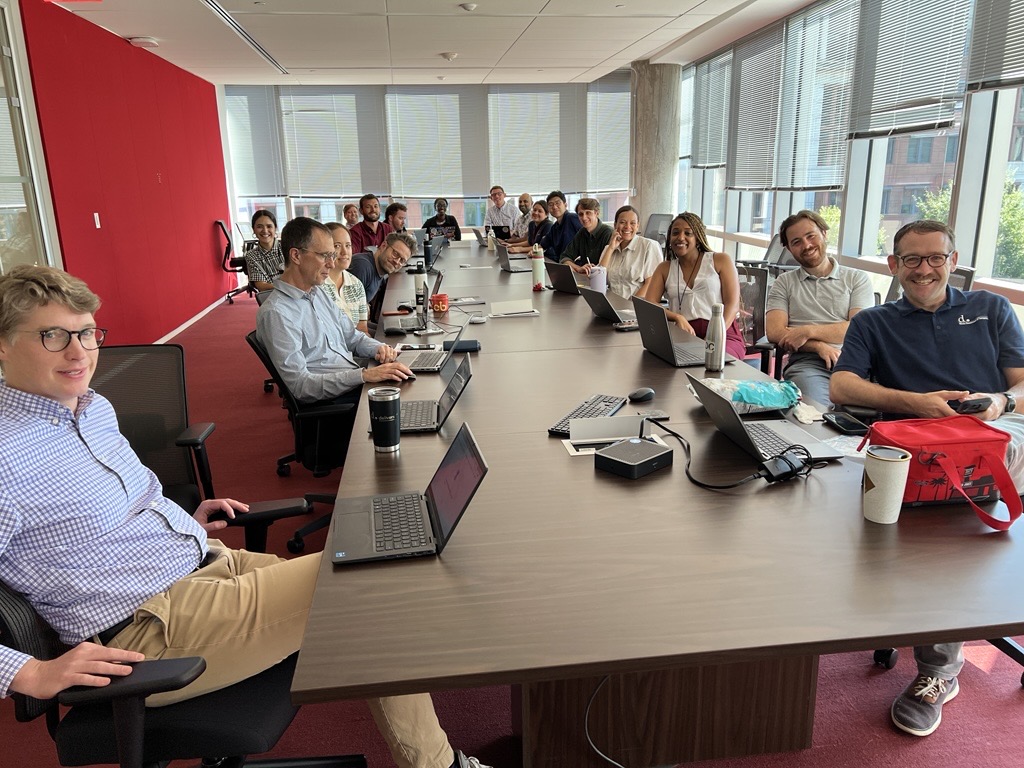
During their time in the fellowship, fellows met regularly for skills-building sessions, one-on-one coaching, special trainer visits, and structured collaboration. All 11 fellows attended this year’s Designing Cities Conference in Washington, D.C. At the annual BBSP Shared Micromobility Roundtable at Designing Cities, fellows presented research projects focused on integrating shared micromobility and transit, community engagement through educational programming and community ambassador programs, and adaptive bike share.
Curate
NACTO turns our members’ common questions, as well as their expertise, into resources for cities. This year, we released the third edition of the Urban Bikeway Design Guide and Urban Delivery by Bike.



Urban Bikeway Design Guide
In January, NACTO launched the newly revised third edition of the seminal Urban Bikeway Design Guide, updated for the first time in a decade.
The new edition includes detailed policy, planning, and project development guidance to ensure connected bikeable streets become standard practice. With more detailed technical guidance than previous editions, the Guide points the way for cities to plan and implement bike networks that account for the many different types of people and vehicles who may be using the street.
Island Press, the book’s publisher, has sold over 2,300 copies and has already reprinted the book, exceeding their expectations for a third edition.
UBDG on the Road
We celebrated the release of the Urban Bikeway Design Guide at a book launch party on January 7 in Washington, D.C. Hundreds of attendees saw exclusive pre-release copies of the book, celebrated members’ growing bike networks, and took home bike-themed stickers and branded bike seat covers.
Other organizations invited NACTO staff to speak about the Guide at trainings, workshops, conference sessions, and webinars, including the Safe Streets Summit, Active Transportation Program Symposium, National Bike Summit, TRB’s International Conference on Roundabouts and Geometric Design, AASHTO’s June Technical Committee on Nonmotorized Transportation, and events hosted by the Association of Pedestrian and Bicycle Professionals (APBP), Center for Pedestrian and Bicyclist Safety, Transportation Research Board, and UCLA Institute of Transportation.
We also weaved the bike guide into many conversations at the Designing Cities Conference, including a workshop on designing bikeable intersections, a peer session on continuing bike lanes at bus stops, and two opportunities to attend a session on how to practically apply the Guide in a real-world context.
UBDG Online
NACTO promoted the Urban Bikeway Design Guide by releasing a series of 10 excerpts on our blog in April and May. At the end of May, we released a full online version of the Guide, allowing everyone to access the information wherever they have access to the Internet. The web version has over 125,000 page views since launch. The most popular page? Designing Protected Bike Lanes.
UBDG in the Headlines
- A Blueprint for Better Bike Lanes – Bloomberg CityLab, January 10
- New from NACTO: Here’s How Your City Can Embrace Biking – Streetsblog, January 9
- 8 Keys to Transforming a City’s Mobility Infrastructure – Next City, February 12
- New Urban Cycling Guide To Help Cities Design Safer, Bikeable Streets – Forbes, January 31
- NACTO Releases Updated Urban Bikeway Guide – Planetizen, January 8
- The Dutch Intersection Is Coming to Save Your Life – Bloomberg CityLab, July 15
- Introducing NACTO and the New Urban Bikeway Design Guide – Active Towns Podcast, March 14
- Designing and Delivering Bike Networks – Talking Headways Podcast, August 21
- Bike Guides to Build Your City, Talking Headways Podcast, May 29
UBDG Training Series
This fall, NACTO members had an exclusive opportunity to take a deep dive into the Urban Bikeway Design Guide with an online training series on applying the new Guide to their cities—from building a successful bike program to making streets fully accessible to all.
At five trainings, staff from NACTO member agencies received chapter-by-chapter insights into the Guide’s design principles and tools. At 10 related workshops—two small-group conversations for each training—attendees applied these principles in real-world contexts.
The trainings and workshops were grounded in real-world examples and challenges, featuring dozens of project examples from member cities and 10 speakers from across our membership.
Across the online series, NACTO counted almost 700 unique registrants from 91 member agencies, with many attending in groups from city conference rooms.
Urban Delivery by Bike
As demand for urban deliveries soars, city governments are facing increasing pressure to reduce congestion, improve air quality, and create safer streets. In June, NACTO released a practitioner paper, Urban Delivery by Bike, that offers practical guidance to addressing this issue by supporting bike deliveries.
Urban Delivery by Bike is designed to help city staff tailor their approach to local conditions—whether that’s helping out interested local businesses, incentivizing a switch to bike delivery, understanding regulatory barriers, or building out the right infrastructure.
NACTO discussed the paper at a Designing Cities session in May, a July webinar, and a September webinar in partnership with UL Standards & Engagement.
Communicate
NACTO strengthens the presence of cities in national transportation conversations. We promote their voices in the media, educate the general public about transportation issues, and comment on and shape federal and state regulations.
A New NACTO.org
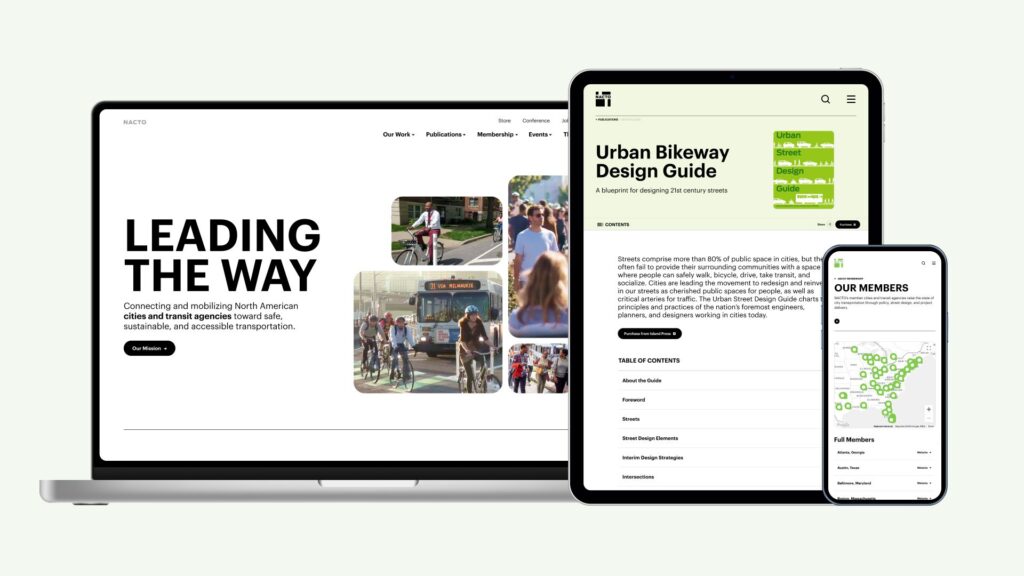
NACTO’s website is a major influence in the transportation industry. In 2024, half a million people accessed guidance and other content on NACTO.org. And in 2025, we completely overhauled it—making our information and guidance more easily accessible, and reflecting how the field has changed in the decade since we last redesigned our website.
From simpler navigation to a cleaner display of our design guides to an easier search for our events, we’re gratified by the response to the new site: More than one million page views to NACTO’s guidance, programs, information, and events across 2025. Thank you!
Speaking Up for Safety
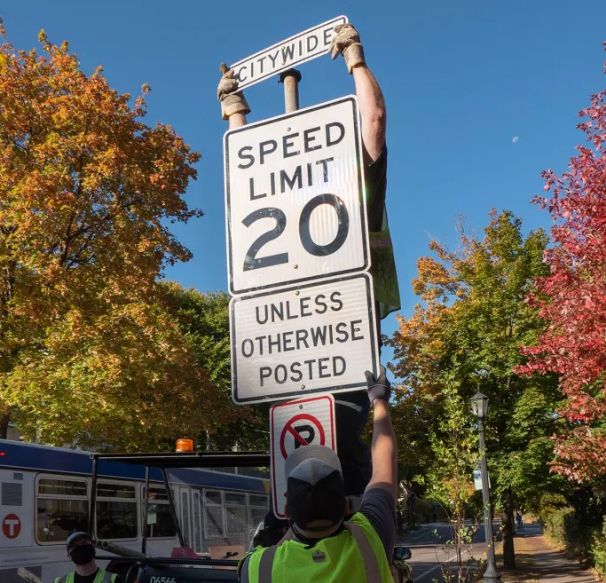
NACTO continued to speak up for safety, with significant news hits in places like the Associated Press (syndicated to hundreds of outlets) on topics including speed limit setting, automated traffic enforcement, autonomous vehicle safety standards, and more.
Headline Highlights
- States rethink a long-held practice of setting speed limits based on how fast drivers travel – Associated Press
- Are speed limits on the rise? As states OK 80 mph on highways, cities say ’20 is plenty’ – USA Today
- How Pedestrian and Cyclist Deaths Have Reached a 40-Year High – Prevention Magazine
- Should a self-driving car have to pass a test? – Detroit Free Press
- All Hail the Humble Speed Hump – Bloomberg CityLab
- A Bright Idea for Road Safety: Traffic Light Timing – Bloomberg CityLab
- Automated Traffic Enforcement Is More Popular Than You Think – Bloomberg CityLab
Sharing Priorities with U.S. DOT
Throughout the year, NACTO advocated for city priorities to the U.S. Department of Transportation, drawing on our federal policy platform and advocating for the needs of our members in different states and regions across the country.
- Capital Investment Grants: In September, NACTO submitted suggestions for improvements to the way that the Federal Transit Administration chooses agencies for Capital Investment Grant (CIG) funding and holds grantees accountable for success. The CIG program helps transit agencies fund big projects, but NACTO’s comments pointed out that the money often comes with unnecessary bureaucratic barriers and red tape.
- Reauthorization: In August, NACTO submitted a letter to U.S. DOT naming specific opportunities in the upcoming surface transportation reauthorization to increase local agencies’ impact and accelerate project delivery.
- Autonomous Vehicles: In March, NACTO submitted a letter to the National Highway Traffic Safety Administration emphasizing the critical need for strong local oversight and greater transparency in the federal government’s framework for overseeing autonomous vehicles. In September, we weighed in on the city-informed research activities needed to support the nationwide deployment of autonomous vehicles.
- National Environmental Policy Act Regulations: In March, the White House Council on Environmental Quality (CEQ) announced an interim final rule revoking all CEQ National Environmental Policy Act regulations. This move didn’t remove the requirement that agencies consider environmental factors: it just removed standardized guidance for doing so. NACTO commented that the changes will cause project delay, confusion, and uncertainty.
Correcting the Record
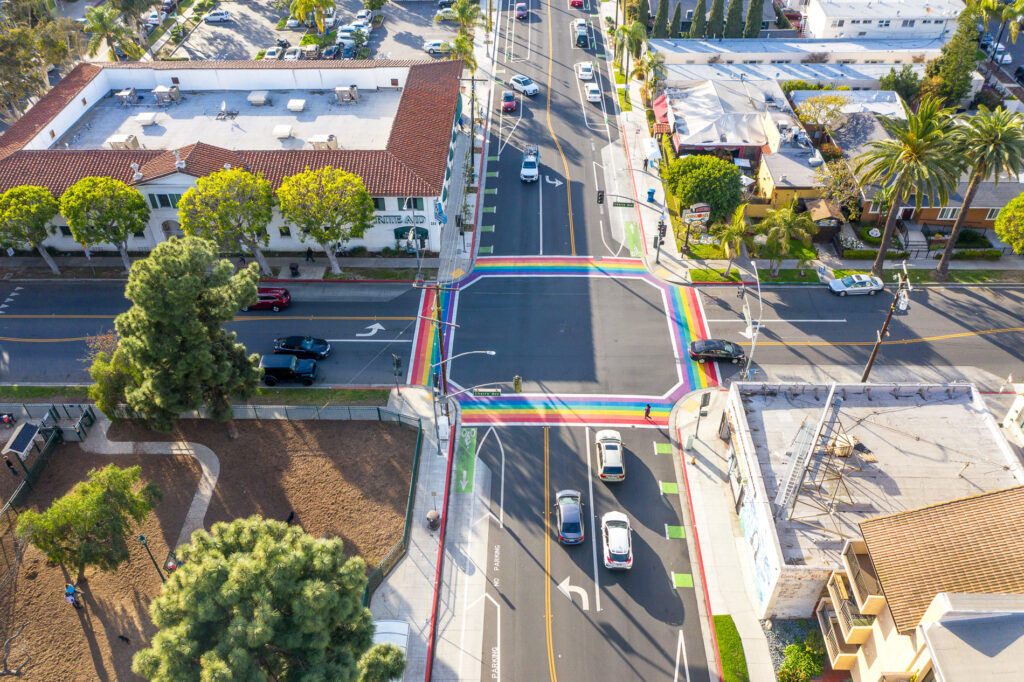
In 2025, cities found themselves on the defense in many ways. The federal government cut budgets, cancelled grants, and questioned—and in some cases ordered the removal of—proven asphalt art treatments.
NACTO served as a voice to correct the record. Cities are efficiently using federal grant funding to deliver for their residents. Asphalt art brings a sense of place and community, and is an effective safety treatment on streets.
Headline Highlights
- Purging ‘Equity’ Programs, G.O.P. Defunded Its Own Roads – New York Times
- As Florida covers it up, study says pavement art improves safety – Spectrum News
- Houston’s Pride crosswalk comes under attack – Houston Chronicle
Cultivate
NACTO made improvements to our internal capacity—providing our staff with the tangible resources, protocols, systems, and strategies necessary for success.

Internal Communications Norms
Clear internal communications norms and purposeful communication practices are key to ensuring the NACTO team works together effectively, stays aligned as a team, and serves members. We updated our documented internal communications norms to strengthen how we communicate with one another on a staff level. The document includes overall best practices as well as guidelines for the various digital platforms NACTO uses.
Community Principles for Events
This fall, we updated our NACTO Events Community Principles to outline NACTO’s expectations for people engaging with our events and help keep all participants accountable to our shared values. The principles underscore NACTO’s commitment to creating an engaging, inclusive, supportive, and productive atmosphere for our forums and events – both virtual and in-person.
Overhauled Visual and Written Style Guides
An organization’s voice and identity lend it credibility. This year, the communications team overhauled NACTO’s visual and written style guides, providing NACTO staff and partners with clear, accessible guidance on how to produce visuals and written materials that reflect our organization’s authoritative, trusted, and human-centered voice.
NACTO in 2025

NACTO’s Network
NACTO’s 100+ member cities and transit agencies raise the state of city transportation through policy, street design, and project delivery.
In 2025, NACTO debuted a new, cohort-based model for new members. This approach simplifies the application process for potential new members, allows NACTO to streamline onboarding, and provides opportunities for new members to form connections with each other.
This year, NACTO gained 11 new members whose work is demonstrating their commitment to NACTO’s values:
- Anchorage, Alaska, recently launched a Neighborhood Greenways program and is expanding Vision Zero efforts by hiring a dedicated Vision Zero coordinator.
- Belgrade, Montana, released a comprehensive safety action plan and is rapidly deploying quick build demonstration projects to better connect its downtown core with surrounding residential neighborhoods.
- Cleveland, Ohio, adopted the ambitious Cleveland Moves transportation plan, which includes plans to build 50 miles of high-comfort bikeways in three years.
- Decatur, Georgia’s Safe Streets Safety Action Plan aims to enhance roadway safety for all users and eliminate traffic fatalities.
- Mesa, Arizona’s 2050 Transportation Master Plan maps out plans for comprehensive bike and pedestrian networks, and its Comprehensive Safety Action Plan identifies specific strategies and projects to reduce transportation-related fatalities and serious injuries.
- New Braunfels, Texas, adopted a Street Safety Action Plan in 2024 and is working on a Bicycle and Pedestrian Network Plan, which identifies projects to improve connectivity.
- Redmond, Washington, adopted a comprehensive safety action plan and is working on three recommended projects from that plan: conducting a citywide speed reduction study, making pedestrian safety improvements along a key multilane transit corridor, and launching a speed safety camera pilot program.
- The Jacksonville Transportation Authority is advancing multimodal infrastructure and autonomous mobility in northeast Florida, ensuring that more communities have safe, reliable, and convenient mobility options.
- The Montgomery County (MD) Department of Transportation is advancing multiple BRT corridors, building out a low-stress bike network, and continuing its nationally-recognized work in accessible design.
- The Spokane Transit Authority is planning a new bus rapid transit project in the region’s busiest corridor.
- The Toronto Transit Commission—the third-largest transit agency in North America—is implementing transit priority measures through its RapidTO initiative, including bus priority lanes and transit signal priority.
Board of Directors
NACTO welcomed two new board members this year: Kelly Scocco and Millicent D. Williams joined the NACTO Board in March. At the same time, Brad Rawson was unanimously re-elected.
- NACTO Secretary Kelly Scocco leads the City of Columbus Department of Public Service, its five divisions, and major transportation initiatives while managing 700+ employees and operating and capital budgets of $275 million, plus an additional $270 million in grant funds.
- NACTO Treasurer Millicent D. Williams is the director of the Portland Bureau of Transportation. Her passion is connecting with and serving local communities, demonstrating how their government can (and does) work to serve their interests.
Board
Janette Sadik-Khan, Chair
Principal, Bloomberg Associates
Michael Carroll, President
Deputy Director for Transportation and Infrastructure, Philadelphia
Laura Rubio-Cornejo, Vice President
General Manager, Los Angeles Department of Transportation
Kelly Scocco, Secretary
Director, Columbus Department of Public Service
Millicent D. Williams, Treasurer
Director, Portland Bureau of Transportation
Brad Rawson, Affiliate Member Representative
Director of Mobility, Somerville Mayor’s Office of Strategic Planning and Community Development
Staff
Welcome, New Staff!
NACTO welcomed two new staff members to our organization this year:
- Charity Hilliman (she/her) joined the NACTO team in September as the new engagement program associate. In her role, she strengthens connections across NACTO’s member network and supports members. Charity’s career has focused on building stakeholder relationships, strengthening partner networks, and designing processes that expand organizational capacity and impact.
- Sophia Benner (she/her) joined us in August as our new senior manager of multimodal design and programs. Her role includes developing design guidance, supporting member networks, and facilitating policy and practice-related workshops. Before joining NACTO, Sophia worked for the City of Austin, initially on the Active Transportation team and later on the Urban Design team.
Staff
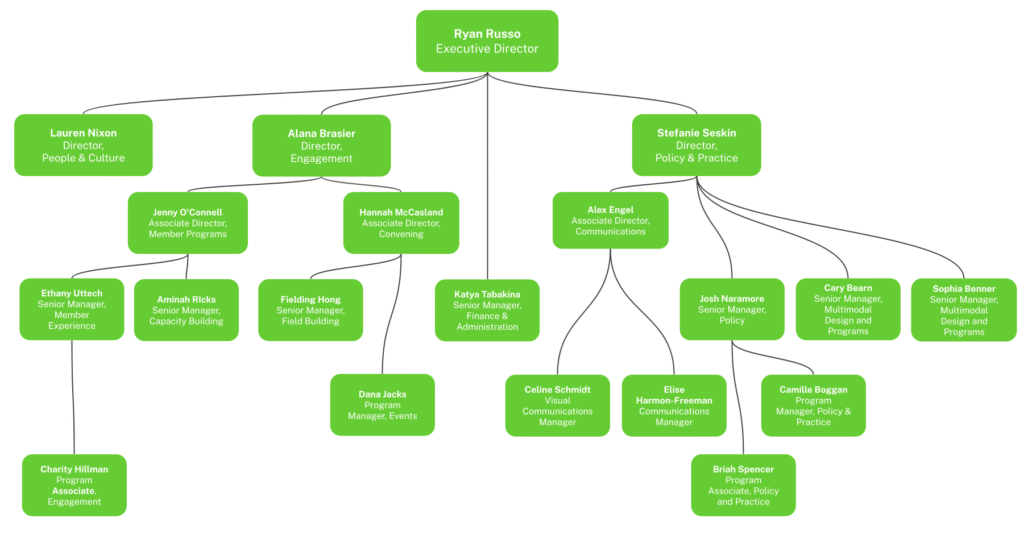
Ryan Russo: Executive Director
Alana Brasier: Director of Engagement
Lauren Nixon: Director of People and Culture
Stefanie Seskin: Director of Policy and Practice
Alex Engel: Associate Director, Communications
Aminah Ricks: Senior Manager, Capacity Building
Briah Spencer: Program Associate, Policy and Practice
Camille Boggan: Program Manager, Policy and Practice
Cary Bearn: Senior Manager, Multimodal Design and Programs
Celine Schmidt: Visual Communications Manager
Charity Hilliman: Program Associate, Engagement
Dana Jacks: Program Manager, Events
Elise Harmon-Freeman: Program Manager, Communications
Ethany Uttech: Senior Manager, Member Experience
Fielding Hong: Senior Manager, Field Building
Hannah McCasland: Associate Director, Convening
Jenny O’Connell: Associate Director, Member Programs
Josh Naramore: Senior Program Manager, Policy
Sophia Benner: Senior Manager, Multimodal Design and Programs
Katya Tabakina: Senior Manager, Finance and Administration
Organizational Chart
Financials
