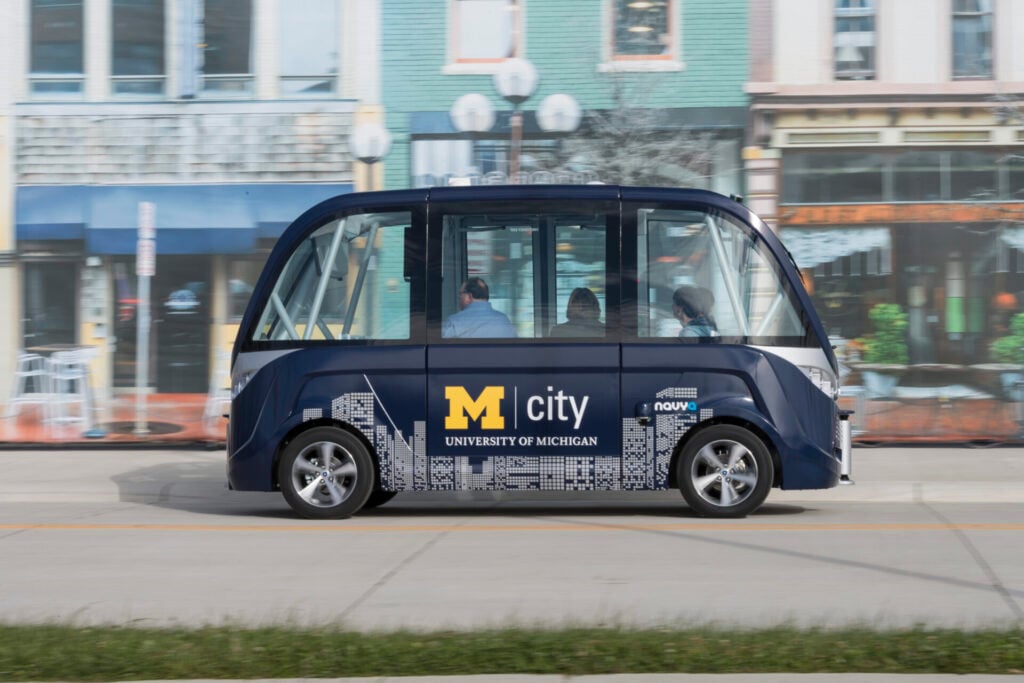
As private companies deploy more and more autonomous vehicles (AVs) on U.S. streets, safety remains a top priority for cities and their residents. That’s why NACTO is emphasizing the critical need for strong local oversight and greater transparency in the federal government’s framework for overseeing vehicles equipped with automated driving systems (ADS).
The U.S. Department of Transportation’s National Highway Traffic Safety Administration (NHTSA) has proposed a voluntary national framework to oversee and evaluate AVs. This proposal, the “ADS-equipped Vehicle Safety, Transparency, and Evaluation Program” (AV STEP), would establish a voluntary review and reporting framework for ADS-equipped vehicles.
NACTO recently reviewed the proposal and submitted comments in response to NHTSA’s Notice of Proposed Rulemaking. Here’s what we found:
Key Points of the Proposed AV STEP
AV STEP would be open to companies that operate (or plan to operate) AVs on public roads. Many vehicles equipped with ADS require exemptions from federal motor vehicle safety standards because of their designs, and AV STEP would allow NHTSA to issue more exemptions, allowing AVs without traditional controls like pedals and steering wheels. NHTSA is promising “an exemption pathway that is tailored for ADS-equipped vehicles,” suggesting a less onerous, time-consuming process for the release of fully driverless vehicles. In exchange for this streamlined exemption process, the agency is requesting more data from the companies that operate driverless cars, arguing that greater transparency is needed to foster public trust in the technology.
NACTO’s Perspective: Local Involvement and Transparency is Key
On March 17, NACTO submitted a comment letter to the federal register.
Highlights from our comments:
AV safety is not a given: NACTO applauds NHTSA’s acknowledgment that AV safety is not a given: regulation and oversight are key to ensuring safety on our streets.
Enhanced reporting requirements: NACTO supports the enhanced reporting requirements in the proposed rule, which include reporting on how many AVs companies are deploying on city streets, where vehicles are operating, how many rely on fallback drivers, and how many traffic violations AVs commit.
Safety standard exemptions should further the public interest: NACTO also supports the requirement that companies seeking federal motor vehicle safety standard exemptions involving commercial activity must demonstrate how the claimed purpose furthers a public interest rather than a purely private one.
Concerns over industry oversight: NACTO raised concerns about the proposed rule’s process for the voluntary review and reporting framework. As written, AV STEP allows the industry near-complete oversight of vehicle design, deployment, operations, and the definition of “safety.” This would leave consumers, riders, and the general traveling public in the dark about key safety issues. NACTO advocates for local government involvement in the review process for safety exemptions. City officials are the figures most often held accountable for traffic safety and should be deeply involved in reviewing and reporting participating vehicles.
The Role of Cities in AV Regulation
Residents experiencing the impacts of AVs on city streets often turn to their local leaders – but cities are often left out of key decisions when it comes to regulating and deploying the new technology. NACTO’s November 2024 Principles for Autonomous Vehicles on City Streets outlines the specific ways that cities must inform and shepherd the deployment of AVs. Developing clear and consistent standards and a level playing field for AV companies goes beyond the involvement of federal, state, and private industry. The most effective regulation will come from the input of cities that regularly experience operational and implementation impacts since vehicles operating on city streets raise unique local concerns.
It’s in everyone’s interest—from the family heading to soccer practice to the American automotive industry—that the best and safest technologies are on the market. As AV technology develops, NACTO and our member cities look forward to engaging in the conversation with NHTSA and private companies to ensure that safety stays at the forefront of decision-making and that cities’ needs are represented.
Photo Credit: Photo by Daniel Ramirez