
Credit: Province of British Columbia, Flickr
Types of Deliveries
From a logistics perspective, there are two categories of deliveries conducted by bike: parcel delivery and on-demand delivery.

Parcel Delivery
Parcel delivery is the delivery of multiple parcels along a single route. The delivery rider typically loads a large number of goods from one location and delivers the packages to multiple locations on each trip.
Parcel deliveries include:
- Last-mile deliveries (e.g., online shopping)
- Local business-to-business deliveries (e.g., from a flower distributor to a florist)
- Local deliveries ordered directly from a store or business (e.g., groceries, laundry)
On-Demand Delivery
On-demand delivery is the delivery of a relatively small amount of goods ordered through an on-demand service. The delivery rider makes frequent trips to and from a business or store and typically delivers to only one or two destinations on each trip.
On-demand deliveries include:
- Local deliveries that are ordered directly or through a third-party application, typically within an hour or less (e.g., meals, pharmacy orders)
Delivery Stages
Delivering goods by bike includes three distinct stages:
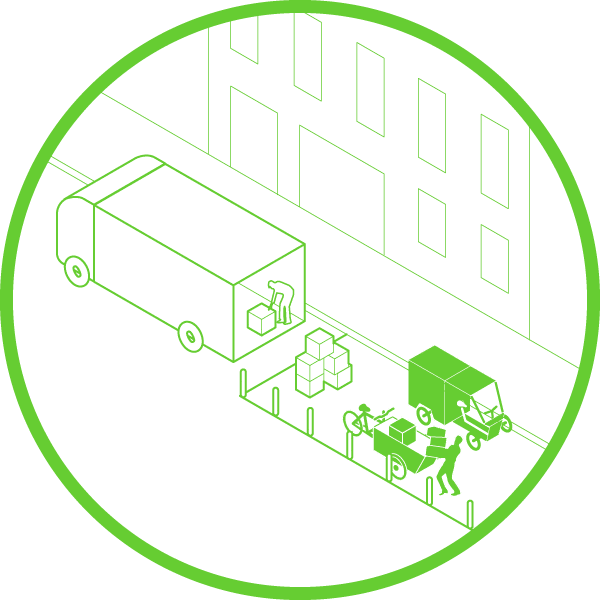
Loading Logistics
Putting the right package on the right bike.
- For parcel deliveries where packages are transferred from a truck, companies use a staging area, often formalized as a microhub.
- For on-demand deliveries, this will typically be done in front of a store.
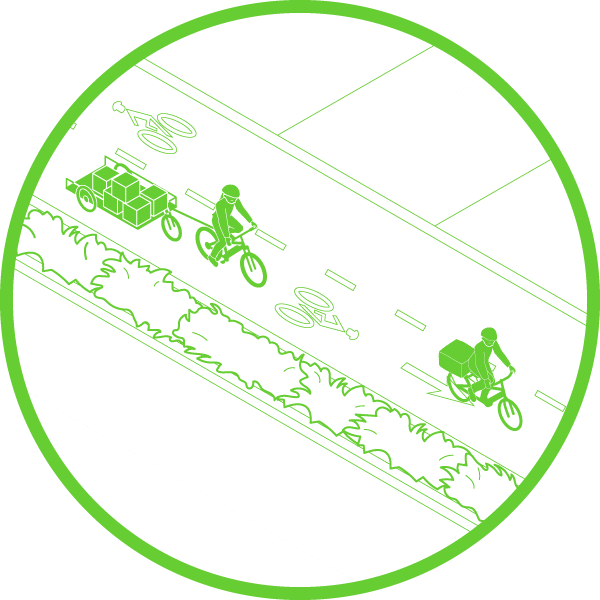
Transportation
Riding the bike to move the package to the destination.
- Encouraging widespread delivery by bike requires cities to invest in a connected, safe bike network designed to accommodate larger bicycles.
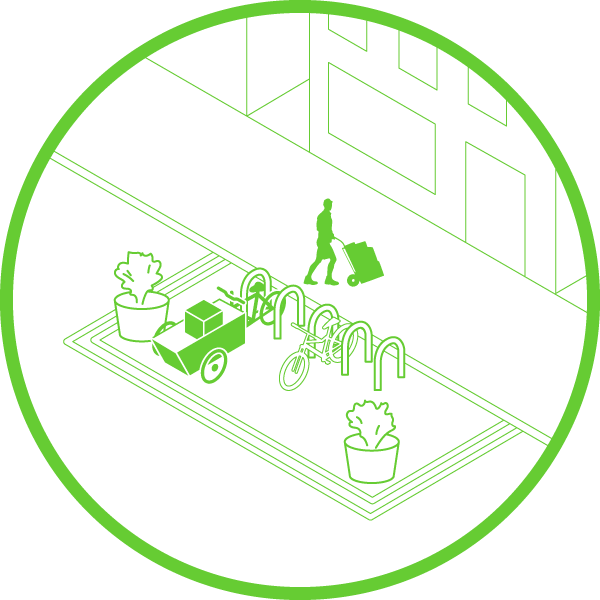
Parking and Final Delivery
Parking and delivering the final package.
- Typically, the operator parks close to the delivery destination and this is a short stop.
- Periodically, the operator may need to take additional time to reorganize parcels.
- Bike parking infrastructure should accommodate wider and longer bikes; typical bike rack spacing and types might not be appropriate.
Types of Bikes
Bikes used for urban delivery vary in width, length, and weight, and are typically, but not always, electric. Although any bike can be used for either parcel or on-demand deliveries, there are some common trends.
Parcel delivery riders often use large bikes with more carrying capacity:
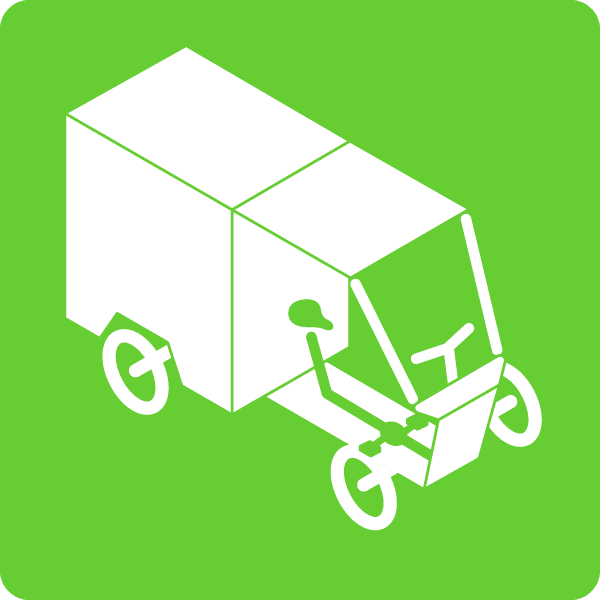
Quad bike
Four-wheeled electric-assist bike with an enclosed rear cab.
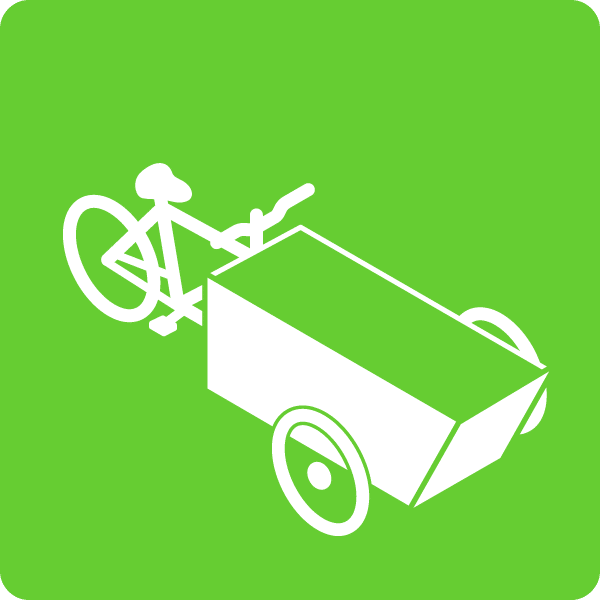
Cargo bike
Two- or three-wheeled bike, typically electric-assist, with a cargo bucket in the front or back.
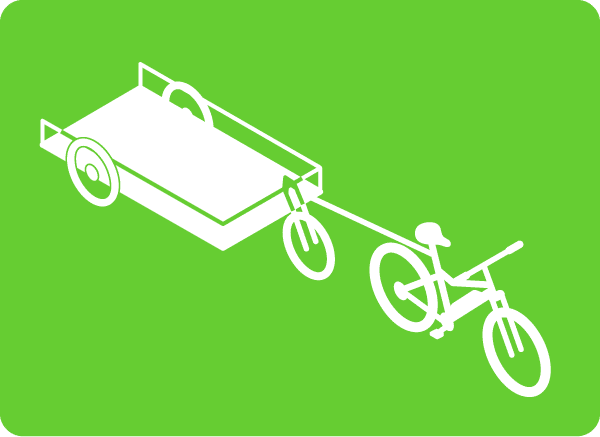
Bike with trailer
Two-wheeled bike, typically electric-assist, with a two- or three-wheeled trailer.
On-demand delivery riders often use bikes with racks or wear backpacks to carry deliveries.

Bike with rack
Two-wheeled bike, electric-assist or pedaled, with a rack, typically in the rear.
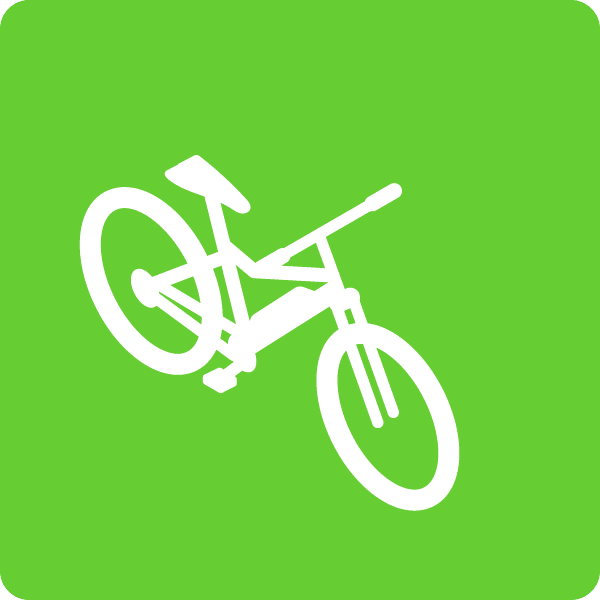
Standard bike
Two- or three-wheeled bike, typically electric-assist, with a cargo bucket in the front or back.
Review local and state laws, rules, and regulations to understand if and how bike types are defined and what their operating constraints are. Larger bikes and throttle-powered bikes may be more limited than electric-assist or pedal-only bikes.
E-bikes are commonly categorized into Class 1, 2, or 3 based on maximum speed and whether or not the bike includes a throttle that allows the operator to propel the bike forward without pedaling. Some e-bikes can go as fast as 28 mph (45 km/h), but these speeds are not necessary for efficient deliveries. Cities may regulate fleet-level speed maximums through business permitting, regulations, or laws.
For more on laws and regulations, see Essentials for Urban Delivery by Bike.