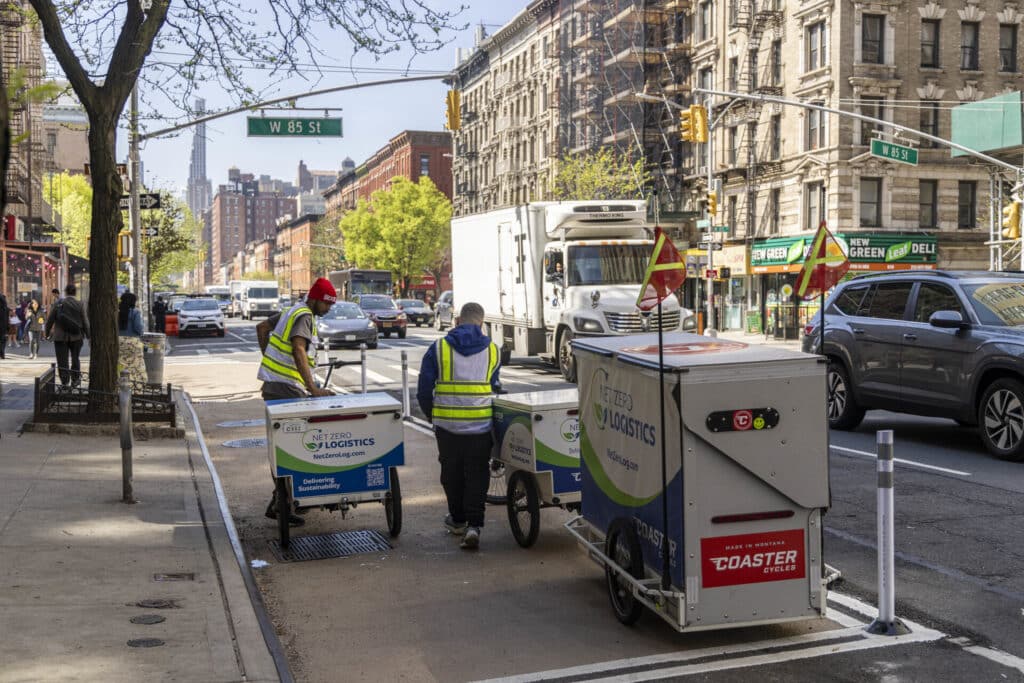
Credit: NYCDOT
With an understanding of the local bike delivery landscape and needs, city staff can identify where to direct their efforts.
Here are some specific steps to consider for different strategies:
Download the Checklist
Legal environment
A supportive legal and regulatory environment can clear the way for increased delivery by bike. City staff must understand what’s currently on the books before recommending specific strategies.
- Keep it simple: Consider what’s possible within the existing legal landscape before looking to adopt new regulations, policies, or laws.
- Define bikes: Research and document any state and local definitions of e-bikes, cargo bikes, and quad bikes. Ideally:
- E-cargo bikes or quad bikes are not prohibited based on size, number of wheels, or other requirements.
- Width and length requirements are flexible (some quad bikes are up to 4 ft / 1.2 m wide).
- People can ride cargo bikes or quad bikes in bike lanes and in general travel lanes.
- Bikes can be parked on the sidewalk and on the street.
Community engagement and education
Residents ultimately benefit from more deliveries by bike, even if a city’s work is directed toward businesses and delivery workers. Share strategies and get feedback from community members to address delivery challenges.
- Local outreach: Plan for community engagement with residents near distribution centers, microhubs, and on-street bike corrals.
- Share details online: Make information about delivery by bike publicly available on the city’s website and in other communications.
- Demonstrate specifics: Consider bringing delivery bikes to community events and block parties to familiarize residents with the bikes they’ll see.
- Introduce partners: Invite delivery stakeholders to community engagement events. Create connections between third-party companies and communities so that companies can be more directly accountable to residents.
- Support immigrant and undocumented communities: Bike delivery can provide economic opportunities for immigrant and undocumented populations. Consider investing in relationships with local organizations providing legal and social assistance to immigrant communities as part of an outreach effort.
Data collection and program evaluation
Ongoing evaluation and reporting can help cities understand and communicate the efficacy of delivery by bike. Scale the evaluation effort to match the work: more substantial programs should involve more substantial evaluation, but even small efforts benefit from an evaluation.
Consider data sources (qualitative and quantitative), analysis needs, and data collection timelines. Adapt the work in response to analysis and feedback.
- Identify resources: Identify how data, mapping, and analysis could be integrated into existing work streams or if additional resources are needed. Consider collaborating with local universities, non-profit partners, or other research hubs to increase data collection and analysis capacity. Data can be collected via periodic community meetings, ongoing online feedback forms, and user-generated maps of bike parking needs.
- Create data-sharing agreements: For large-scale delivery programs led by private companies, identify data needs and create data-sharing agreements that directly support project evaluation goals.
- Get feedback from riders: Use intercept surveys or focus groups to check in with delivery riders before, during, and after an intervention.
Connected bike network for deliveries
Bike networks that support delivery by bike advance key connections and designs that accommodate faster speeds and a wider range of devices. (See NACTO’s Urban Bikeway Design Guide.)
- Identify network gaps: Evaluate the quality and connectivity of the bike network along delivery routes, especially near business districts, potential microhub locations, or other high-traffic areas.
- Plan network projects to support delivery bikes: Prioritize wider protected bike lanes along strategic commercial corridors to accommodate wider delivery bikes and more frequent passing.
- Update typical designs and standard details: Engineering standards that reflect the needs of common delivery bikes—typically a bit faster, heavier, wider, and longer than regular bikes—can make project design and delivery more efficient.
Bike parking
Adding more bike parking that accommodates wider bikes near interested businesses can be a low-cost first step to supporting more delivery by bike.
- Keep sidewalks clear: Allow people to park their bikes on sidewalks for short periods of time, as long as the bikes do not block the pedestrian path of travel.
- Accommodate large bikes: Update bike parking design standards for racks and on-street corrals to accommodate wider and longer bikes.
- Identify parking demand: Interview delivery riders to understand parking activities and durations.
- Design for flexibility: Convenient and practical mechanisms (e.g., parking requirements, legislation, new sign plaques) can accommodate flexible short-term parking and loading.
- Design flexible on-street spaces for loading packages onto bikes.
- Allow bikes to use existing on-street vehicle parking and loading spaces.
Microhubs
Successful microhubs require strong partnerships between city departments and with private partners.
- Identify land use restrictions: Review and update zoning codes, if necessary, to ensure the development of locally preferred types of micro hubs.
- Design details with delivery partners: Work with delivery partners to ensure the design and location of a microhub will address specific needs. Let delivery partners take the lead in making decisions whenever appropriate. Consider:
- Whether structures such as tents or shipping containers are necessary, and which permits will be required.
- Secure indoor locations with bike storage, break space, and restrooms.
- Connections to the electrical grid for battery charging and swap cabinets.
- Whether paving is necessary, if sited in open lots.
- Leverage partnerships to facilitate logistics: Collaborate with land owners and other stakeholders such as university partners, business improvement districts, and other city departments to identify locations for easy-to-implement microhubs.
- Clarify partner responsibilities: Identify partner roles in decision-making processes, funding, and maintenance of microhub sites and structures.
Battery charging and swapping
To reduce fire risks, require compliance with local safety standards.
- Establish local safety standards: Work with fire department to establish charging requirements that meet ULSE standards.
- Make regulations understandable: Share requirements and standards, in simple terms, directly with delivery riders.
Subsidy programs
Design a subsidy program that addresses local needs based on feedback from a broad range of stakeholders, including current delivery workers, worker unions, local bike shops, employers, and/or business improvement districts.
- Clarify equitable eligibility requirements: Establish who is eligible and if there are any program requirements (e.g., how many bike deliveries people or businesses need to conduct).
- Identify workers: Partner with unions, community organizations, employers, or third-party delivery apps to identify workers who would benefit from the program.
- Support workers with charging and storage: Collaborate with delivery riders and local businesses to identify where bikes can be securely stored and safely charged. Consider centralized storage and battery charging locations as needed.
- Build knowledge: When providing bikes to new riders, prioritize education campaigns on safe e-bike charging, storage, and riding. (See Outreach, Education, and Training below.)
For programs that directly purchase bikes for business or delivery workers:
- Define ownership: Determine bike ownership requirements: are bikes returned to the program administrator, owned by the rider, or rented to own at a discounted rate?
- Select a serviceable bike: Ensure replacement parts and repair/maintenance options are readily available at local bike shops.
For programs that incentivize third-party bike rental services:
- Learn about the options: Research third-party bike rental services to make sure the programs align with the city’s goals and address local needs.
For programs that connect local businesses to third-party bike delivery companies:
- Right-size the opportunity: Collaborate with third-party bike delivery companies to understand what investments they may need (e.g., microhub infrastructure) and what areas and businesses are best suited for their business model.
Business permitting
Work with delivery partners and stakeholders to ensure practical logistics.
- Establish a simple registration process: Consider labels or permits for commercial bikes instead of formal licensing with the state.
- Remove barriers to employment: Bike delivery can provide economic opportunities for people without a driver’s license. Support avenues to secure employment by carefully considering if driver’s licensing requirements for delivery workers are absolutely necessary for your city’s goals.
- Prioritize rider safety: Encourage or require companies, small businesses, and restaurants to invest in rider safety as part of a permit program. Ideally, delivery partners, including on-demand delivery services, should:
- Offer frequent opportunities for bike training and education.
- Provide workers with safety gear, such as lights, reflectors, and helmets.
- Ensure bathroom access: Collaborate with local businesses to provide delivery riders with access to bathrooms.
Outreach, education, and training
Collaborate with stakeholders to create a thorough education, training, and outreach program.
- Identify training needs with stakeholders: Work with a broad set of stakeholders (including delivery riders, logistics companies, relevant unions, businesses using bikes for deliveries, and local residents) to understand what topics should be covered and create collaborative learning spaces.
- Work with local trainers: Local bike training and education organizations can help design courses to educate workers on their rights, provide them with safety gear, and teach them to ride e-bikes on city streets.
- Leverage private investments: Larger employers may be best suited for implementing the logistics of a training program.