Faster travel times, shorter headways, and reliable trips transform daily life for people who depend on buses and attract new riders to public transit. Individual projects can make a difference on a single bus line or street, but transformative change comes from long-range programmatic work that considers the entire network.
In the U.S. and Canada, this scale of change is typically implemented by agencies with established transit priority programs, backed by dedicated full-time staff and financial resources.
More than a quarter of agencies in the inventory self-reported as having a mature transit priority program, with a team focused on transit priority and dedicated funding to plan, design, build, and maintain real-world changes to streets. Out of the 20 agencies with mature programs, 11 were transit agencies, eight were city DOTs, and one was a non-operator regional agency.
This section highlights key findings on project funding sources, project delivery, and areas of success from agencies with established, mature transit priority programs.
Transit Priority Teams
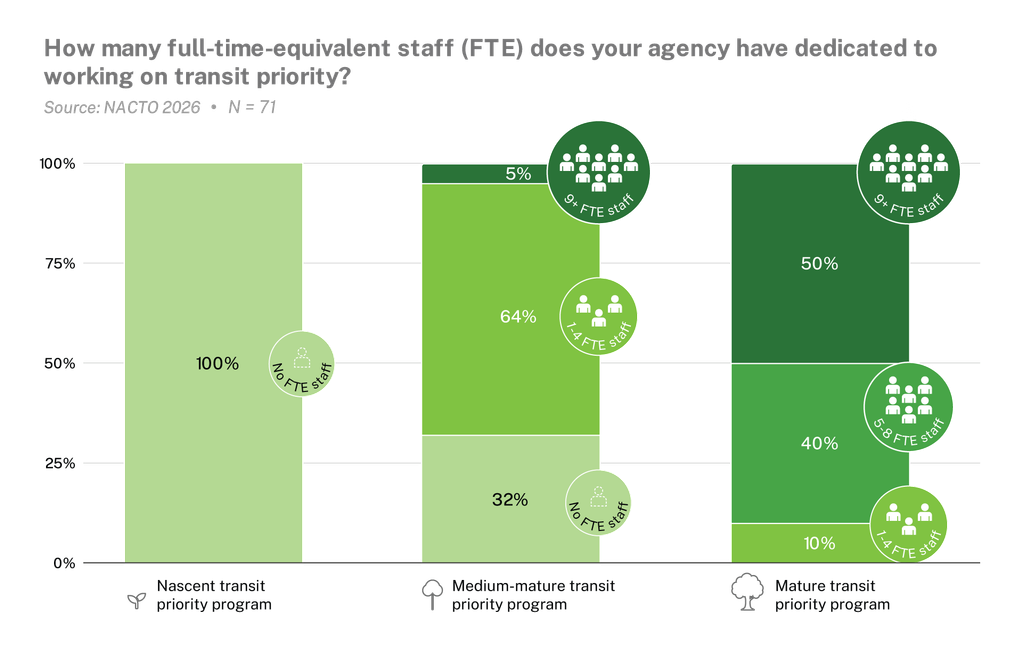
A primary indicator of a mature transit priority program is a multi-person team that is dedicated to improving bus speeds and reliability. Developing a team requires a vision and multiyear support from agency leadership and elected officials. Once established, the transit priority team can be tasked with a sustained, year-over-year strategy to build partnerships and deliver meaningful change for riders across the system.
Ninety percent of respondents with mature transit priority programs reported their program has five or more full-time-equivalent staff dedicated to transit priority, and half (50%) reported they have nine or more staff. These larger teams set mature programs apart from medium-mature programs: 64% of respondents with medium-mature programs reported having between one and four full-time staff members, 5% reported having nine or more, and over a quarter do not have any full-time-equivalent staff dedicated to transit priority.
Delivering Transit Priority Projects
Transit priority projects can be delivered as major capital investments along a corridor, such as Madison’s East-West BRT project, as well as through lower-cost projects with meaningful impact, like the District Department of Transportation’s bus stop balancing project along Upshur Street NW. Mature programs have the staffing and funding necessary to deliver at multiple scales, depending on the current needs and budgetary realities.
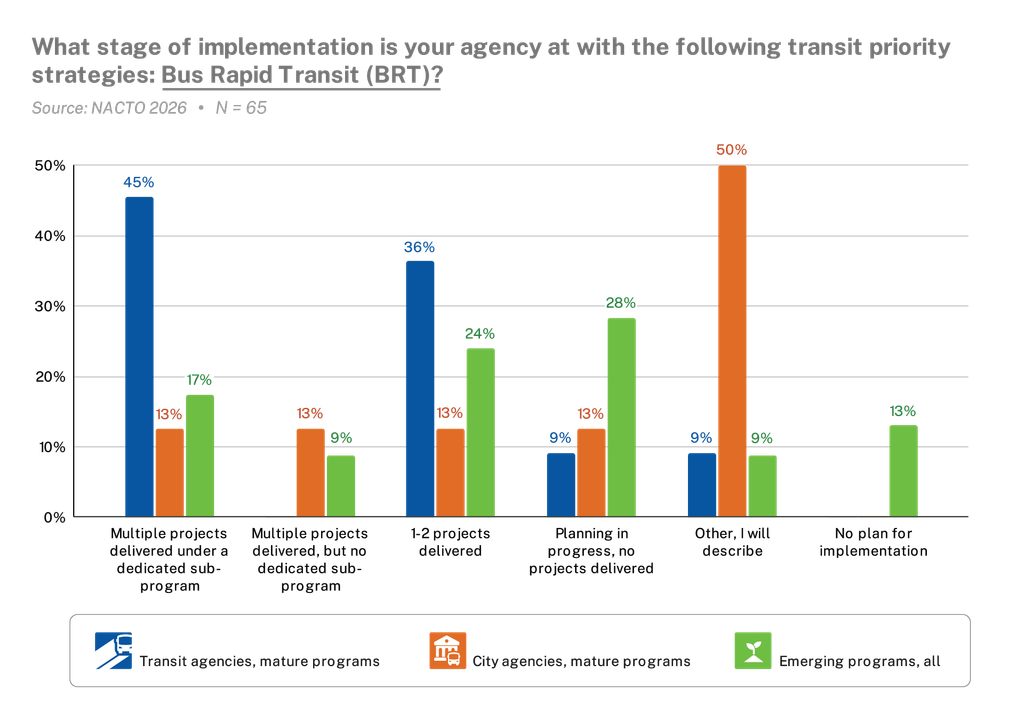
Corridor-level signature projects are important to a city’s transportation system, providing fast, reliable service for busy routes on congested corridors. Survey responses indicate that transit agencies with mature transit priority programs are more likely to have led the implementation of BRT projects. Many city DOTs with mature programs reported that they do not lead implementation of BRT, but play a supportive role in their partner transit agencies’ plans.
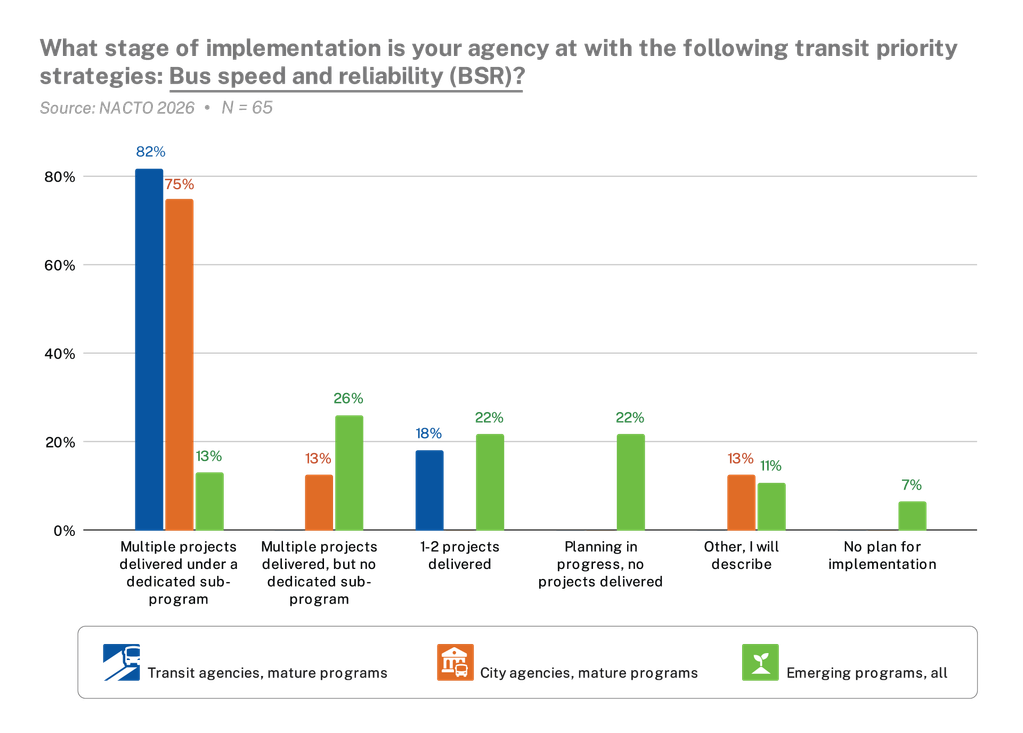
Transit riders benefit from projects at other scales and delivered across a wider portion of the system. Overall, mature programs at both transit agencies and city departments have delivered a significant number of these less-expensive speed and reliability projects. Over 80% of mature programs at transit agencies and 75% of mature programs at city DOTs have delivered multiple projects under dedicated bus speed and reliability sub-programs.
Transit Priority Funding
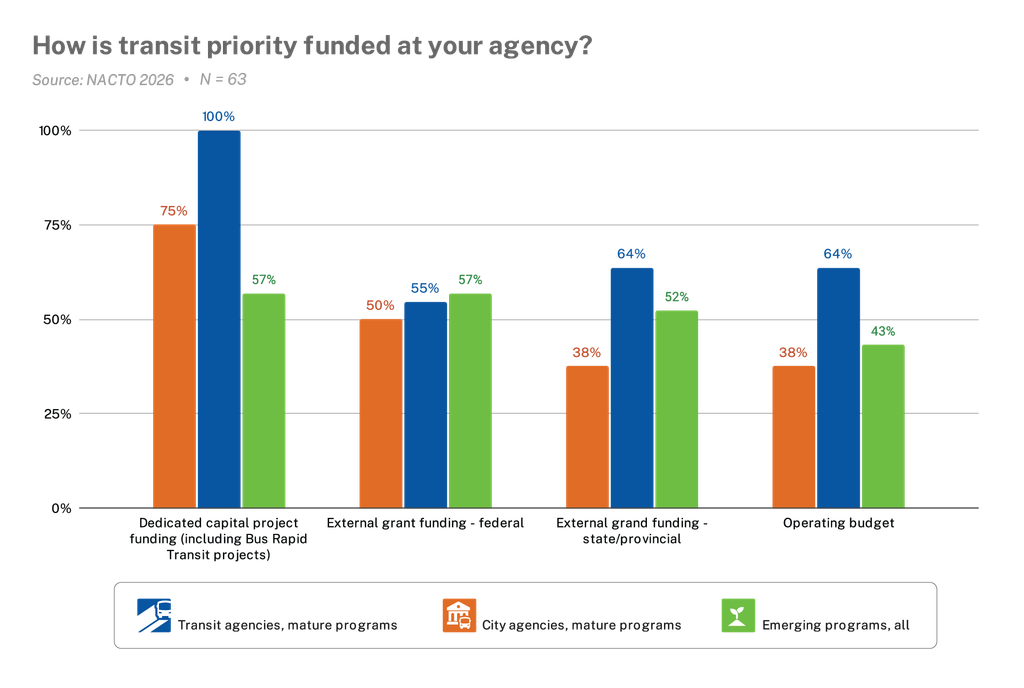
Mature programs tend to have a mix of capital, grant, and operating dollars available to deliver results. Every transit agency with a mature transit priority program reported having dedicated capital funding, unrelated to grants, for transit priority projects, and 75% of city DOTs reported they had dedicated funding. Transit agencies with mature programs were also more likely to have the operating budget necessary to ensure a dedicated team and ongoing programs.
For comparison, dedicated capital funding was available for just 57% of respondents with medium-mature or nascent programs: 67% of transit agencies and just 8% of cities.
Successes and Challenges for Mature Programs
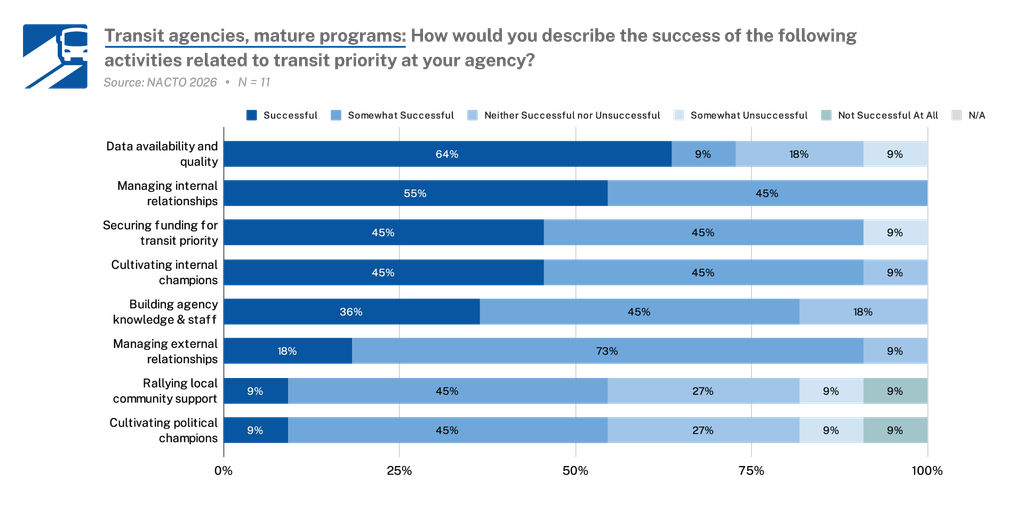
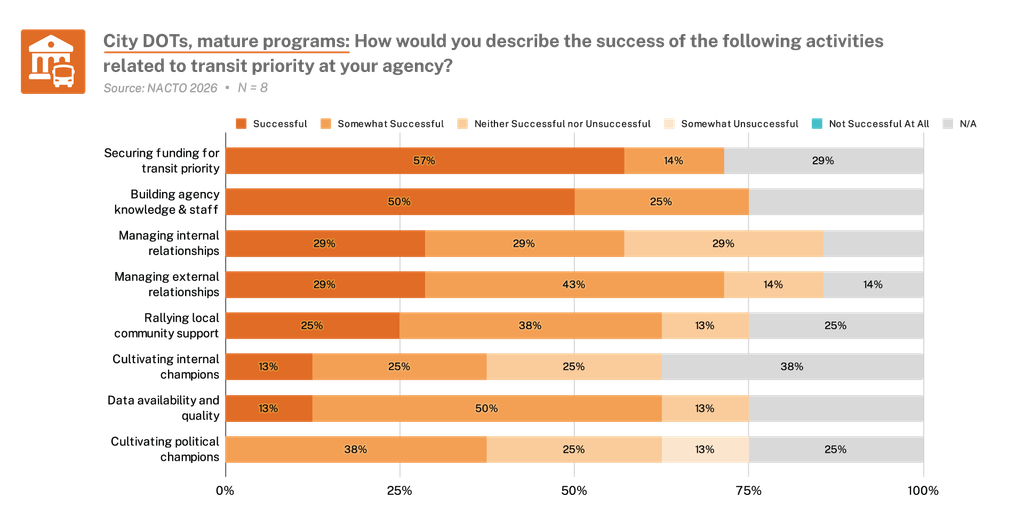
Beyond documented success in securing funding for transit priority projects and programs, mature programs in both transit agencies and city departments enable successful internal relationships, knowledge, and capacity. In emerging programs, only 17% of city DOTs and 10% of transit agencies reported outright success with building agency knowledge and staff capacity.
Transit agencies with mature transit priority programs, notably, are the most successful in acquiring quality data compared to all other programs. Less than a fifth of transit agencies with emerging transit priority programs, and all programs at city DOTs, reported outright success with data availability and quality. Quality data, in turn, means improved abilities to measure success and identify areas for improvement. TransLink’s Bus Speed and Reliability Report, for example, turns extensive quality data into clear, actionable steps to further improve bus travel in the region for riders.
Securing political and local community support for transit priority is the greatest area for growth. Both cities and transit agencies ranked success with cultivating political champions last, and only a small percentage (9%) of transit agencies reported outright success in this area. City DOTs with mature programs report slightly higher success rates in finding community support (25%) than transit agencies (9%), and both report some success at high levels (38% and 45%, respectively).