To bridge gaps in Washington, D.C.’s bike network, the District Department of Transportation (DDOT) needed a strategy for narrow residential streets where high parking demand made constrained bike lanes difficult to install.
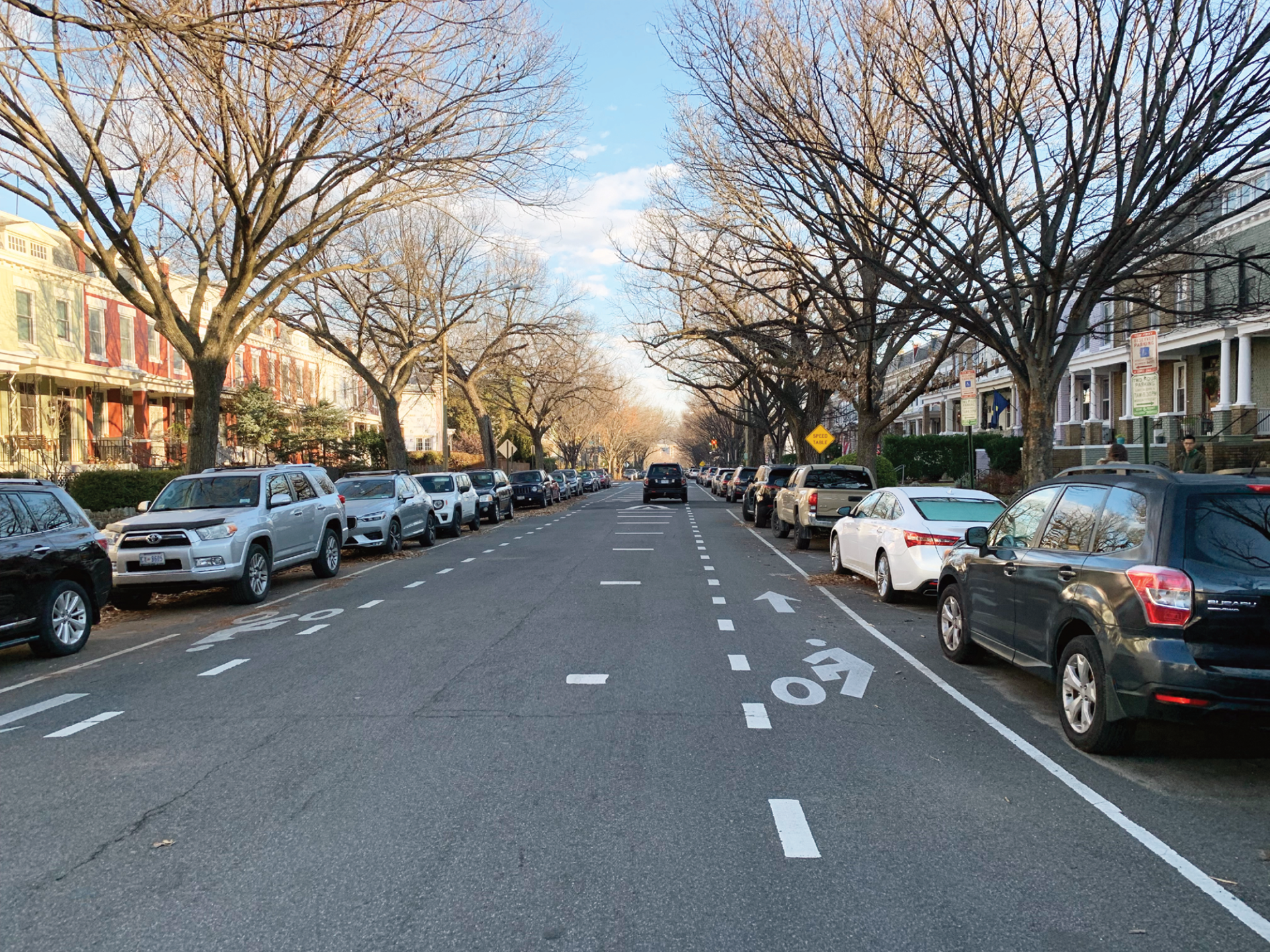
Rather than choosing between parking and cyclist safety, DDOT tested out a new-for-them style of bike infrastructure— advisory bike lanes—across five streets in the Capitol Hill neighborhood. The results? Sidewalk riding decreased, and surveys showed that a majority of cyclists, drivers, and pedestrians felt the corridors were safer and easy to navigate.
What are advisory bike lanes?

Advisory bike lanes are typically used on streets that are too narrow for both marked bike lanes and general travel lanes in two directions. In NACTO’s Urban Bikeway Design Guide, streets with advisory bike lanes (also referred to as edge lane roads) have a narrow central travel lane for two-way general-purpose travel and dashed one-way bike lanes on each side of the street. The single vehicle lane operates as a yield street—a familiar situation for urban drivers—and motor vehicle drivers can use the advisory bike lanes to pass oncoming cars when the bike lane is clear.
Advisory bike lanes can be a great alternative to constrained bike lanes along streets with high-demand, low-turnover residential parking, according to NACTO guidance. On these streets, curbside constrained bike lanes can be blocked by illegal parking and loading activities.
| Bikeway | Target Motor Vehicle Speed |
Motor Vehicle Lanes In Same Direction |
Motor Vehicle Volume Per Day |
Motor Vehicle Volume Peak Hour in Peak Direction |
| Advisory Bike Lane |
≤ 20 mph ≤ 30 km/h |
Single lane
or none |
≤ 500-2,000 | < 50-150 |
Advisory bike lanes are categorized as experimental under the 11th Edition of the Manual on Uniform Traffic Control Devices (MUTCD). Cities may implement them if they file a request to experiment with the Federal Highway Administration, as D.C. did.
Testing out advisory bike lanes in D.C.
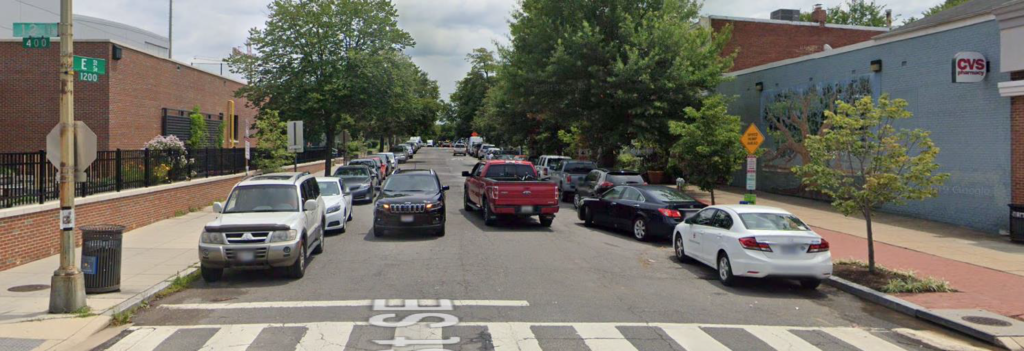
Photo Credit: Google Maps
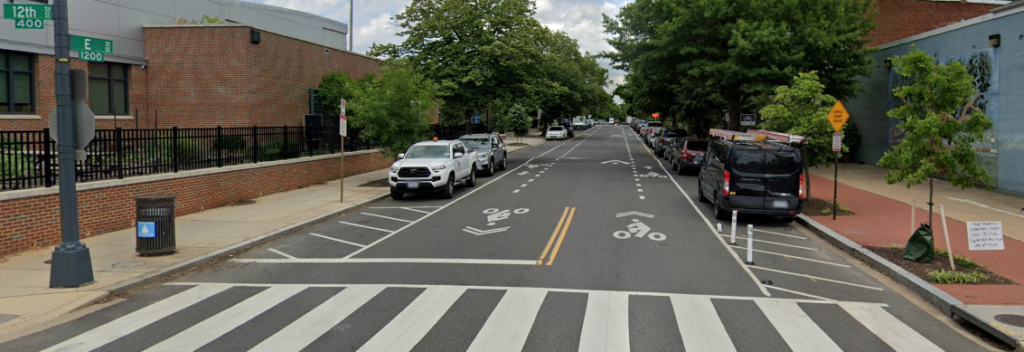
Photo Credit: DDOT
In 2019, DDOT received permission from the Federal Highway Administration to test out advisory bike lanes. Between 2020 and 2021, DDOT deployed advisory bike lanes on five streets in the Capitol Hill neighborhood.
The streets were all local, residential roads with heavily-used street parking on each side of the street and 20 mph speed limits. Vehicle volumes were low on all streets—under 2,000 vehicles per day.
The E Street SE corridor—where residents had requested a bike lane—shows how DDOT solved the spacing puzzle. On parts of the street with a 40-foot cross section, the final design included a 14-foot central lane, with 8-foot parking lanes and 5-foot bike lanes. Some segments of the street were as narrow as 35 feet: in these, the central lane was reduced to 11 feet, and parking lanes went down to 7 feet.
The advisory bike lane design naturally improves visibility and reinforces the neighborhood speed limit. By placing most moving motor vehicles in the middle of the roadway, DDOT reduced the risk of sideswipe crashes into parked cars.
In its final report to FHWA, DDOT found:
- Bike Comfort: 61% of bike riders reported feeling safer, and sidewalk riding decreased substantially.
- Pedestrian Comfort: 79% of pedestrians felt crossing the road was as safe as or safer than before.
- Intuitive Design: 85% of cyclists and 69% of drivers surveyed said they understood how to navigate the new configuration—even without explanatory signage. DDOT observed that interactions between cyclists and drivers were generally safe, with drivers yielding to cyclists in front of them when an oncoming car approached.
Beyond D.C.
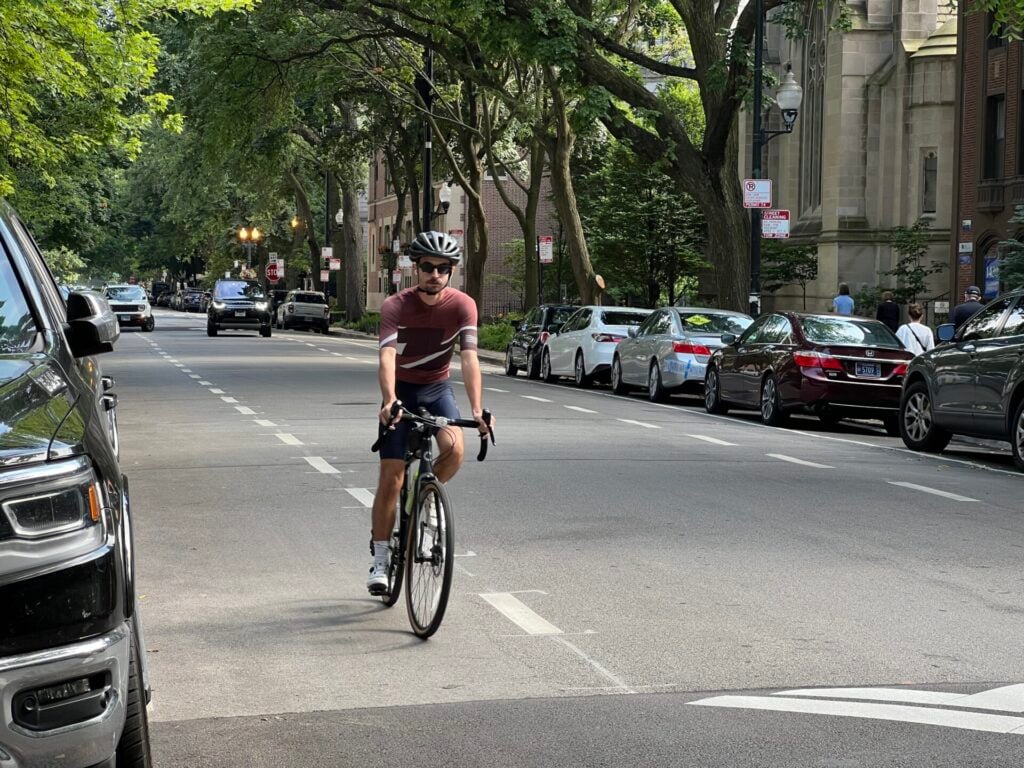
Washington, D.C. is part of a growing group of North American cities successfully implementing advisory bike lanes. Planners are using advisory bike lanes to connect their bike networks in larger cities like Chicago and Portland, Oregon, and in smaller communities like Sandpoint, Idaho, and Scarborough, Maine.
Research (Mineta Report 2021; Alta Report 2017) into these installations shows the D.C. experience isn’t an outlier. A literature review of advisory bike lane projects across the U.S. and Canada found that on streets with these treatments, motor vehicle speeds typically stayed the same or decreased, crash rates remained equal or lower than previous configurations, and bike ridership increased or stayed the same. On average, the literature review found that these streets with advisory bike lanes saw roughly 2,000 vehicles per day and had narrow cross-sections.
From Capitol Hill and beyond, cities are rethinking the residential street and demonstrating that advisory bike lanes can help transform narrow neighborhood streets into intuitive, shared spaces.
More Information
NACTO Design Guidance
From DDOT
- Experiment results report to FHWA
- DDOT’s bike lane project tracker
- DDOT’s Bicycle Facility Design Guide
Header Photo Credit: DDOT