Photo credit: New York City Department of Transportation
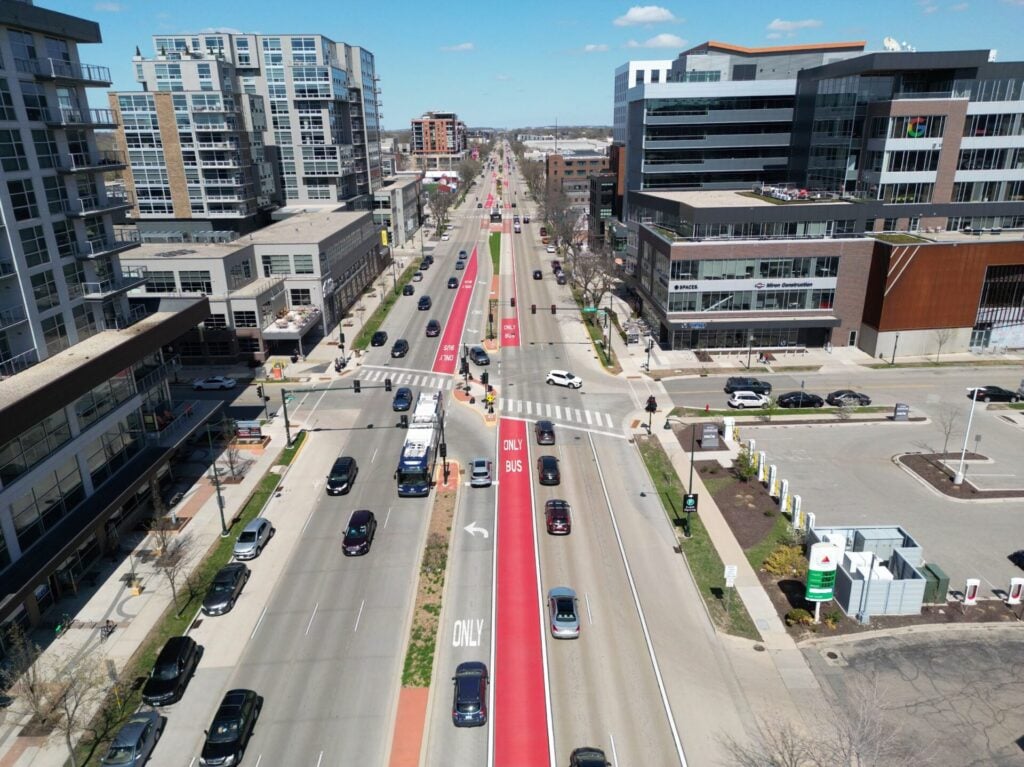
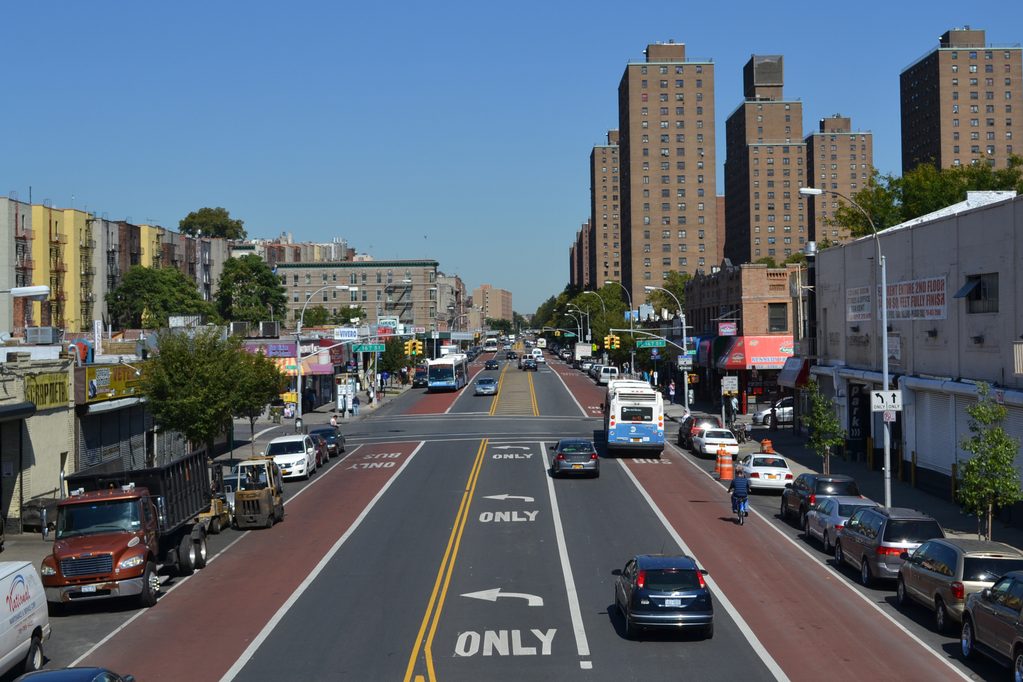
As part of New York City’s Select Bus Service program, NYC DOT and the MTA have partnered to upgrade targeted bus routes to provide frequent and high-quality rapid bus service. Significant upgrades were made to Webster Avenue in the Bronx as part of a package to improve the Bx41 bus route, including the installation of offset bus lanes in both travel directions along 4 miles of this major bus corridor.
In addition to dedicated bus lanes, the project included signal coordination, all-door boarding, the introduction of off-board fare payment, and new buses. Three critical intersections were substantially redesigned, using new signals and pedestrian crossings, left-turn prohibitions, and simplified intersection geometry with shorter pedestrian crossings. Refuge islands and related pedestrian safety improvements were installed along the corridor.
Prior to the project, the MTA operated a Local and a Limited service on the Bx41 route, with a total ridership of just under 20,000 passengers per day. Both Local and SBS services use the new dedicated lane, which may be entered by general traffic to permit turns and parking.
Comparing service from a year before installation to a year after, bus travel times through the corridor dropped 19% to 23% for rapid buses. A Bx41 SBS trip during the PM peak fell to 40 minutes, compared to 52 minutes on the previously operated Bx41 Limited. The local bus also saw benefits, with trip times reduced by 11 to 17%.
Ridership grew 25% on the Bx41 SBS route in the year following implementation, and a share of previous Bx41 local riders shifted to the Select bus, now reaching a combined 25,000 riders per day on both the local and SBS routes. Finally, general traffic volumes and travel speeds remained similar a year after implementation, with slightly shorter travel times in peak periods.
The redesign of Webster Ave. demonstrates how organizing a multi-lane street, with an exclusive transit lane combined with operationally important design changes, can increase a street’s person capacity, substantially reduce travel times, and improve walking conditions and network connectivity, without affecting the movement of private motor vehicles and freight.
Transit Street Design Guide
Learn more about transit streets in NACTO’s Transit Street Design Guide.