City governments across the U.S. and Canada are addressing the ever-increasing demand for deliveries by incentivizing and regulating deliveries by bike rather than motor vehicle. NACTO’s Urban Delivery by Bike work includes best practices and real-world case studies that show challenges, successes, and lessons learned for helping shift more deliveries to bike delivery.
The Pilot
The City of Toronto’s on-street microhub pilot helped a logistics company successfully replace some of its delivery trucks with e-cargo bikes in a dense urban area.
Background
In 2022, the City of Toronto’s Transportation Services Division sought to test whether e-cargo bikes could be a competitive alternative to delivery trucks. After new City rules allowed large cargo e-bikes on city streets, the City of Toronto created an on-street microhub pilot program.
Logistics companies were invited to apply for the opportunity to operate out of an on-street microhub. Purolator, a Canadian logistics company, expressed interest and, after a collaborative process with the City, deployed the first on-street logistics hub in Toronto. The goal was to explore how a microhub could support last-mile delivery using e-cargo bikes in a dense urban setting near a university campus.

The Microhubs
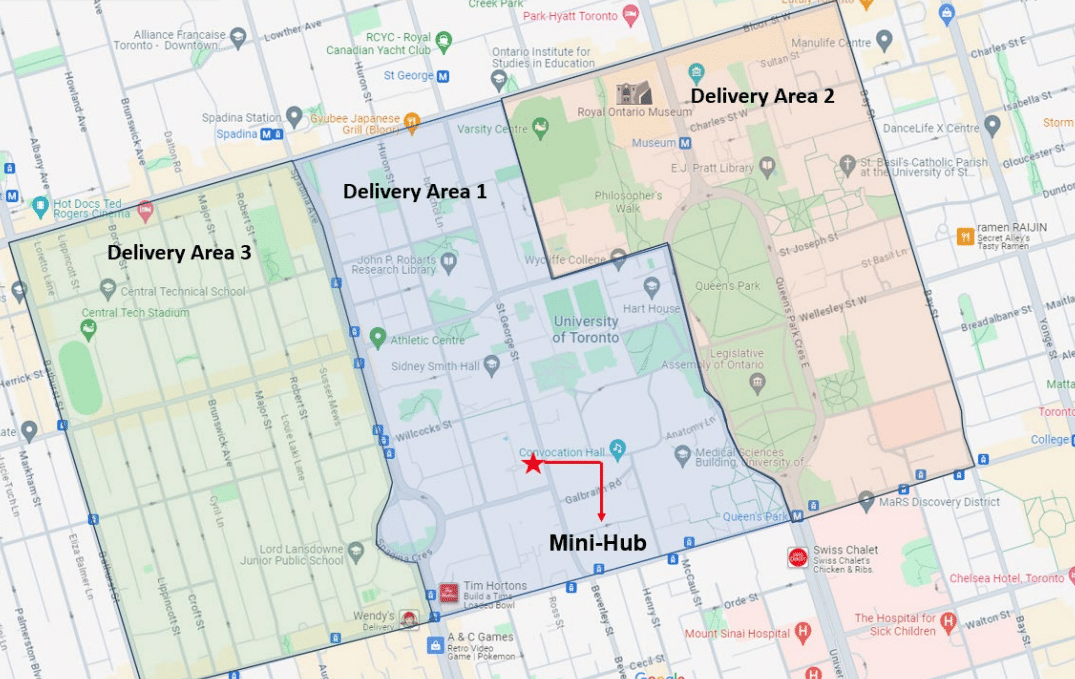
During the pilot, the City charged Purolator a fee to use five metered on-street parking spaces on a university campus to accommodate a 40-ft shipping container, providing space to unload packages from trucks and onto bikes. The site was able to tap into the university’s power supply to support e-bike charging.
The Toronto Parking Authority initiated a similar but separate pilot with Purolator, installing a microhub in the municipal parking lot at 19 Spadina Road (north of Bloor Street West). The City found that both the on-street and off-street microhub options complemented each other depending on the local street and area’s context.
Logistics
Purolator took responsibility for operational and logistics decisions and used the microhub for three functions:
- A mini-logistics center for transferring packages from trucks to three e-cargo bikes.
- An overnight storage and charging center where e-bikes were charged and packages were stored.
- A retail service window where customers could pick up and drop off packages.
Cargo e-bikes and delivery trucks were dedicated to specific delivery areas to compare efficiency measures.
Timeline
June 2022
City of Toronto passes bylaws approving a pilot on-street microhub.
September 2022
Purolator begins operations at the microhub.
June 2024
Toronto City Council makes the microhub permanent and announces that microhubs will be allowed to operate across the City, subject to various siting criteria.
Outcomes
- Vehicle replacement: Three cargo e-bikes each served a specific delivery area, reducing reliance on delivery trucks.
- Right-sized vehicles: Bikes are well suited to dense urban areas with limited parking and short delivery distances. During the pilot, a single delivery truck continued to operate in the study area to deliver oversized packages.
- Increased efficiency: A study conducted by the University of Toronto found that the e-cargo bikes stopped more frequently (averaging 25 delivery stops per day) than delivery trucks (averaging 19 stops per day) and parked for less time at each stop. E-cargo bikes stopped for an average of under four minutes per stop, compared to over 10 minutes per stop for delivery trucks before the pilot.
- Reduced emissions: The University of Toronto found that replacing one delivery truck with an e-cargo bike eliminated 3.1-5.5 metric tons of greenhouse gas emissions each year, and that bike operators were likely exposed to fewer harmful particulates than delivery truck drivers.
Takeaways

Microhubs work. With the right support, e-cargo bikes plus microhubs can replace delivery trucks. Repurposing public space (like motor vehicle parking) for logistics can enable cleaner, faster delivery systems.
Regulatory balance is key. In 2021, the City of Toronto allowed large cargo e-bikes to operate on roads, bike lanes, and protected bike lanes. The city also allowed cargo bikes to park like other commercial vehicles, including in designated on-street commercial loading zones and delivery vehicle parking zones. The city maintained flexibility during the microhub pilot, avoiding overly rigid definitions and allowing innovation before establishing program details.
Partnerships matter. A collaborative team made up of multiple stakeholders promoted regulatory clarity and safe operations and had clearly-defined roles around logistics, data collection, and community engagement. Stakeholders included multiple teams from the City’s Department of Transportation: the policy unit, internal parking unit, legal team, and cycling team. External stakeholders included the University of Toronto, the Pembina Institute, and Purolator.
Tell the story with data. The University of Toronto and Pembina Institute supported data gathering and analysis. These data were key to communicating success and informing future policy and infrastructure changes.
Anticipate operational needs. Purolator and Toronto identified e-cargo bike maintenance as an unforeseen challenge. Consult local bike shops prior to purchasing bikes to understand upkeep needs and repair timelines.
NACTO’s Urban Delivery by Bike practitioner paper outlines how any city can begin to harness the possibilities of bike delivery, with a menu of strategies and actions that staff can apply to their city’s unique context.


