
Header Photo: Boston, MA.
Photo Credit: Marilyn Humphries
In January, NACTO published the third edition of Urban Bikeway Design Guide, its first update in a decade. The new edition goes beyond a kit of parts to a more complete how-to manual for designing safe, bikeable, inviting streets. Soon, we’ll make the Urban Bikeway Design Guide available for free on our website. In the meantime, we’re posting excerpts each week here on our blog. Can’t wait until the Guide is on our website? Buy it from Island Press, and use code UBDG3 for 20% off.
Today’s excerpt is from Section 3: Designing Bikeways
Motor vehicle volumes and speeds are not fixed. They can be changed through policy and design, resulting in safer streets for all users. Implementing bikeways will increase the comfort of people on bikes and improve safety for all users.
In some cases, a bicycle facility may fall short of the All Ages & Abilities (AA&A) criteria but can still substantially reduce traffic stress for people on bikes. Jurisdictions should not use the inability to meet the AA&A criteria to avoid implementing a bikeway and should not prohibit the construction of facilities that do not meet the criteria.
Design User
To achieve growth in bicycling, bikeway design should meet the needs of a broad set of people who would potentially bike. When selecting a bikeway design strategy, identify potential design users based on network goals and the potential to broaden the base of people who might bike on a specific street.
A typical bikeway should appeal to current and potential users, favoring those who need low-stress bikeways, such as protected bike lanes or bike boulevards, to be safe and confident while biking. Personal safety concerns should be considered in bikeway design, resulting in well-lit, connected routes that attract more users.
For AA&A bikeways, pay additional attention to the needs of younger and older users, including differences in the ability to detect risks, visual acuity, and physical strength.
All Ages & Abilities Bikeways
Community conversations and Bike Network Plans should be oriented toward an AA&A bike facility that will serve the broadest range of people. Bikeways should be selected based on local conditions, including street design, motor vehicle speeds and volumes, transit use, adjacent land use, and curbside demand.
Protected bike lanes are the only type of AA&A bikeway tool permissible for AA&A streets with high curbside demand, speeds of more than 25 mph (40 km/h), multiple adjacent general-purpose travel lanes, and streets with volumes above 6,000 vehicles per day.
Not every segment of a bike network must have a protected bike lane. Where motor vehicle speeds and volumes are strictly managed, designers can draw on a range of bikeway types. The number of adjacent general travel lanes for these bikeways must not exceed one at the midblock. Additional lanes may be added at signalized intersections as necessary for safety and where the bikeway is designed through the intersection.
Guidance for Selecting All Ages & Abilities Bikeways
| Bikeway | Target Motor Vehicle Speed | Motor Vehicle Volume per day | Motor Vehicle Volume - Peak Hour in Peak Direction |
|---|---|---|---|
| Protected Bike Lane | Any | Any | Any |
| Shared Spaces | ≤10 mph≤15 km/h | ≤ 1,000 | ≤60 |
| Bicycle Boulevard | ≤ 20 mph≤ 30 km/h | ≤ 500 - 2,000 | <50-150 |
| Advisory Bike Lane | ≤ 20 mph≤ 30 km/h | ≤ 500-2,000 | <50-150 |
| Constrained Bike Lanes | ≤ 20 mph≤ 30 km/h | ≤ 1,500-3,000 | ≤ 300 |
| Constrained Bike Lane with Buffer | ≤ 25 mph≤ 40 km/h | ≤ 6,000 | ≤ 600 |
Design Speed
Speed plays a critical role in the likelihood and severity of crashes. There is a direct correlation between speed, crash risk, and the severity of injuries. Design streets using target speed (the speed you intend for drivers to go) rather than operating speed. Bring the design speed in-line with the target speed by implementing measures to reduce and stabilize operating speeds as appropriate. Narrower lane widths, fewer general-purpose travel lanes, constructed traffic-calming devices, and the addition of dedicated bikeways reduce traffic speeds and improve the quality of the bicycle and pedestrian realm.
Bikeway Design Speed
While e-bikes and conventional bikes can have similar speeds, observed operating speeds for e-bikes are typically higher and spread over a smaller range than conventional bikes. Urban e-bike operating speeds are typically 12-18 mph (19-29 km/h), while conventional bike speeds range from about 4-18 mph (4-29 km/h).1,2 Electric options for mini devices are typically limited to 8-15 mph (13-24 km/h).
In bike boulevards, advisory bike lanes, constrained bike lanes, protected bike lanes, and shared-use paths, the typical design speed for people riding bikes can be assumed to be 10-15 mph (16-24 km/h), although signal progression, operating width, and platooning will reduce overall operating speeds. On shared-use paths or bike paths with low volumes of pedestrians, people on bikes or other mobility devices may travel at speeds of 20 mph (32 km/h) or more, though slower users should be expected.
When designing bikeways, keep in mind the design user; they may be people traveling at the lower end of typical speeds. Do not assume confident people on bikes will set the pace for all others. Speed differentials may also require different design strategies when considering downhill and uphill needs.
Design Year
Credit: Seattle DOT, Flickr
City policies and goals should outweigh traffic forecasts when making design decisions. Traditional forecasting substantially overestimates the potential for traffic growth. When designing roadways, future “build” or “no build” traffic conditions should be treated as estimates and not facts. Conversely, traditional forecasting does not account for mode shifts or increases in people walking, biking, or taking public transportation.
Corridor- and intersection-level analyses completed when designing bikeways should reflect the traffic volumes for the year of anticipated project completion–not ten or more years in the future.
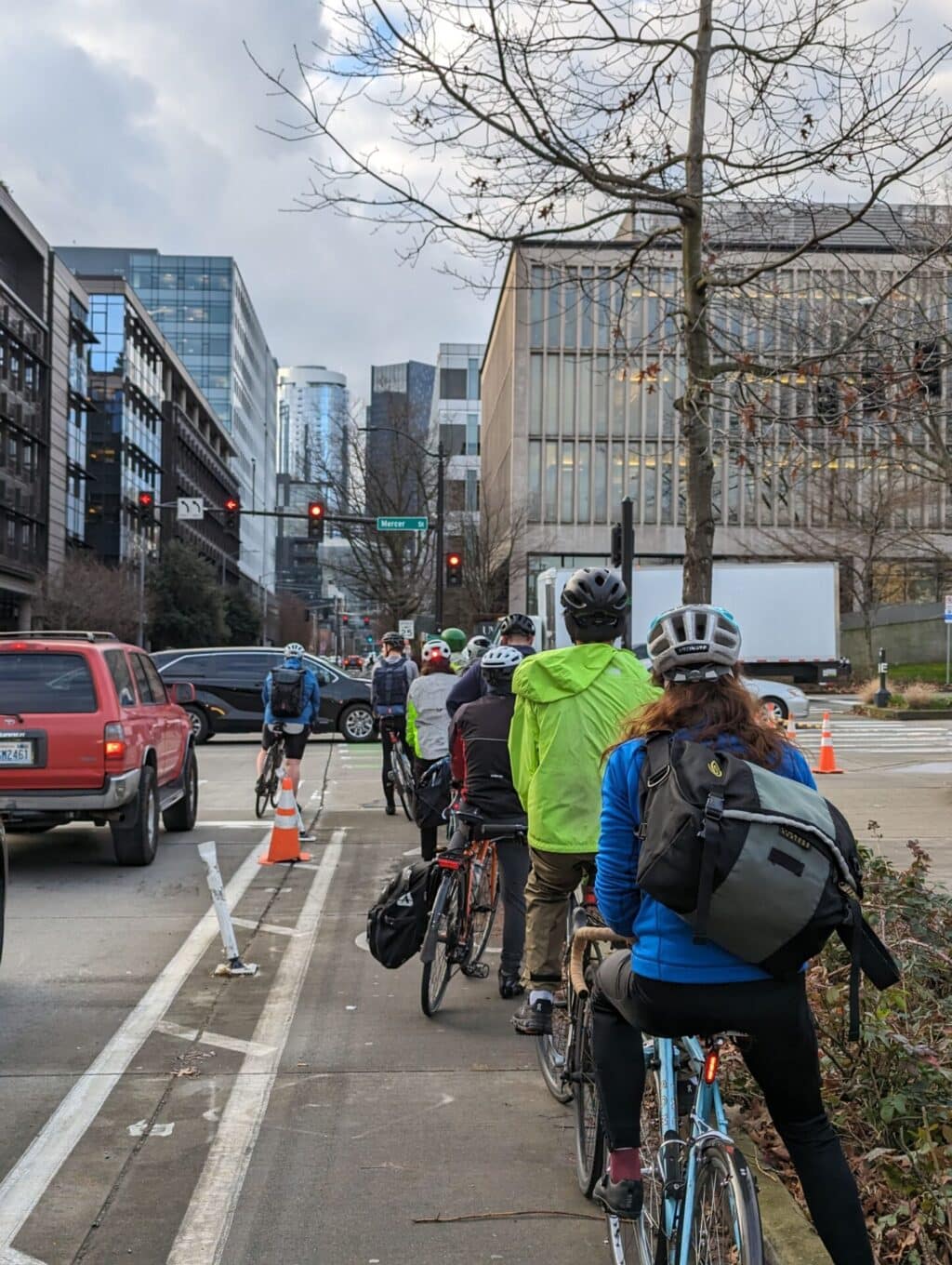
A connected bike network will increase bike volumes network-wide. When designing a bikeway, anticipate higher volumes of cycling than exist today and even more as the network grows. Prepare for this growth by providing wider bikeways in each project.
Adapted from Urban Bikeway Design Guide, Third Edition, published by Island Press


