In January, NACTO published the third edition of Urban Bikeway Design Guide, its first update in a decade. The new edition goes beyond a kit of parts to a more complete how-to manual for designing safe, bikeable, inviting streets. Soon, we’ll make the Urban Bikeway Design Guide available for free on our website. In the meantime, we’re posting excerpts each week here on our blog. Can’t wait until the Guide is on our website? Buy it from Island Press, and use code UBDG3 for 20% off.
Today’s excerpt is from Section 3.2: Bikeways on Low-Speed, Low-Volume Streets.
Advisory bike lanes (also referred to as edge lane roads) are defined by a narrow central travel lane for two-way general-purpose travel and dashed one-way bike lanes on each side of the street. Motor vehicles operate in yield conditions and use the advisory bike lane to pass oncoming cars when the bike lane is clear.
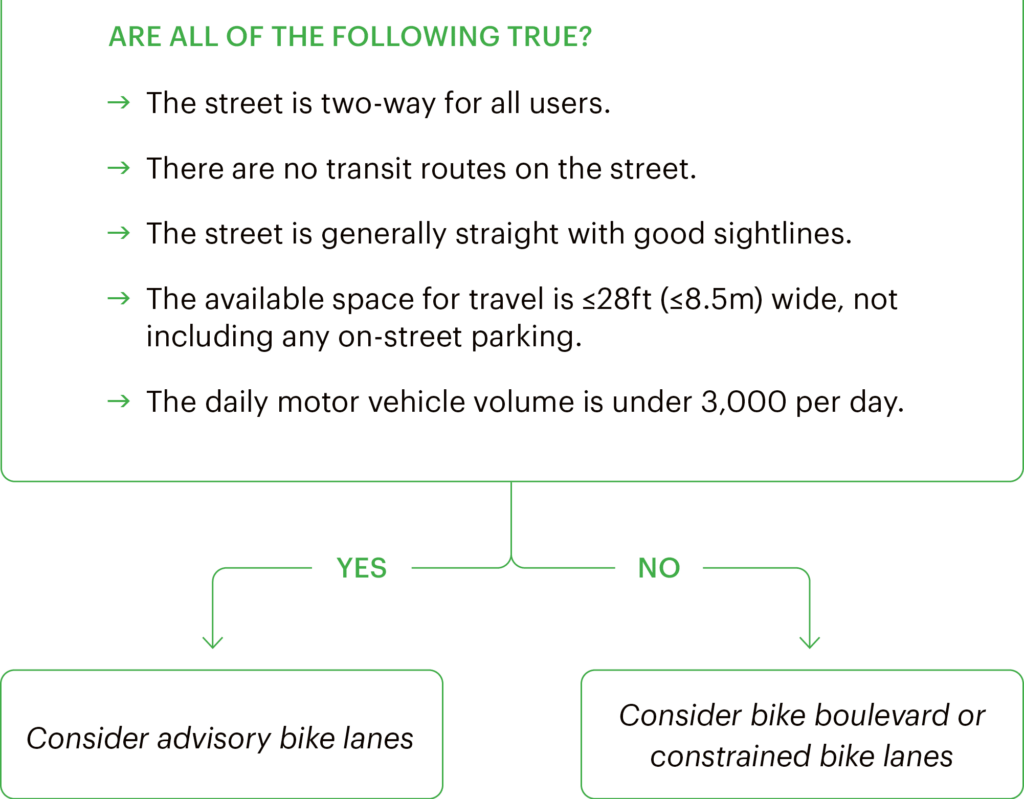
Advisory bike lanes are typically used on streets that are too narrow to accommodate both marked bike lanes and conventional general travel lanes in two directions, but where some organization of the roadway is desired. They are also useful on slightly wider streets where additional space for prioritizing biking is desired. Similar to bike boulevards, advisory bike lanes are successful where total vehicle volume is at or below 3,000 vehicles per day and the 95th percentile speed is at or below 25 mph (40 km/h).
Where horizontal or vertical curvature limits visibility of oncoming users, designers should use additional design strategies to slow users, protect the bike lane, and open sight lines. Consider the use of alternative bikeway designs for the corridor.
Advisory Bike Lane Decision-Making Flow Chart
Designing for All Ages & Abilities
Advisory bike lanes are most appropriate along low-speed, low-volume streets with operating characteristics similar to bike boulevards. They are most common along small residential streets with parking but work in a variety of land use contexts.
Advisory bike lanes are most comfortable for people on bikes where the speed limit is no greater than 20 mph (30 km/h); the volume of vehicles is under 2,000 per day; and no more than 150 motor vehicles per peak hour (fewer than three vehicles per minute).
| Target Motor Vehicle Speed | Motor Vehicle Lanes in same direction | Motor Vehicle Volume per day | Motor Vehicle Volume peak hour in peak direction | |
| Advisory Bike Lane | ≤20 mph ≤30 km/h | Single lane or none | ≤500-2,000 | <50-150 |

Dimensions
Advisory bikeways are typically implemented on streets narrower than 28 ft (8.5 m) wide, excluding any space dedicated to on-street parking.
The advisory bike lane space should be 5-6.5 ft (1.5-2 m) wide. Avoid advisory bike lanes that are 7 ft (2.1 m) or wider, especially when adjacent to the curb, to limit the likelihood that people will use them as parking or travel lanes.
The central motor vehicle space should be 10-15 ft (3-4.5 m) wide, which allows for motor vehicle travel in one direction at a time between the advisory bike lanes. The total combined width of the central motor vehicle space and the bike lanes will provide an effective width of at least 20 ft (6 m) for two-way motor vehicle travel.
The maximum width for the central motor vehicle operating space is 18 ft (5.4 m), providing an effective width of 28 ft (8.4 m) for a motor vehicle to pass another from the opposing direction.
Where more than 15 ft (4.5 m) of space is available for the central motor vehicle lane and the advisory bike lanes are at least 5 ft (1.5 m) wide, additional right-of-way can be allocated to the parking lane. Cities can add a buffer alongside the parking lane or mark the parking lane up to 9 ft (2.7 m) off the curb. Wider parking lanes may be preferable for streets with frequent delivery activity or unique curbside access needs, such as accessible loading.
Where the central motor vehicle lane is larger than 18 ft (5.4 m), constrained bike lanes with buffers may create a more comfortable and predictable biking environment.
Mid-block pinch points (also known as chokers or hugs) can be used to discourage motor vehicles from driving regularly within the advisory bike lanes. These pinch points include short segments of protected bike lane conditions and are wide enough for only a single motor vehicle. Drivers are forced into a yield condition.
Advisory bike lanes adjacent to parking lanes are not recommended where on-street parking demand and use is low. Users may be confused by the mostly empty curbside lane. In these cases, parking lanes should be reallocated to other uses, such as protected or buffered bike lanes.
Adapted from Urban Bikeway Design Guide, Third Edition, published by Island Press


