Cities need to be proactive. Even before robotaxis start testing and operating on public streets, cities should:
- Understand the legal and political context of their city.
- Identify a robotaxi point person.
- Start learning from peer cities that have already started this work.
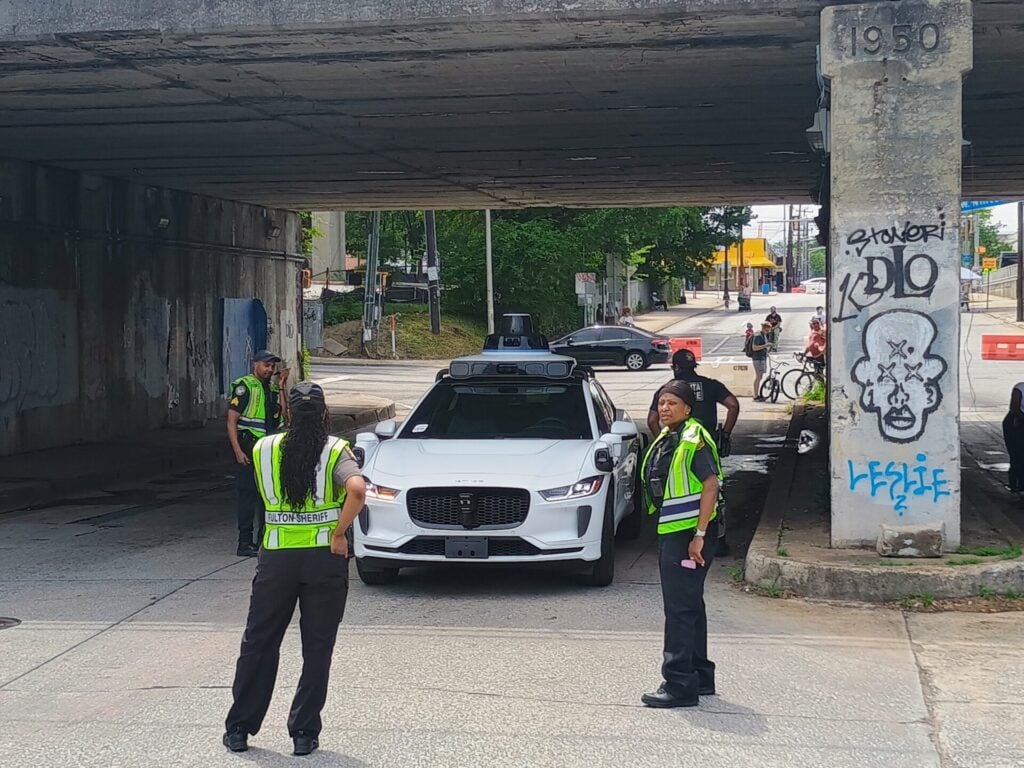
Four law enforcement officers surround a robotaxi attempting to enter a street closed for an open streets event. Photo credit: Byron Rushing.
Understand your city’s legal and political framework
Cities can take many steps to improve how robotaxis interact with the transportation network within their regulatory environment, which varies significantly by state and province. New robotaxi regulation likely will be informed by the existing legal and political context for autonomous vehicles writ large, ride-hail services (such as Uber and Lyft), taxis, and limousines at the state and local levels.
Consider the full context of how state legislation, provincial responsibilities, regulations, and definitions may limit or enable municipal oversight and regulation.
Many cities are fully preempted by state or provincial law from regulating or overseeing robotaxi testing and operations, making it challenging to incorporate robotaxi fleets into city transportation networks in ways that support city transportation goals. In the U.S., Congress has proposed legislation that could further strip authority from both states and local jurisdictions.
Transportation department staff can conduct this research, but their work will benefit from collaboration with the city’s legal department, government affairs team, mayor’s office, other local elected officials working on the issue, and any neighboring jurisdictions.
This work is best initiated before any robotaxi fleets are testing or operating locally, but can be done at any time—and should be monitored regularly. A strong understanding of the regulatory environment will focus discussions on what can be meaningfully achieved by cities.
Key considerations:
- Understand state or provincial laws and definitions: What does your state or province define, regulate, allow, or preempt when it comes to regulating autonomous vehicle testing, robotaxi customer service, ride-hail services, taxis, limousine service, or other for-hire vehicles? How does each definition cover or exclude robotaxis? Would ride-hail licensing programs apply to robotaxis? If relevant in your state or province, review existing regulations, permit processes, and permitted autonomous vehicle operations.
- Review local for-hire vehicles policies and regulations: What are the existing city definitions and policy tools relevant to autonomous vehicles, ride-hail services, and other for-hire vehicles operations?
- Identity opportunities and limitations: What elements of the legal framework limit the potential for your city to regulate robotaxis? What regulations and laws can you apply to robotaxi operations, even if you’re preempted from making AV-specific regulations? Are there any relatively easy changes to definitions that could create a more supportive environment?
- Consider liability: What new liability issues may arise with the introduction of robotaxis? How do these liability concerns impact local government? How do they impact other roadway users?
Cities may find themselves in one of three common scenarios:
- Fully preempted: The state or province clearly and explicitly prohibits local jurisdictions from regulating any component of robotaxi testing or operations. This is the case in Florida and Texas, among other states.
- State-led regulations: The state or province establishes a permitting process to govern AV testing, robotaxis, or other for-hire vehicles, superseding local jurisdictions’ authority to lead such permitting. This is the case in California.
- Framework in progress: The state or province is generally interested but concerned. Its government, administratively and/or legislatively, will likely create a process for permitting and regulating AVs and robotaxi operations that gives local jurisdictions regulatory authority. This is the case in states such as Washington and Illinois.
Identify a robotaxi point person
Cities need a single primary point of contact to coordinate and organize communications with robotaxi companies. Typical responsibilities of a robotaxi point person include:
- Understanding and staying aware of citywide robotaxi operations.
- Building relationships with primary contacts at all robotaxi companies and any operations partners. For example, this person may also coordinate with Uber if Waymo offers rides through the Uber platform.
- Establishing open lines of communication with robotaxi companies to address issues, understand their limitations, and identify opportunities.
- Documenting all conversations with robotaxi companies and other operators and sharing them with relevant stakeholders.
A successful robotaxi point person should have strong communication skills, be able to navigate internal politics and relationships, understand city operations, and represent the city’s priorities and interests with private robotaxi companies. If this work needs to be split across multiple staff due to capacity constraints, ensure there is still a single point person to coordinate the work and maintain transparent communication.
As robotaxi testing and deployment progress, private companies may need to interact directly with other city staff, such as first responders and operational teams; however, the point person should always be kept apprised of those communications and get regular updates. Robotaxi companies must also know how to contact emergency responders if a passenger needs immediate medical assistance.
If you do not yet have robotaxis in your city, consider proactively reaching out to companies you anticipate might want to operate there in the future to establish communication expectations.
Learn from your peers
The city point person should participate in knowledge-sharing opportunities with other cities. Learn what to expect from city staff where robotaxis have already deployed and exchange insights with peers in your region or state. Explore similarities and differences in your situations and discuss what has worked and what has not. These types of forums also help cities coordinate policies and present a unified vision for robotaxi policy and regulation going forward.
NACTO member agencies:
- Join NACTO’s Autonomous Vehicles Working Group to share experiences with and learn from your peers across the U.S. and Canada. The Working Group includes cities with years of experience with fleets of robotaxis carrying passengers as well as those where operations have yet to be announced. Collectively, the group offers a sounding board for ideas and a body to solve shared challenges.
Other national policy organizations. Join the conversation with:
- Open Mobility Foundation (OMF). The Mobility Data Specification (MDS) and Curb Data Specification (CDS) are free, open-source digital tools developed by cities and private mobility providers that can help cities manage transportation in the public right-of-way. The OMF hosts an MDS working group that discusses data-sharing between cities and private mobility providers, including robotaxis.
- National League of Cities (NLC). NLC is working directly with staff from Congressional offices and Congressional committees to offer the city perspective on autonomous vehicle issues with legislators.
- Partners for Automated Vehicle Education (PAVE). PAVE brings together the private and public sectors to coordinate on autonomous vehicle policy. They host a public-sector advisory council to raise public awareness of automated technology and to discuss impacts on public agencies. The group includes cities, state departments of transportation, and metropolitan planning organizations.