City governments across the U.S. and Canada are addressing the ever-increasing demand for deliveries by incentivizing and regulating deliveries by bike rather than motor vehicle. NACTO’s Urban Delivery by Bike work includes best practices and real-world case studies that show challenges, successes, and lessons learned for helping shift more deliveries to bike delivery.

NYC DOT’s Commercial Cargo Bicycle Pilot
The New York City Department of Transportation launched the Commercial Cargo Bicycle Pilot in 2019 to test the feasibility of formal commercial e-cargo bike regulations. The department sought to establish a regulatory environment that could sustain existing bike delivery operations while incentivizing new businesses to shift more of their deliveries to e-cargo bikes.
After a successful 1-year pilot, the Commercial Cargo Bicycle Program was made permanent. In March 2024, the City announced new rules and formalized the program by legalizing pedal-assist e-cargo bikes up to 48” and dedicating more curb space for cargo bikes to load and unload goods. In April 2025, NYC DOT launched the city’s first microhubs on the Upper West Side as part of a new Smart Curbs program to further incentivize e-cargo bike deliveries.
The Program
While some cargo bikes were already operating legally on city streets, large logistics companies approached NYC DOT with an interest in testing out wider e-cargo bikes after a 2018 rulemaking legalized pedal-assist cargo bikes. The 2018 rule became the foundation for the pilot—if large companies could successfully operate in the existing regulatory landscape, smaller companies and businesses would follow their lead.
The Department of Transportation’s legal team, Freight Mobility Unit, Bike Unit, and Parking Unit collaborated to build a regulatory framework focused on incentives, not restrictions. Their goal was to develop a partnership with the freight and logistics industry to identify regulations that were appropriate for sustaining cargo bike delivery while giving NYC DOT access to quality data to inform future policies.
Logistics
The pilot program launched with a flexible set of regulations. NYC DOT developed a loose letter of understanding for delivery partners that allowed the City to terminate the agreement if any terms were violated and required data sharing between the City and pilot participants. Data sharing agreements between the City and delivery partners were modeled after other City data sharing agreements (like those for shared micromobility operators) for ease of getting companies on board. The agreement included a requirement for bike operator surveys to gather qualitative data from workers in addition to GPS-tracked data from the companies.
The Commercial Cyclists Law, passed in 2017, provided additional regulatory support for the cargo bike pilot. The law lays out requirements for businesses and workers using bikes to make deliveries, such as registration forms, parking behaviors, and safety courses for commercial cyclists. DOT established a Commercial Bike Unit to handle compliance enforcement. The Commercial Bike Unit manages the bike delivery-related 311 workflow and ensures companies are in compliance with safety standards and speed limits.
The Rules
- Vehicle Specifications: As of 2024, vehicles up to 48” wide and with four wheels can operate in both bike lanes and general travel lanes. Cargo bikes are limited to a maximum length of 16 feet and height of 84 inches. Dimensions were expanded from the initial pilot after incorporating feedback from small businesses and logistics companies who desired more bike options for their unique operational needs.
- Safe Operations: Speed limits for e-cargo bikes are currently capped at 15 MPH, an increase from 12 MPH during the pilot phase.
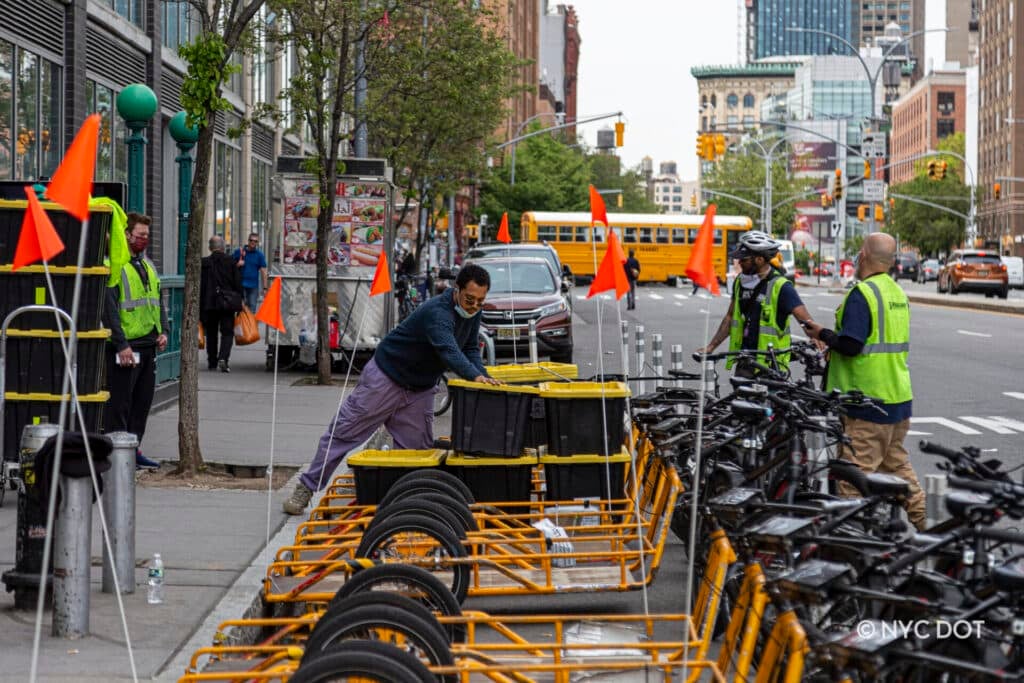
- Loading, Unloading & Staging: Commercial cargo bikes can load and unload at designated cargo bike corrals or authorized commercial vehicle loading zones without paying the meter. Allowing cargo bikes to not pay the meter was a major “carrot” for bringing big industry partners to the table.
- Education & Enforcement: Operators are required to offer and enroll delivery workers in safety training programs. Moving violations and abandoned bikes are enforced by the NYPD, while other safety violations are enforced by the Commercial Bike Unit.
- Data Sharing: During the pilot phase, all program participants were required to share GPS data from their fleets. In the current program, businesses are encouraged–but not required–to continue sharing their data with the DOT.
Timeline
April 2018: Rulemaking legalizes the operation of pedal-assist bicycles (max speed <20 MPH) on city streets.
November 2019: NYC DOT informs elected officials and community stakeholders about the upcoming commercial bike delivery pilot program.
December 2019: The city publicly launches the Commercial Cargo Bike Pilot with three participants (Amazon, DHL, UPS) and 100 e-cargo bikes.
April 2020: The New York State budget bill reduces the legal operating width for e-bikes from 48” to 36”.
May–June 2020: The pilot program expands to Brooklyn and north of 60th Street in Manhattan. Reef Technology joins the pilot, adding 200 more e-cargo bikes to the program.
July–October 2020: FedEx and NPD Logistics join the pilot.
November 2020–January 2021: NYC DOT installs cargo bike corrals with the capacity for 200+ bikes on Warren Street and Houston Street in Lower Manhattan.
August 2023: NYC DOT proposes new rules to authorize large (>36” wide) pedal-assist cargo bikes.
March 2024: The cargo bike program becomes permanent when New York City legalizes the use of pedal-assist cargo bikes up to 48” wide and with up to four wheels on city streets and in bike lanes.
April 2025: NYC DOT launches the city’s first microhubs on the Upper West Side as part of a new Smart Curbs program to further incentivize e-cargo bike deliveries.
Outcomes
- Reduced emissions: NYC DOT found that 20 cargo bike miles/day replaced 20 van or box truck miles, resulting in a per-bike CO2 savings of approximately 7 tons per year. In 2022, cargo bikes in New York City made more than 130,000 trips delivering packages, reducing over 650,000 metric tons of CO2 emissions.
- Sustainable scalability: The pilot program launched in a small area of Manhattan with 3 companies and 100 bikes, growing to 6 participants with 350 bikes and an expansion to Brooklyn by the end of the first year. Starting small allowed the city to track outcomes in real time and make data-driven decisions for future expansions.
- Granular knowledge: Information collected via data sharing agreements with delivery partners provided invaluable insight into travel patterns and commercial activity across the city. These data sets are valuable not only for improving future policies but also for identifying priority corridors for wider bike lanes.
Takeaways

Lead with flexibility. Partnerships have to work for both the city and the industry. If a program is too restrictive at first, operators won’t join. Fewer restrictions in the beginning allow both the city and operators to iterate and refine rules and regulations over time.
Get clear on the regulatory landscape. Be aware of potential conflicts between local, state, and federal regulations before engaging with delivery partners and stakeholders. NYC DOT had to bring in an intergovernmental affairs team to advocate for a rule change after the April 2020 state budget bill amended the definition of e-cargo bikes, which briefly disrupted operations for some pilot participants.
Pair new rules with supportive infrastructure. The pilot quickly called attention to curbside areas that needed improvement to further support cargo bike delivery. NYC DOT worked alongside pilot participants to set up bike corrals for staging to improve delivery operations, which then led to the development of the currently running curbside microhub pilot.
Quantify program successes. Data collected from the first year of the pilot was critical for validating its effectiveness and determining where adjustments needed to be made in order to make the program permanent.
NACTO’s Urban Delivery by Bike practitioner paper outlines how any city can begin to harness the possibilities of bike delivery, with a menu of strategies and actions that staff can apply to their city’s unique context.