Neighborhood routes are core components of a connected walking and bike network, offering people comfortable and quiet routes for everyday trips. But a network is only as good as its intersections, and a comfortable trip quickly becomes stressful—or even dangerous—when a low-traffic neighborhood street intersects with a busier, multilane road.
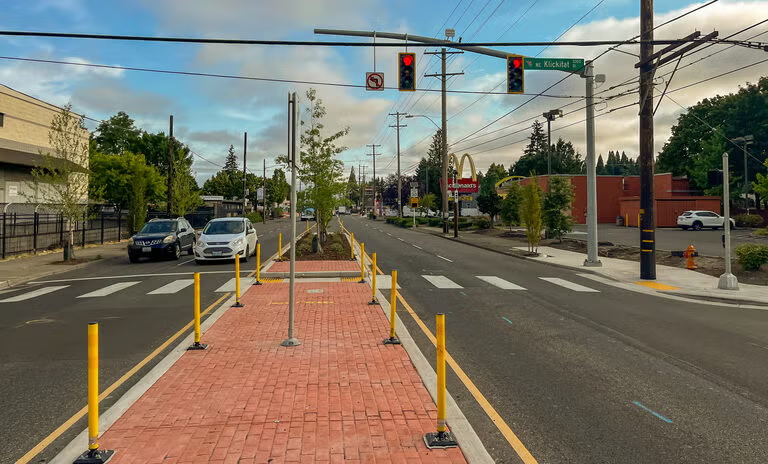
Portland, Oregon, uses half signals where lower-stress neighborhood biking and walking routes meet major roads. This intersection control strategy helps pedestrians and bikes cross safely and keeps traffic volumes low on the neighborhood streets.
Half signals in Portland
Portland has over 50 half-signal intersections, and many of them were installed before 1970! A half signal is an intersection control strategy where only the major street sees a traffic light. The minor street is stop-controlled.
Half signals force vehicles on the road with heavier traffic to stop when the signal turns red, providing dedicated time for people biking and walking to cross. Meanwhile, the side street vehicle traffic stops and yields to the major street’s traffic or to people crossing.
- Major street approaches have regular traffic signals with standard green, yellow, and red indications. In Portland, the signal rests in green, but changes to yellow then red when someone walking or biking is detected by a sensor or pushes a button.
- Minor street approaches are controlled by stop signs. In Portland, cars and other vehicles at newer half signals can only turn right onto the major street; they cannot go through the intersection or turn left. A built median reinforces the right-turn-only nature of the minor street. NACTO’s Urban Bikeway Design Guide also allows for these approaches to be controlled by flashing red lights.
- There is a WALK/DON’T WALK signal at the crosswalk for pedestrians crossing the major street.
At half signals in Portland, there aren’t bike signals. So, people biking along the minor street can choose to wait for the pedestrian signal or cross when there’s a gap in traffic.
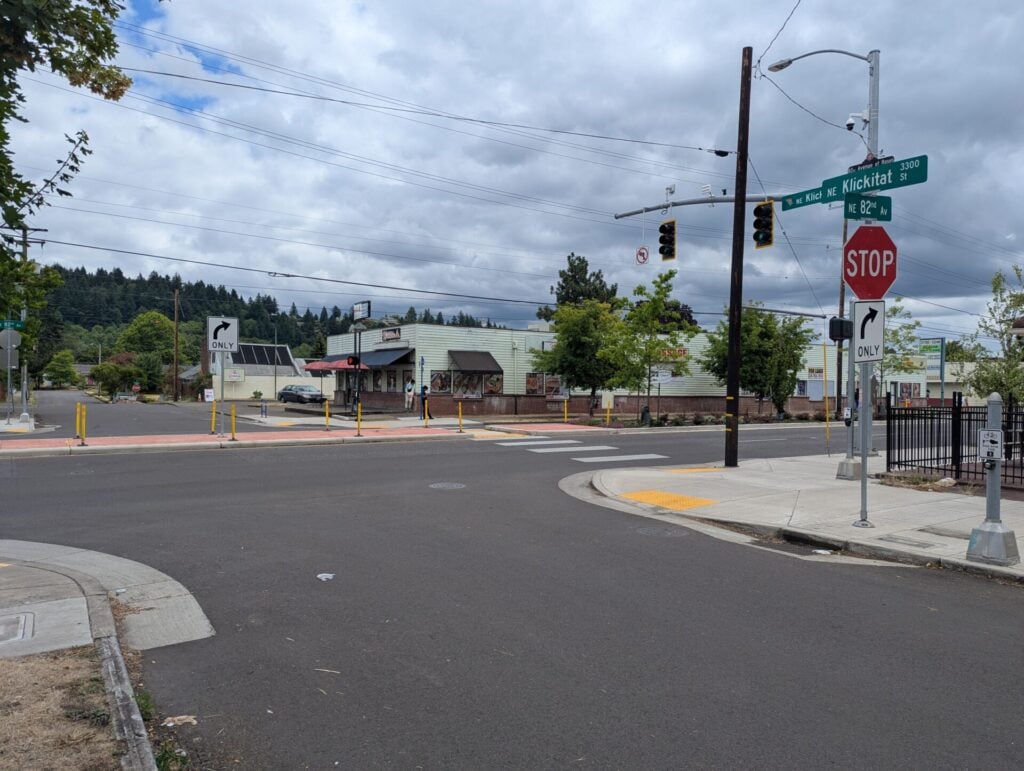
Why Portland uses half signals:
- They cost less. The Portland Bureau of Transportation (PBOT) has found that half-signals cost about 30% to 40% less than installing a full signal.
- They prevent unwanted cut-through traffic. Because Portland pairs half signals with access management strategies, drivers are not able to proceed along a neighborhood bikeway; they must turn off at the intersection. This avoids the potential of a full signal attracting car traffic, and filtering keeps volumes in a more comfortable range for people biking, walking, playing, and living along the bikeway.
- Red light compliance is high. Drivers understand the red-yellow-green indications used at half signals. Red light compliance at half signals in Portland is between 99.6% and 99.9%.
Signalizing neighborhood greenway crossings
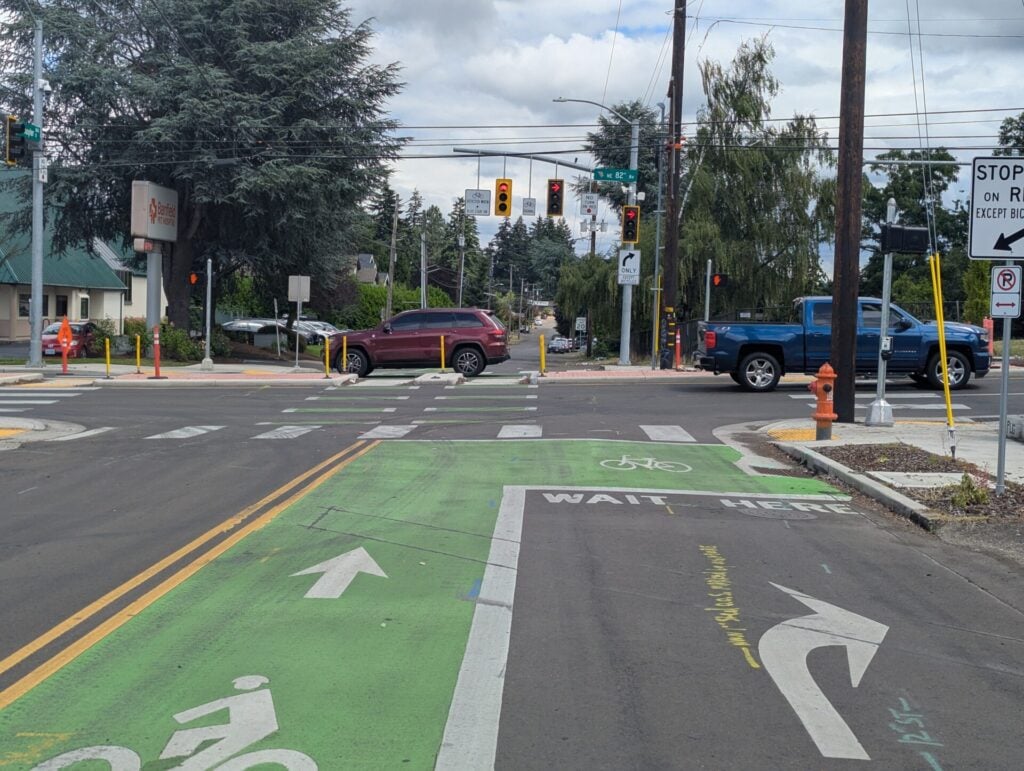
NACTO’s Urban Bikeway Design Guide notes that half signals should be prioritized where cross traffic rarely yields or where people on bikes cross multiple lanes at a time, and identifies a bike signal facing the minor street as a best practice.
Portland calls low-speed, low-volume streets that prioritize people walking, biking, and rolling “neighborhood greenways.” Along Portland’s neighborhood greenways, the PBOT modifies its half signal design to more closely resemble a full signal. The bike crossing is placed in the center of the intersection, so that turning drivers do not conflict with people riding bikes through. People biking use a bike signal with green/yellow/red indications. Loop detectors sense when someone is waiting; a blue confirmation light lets bikers know that they were detected and that the signal will soon change.
Drivers on the side street typically approach a flashing yellow right arrow. When pedestrians see a WALK signal, drivers on the major street get a red ball with a NO TURN ON RED sign.
More Information and Resources
Dive into the technical resources below if you want to use this strategy in your city.
NACTO Urban Bikeway Design Guide
Portland Resources
- Safety at Half-Signal Intersections in Portland, Oregon. 2015. Master’s thesis, Portland State University. https://doi.org/10.15760/etd.2197
- PBOT City Traffic Engineer Directive LW-003 – Half Signals. 2019. https://www.portland.gov/transportation/engineering/documents/half-signals/download
- PBOT Companion to City Traffic Engineer Directive LW-003 – Half Signals. 2019. https://www.portland.gov/transportation/engineering/documents/companion-lw-003-half-signals/download