On February 3, 2026, President Trump signed the $1.2 trillion Consolidated Appropriations Act, 2026 (H.R. 7148), officially ending the partial government shutdown and securing funding for federal transportation programs through September 30, 2026.
This bipartisan package is a mixed bag for city transportation officials. While it avoids the worst-case scenarios presented in earlier proposals, it continues a concerning trend of targeting key innovation and electric-vehicle programs established under the Infrastructure Investment and Jobs Act (IIJA).
The Numbers, Transit, and Grant Shifts
The bill provides the U.S. Department of Transportation (DOT) with an overall funding increase, though the most significant boosts are directed toward the Federal Aviation Administration (FAA).
For city transportation officials, the following funding shifts and program changes are particularly impactful.
Federal Highway Administration (FHWA)
The FHWA budget sees a $1.9 billion increase over FY 2025, bringing total budgetary resources to $64.3 billion. However, this comes with significant reprogramming of funds:
- SMART Grants Gutted: The bill transfers over $200 million away from the Strengthening Mobility and Revolutionizing Transportation (SMART) grant program, effectively zeroing it out. This program has funded initiatives such as smart signals to improve accessibility for pedestrians with low vision and enhance bus performance and reliability. All remaining unobligated funds will be redirected to the FHWA for other highway infrastructure programs.
- Electric Vehicle Funding Reductions: The legislation repurposes $1 billion in advance appropriations for highway infrastructure programs under the IIJA, including more than $800 million taken from the National Electric Vehicle Formula Program (NEVI). Because many states had already contracted for initial highway-side charger installation, these cuts are expected to heavily impact the next stage of the NEVI program, which was focused on bringing chargers into local communities.
- Member-Directed Projects: The bill includes $1.5 billion in earmarks. This funding supports local projects at many NACTO member agencies, including bridges, transit, electric vehicle charging, safety, and complete streets.
- Reconnecting Communities: This popular program to address the ramifications of past highway projects is back after being cut in the summer’s HR.1. However, it is funded at just $30 million, just 15% of the $200 million obligated for this year in the bipartisan infrastructure bill.
Federal Transit Administration (FTA)
While the FTA received more funding than previous budget proposals suggested, the final amount is still $165 million less than FY 2025 levels.
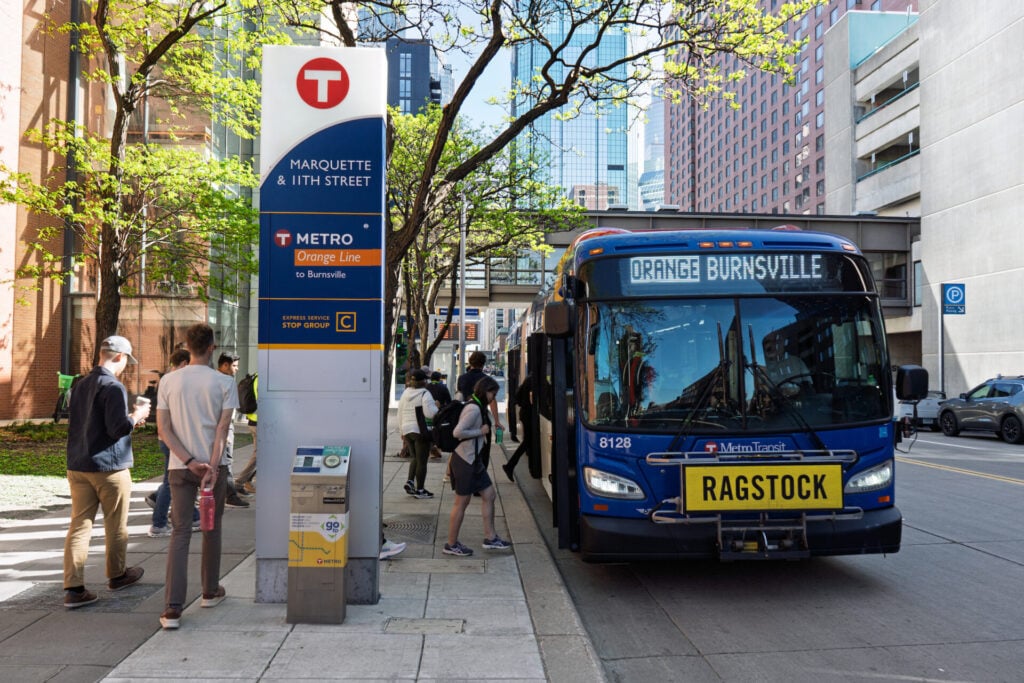
- Increase for Transit Formula Grants: $14.6 billion is allocated for Transit Formula Grants to expand bus fleets and maintain a state of good repair—an increase of $363 million above FY 2025.
- Capital Investment Grants (CIG): The bill provides a total of $3.7 billion for CIG, almost $500 million below the funding levels set in previous years. This program has been a key source of funding for transit agencies to fund new and expanded rapid, commuter, and light rail, streetcars, ferries, and bus rapid transit investments.
Special Events Funding
The bill allocates specific funding to assist transit agencies in managing local transportation for upcoming major global events:
- $100 million for the 2026 World Cup: Supporting host cities including Atlanta, Boston, Dallas, Houston, Kansas City, Los Angeles, Miami, New York/New Jersey, Philadelphia, the San Francisco Bay Area, and Seattle.
- $94 million for the 2028 Olympics: Directed toward supporting transportation efforts in Los Angeles.
Takeaway: 2026 Appropriations are “Better than Bad”
Cuts to programs—while not good—are better than feared. Provisions that would have prohibited automated speed enforcement cameras and blocked funding for New York City’s congestion pricing program were notably absent from the final bill.
Overall, the 2026 appropriations bill can be characterized as “better than bad.” It continues funding for many essential services but reinforces the precedent set by the “One Big Beautiful Bill Act” (H.R. 1) from the summer of 2025, which contained numerous provisions negatively impacting city transportation departments. The trend is clear: programs that cities rely on are increasingly being targeted for cuts.
The Road Ahead
The immediate funding battle has ended, but a larger challenge looms. The IIJA expires on September 30, 2026, the same day this new funding package runs out.
We are entering a critical window for federal transportation policy. Work is now shifting to funding for fiscal year 2027 —the first year beyond the current IIJA authorization. The bill is expected to cover multiple years of transportation funding. The draft text for the next transportation reauthorization bill has not yet been released, but is expected potentially in March or April.
Many transportation programs vital to cities are currently on “life support,” and we expect significant battles over both the 2027 appropriations and the reauthorization bill. NACTO will continue to advocate for the protection and expansion of critical priorities, including:
- Continued support for direct federal funding to cities, including via grant programs such as Safe Streets and Roads for All and Reconnecting Communities
- Robust funding for transit capital programs and everyday operations
- Reforms to accelerate project delivery, including in the grant-making process
Learn more about NACTO’s federal policy work.