Kevin Zolkiewicz, Flickr
As part of an effort to balance bicycling and transit accommodations, the City of Toronto has introduced innovative stop designs on two constrained streets: Roncesvalles Avenue is a neighborhood streetcar street, and Sherbourne Street is an important bus corridor leading downtown.
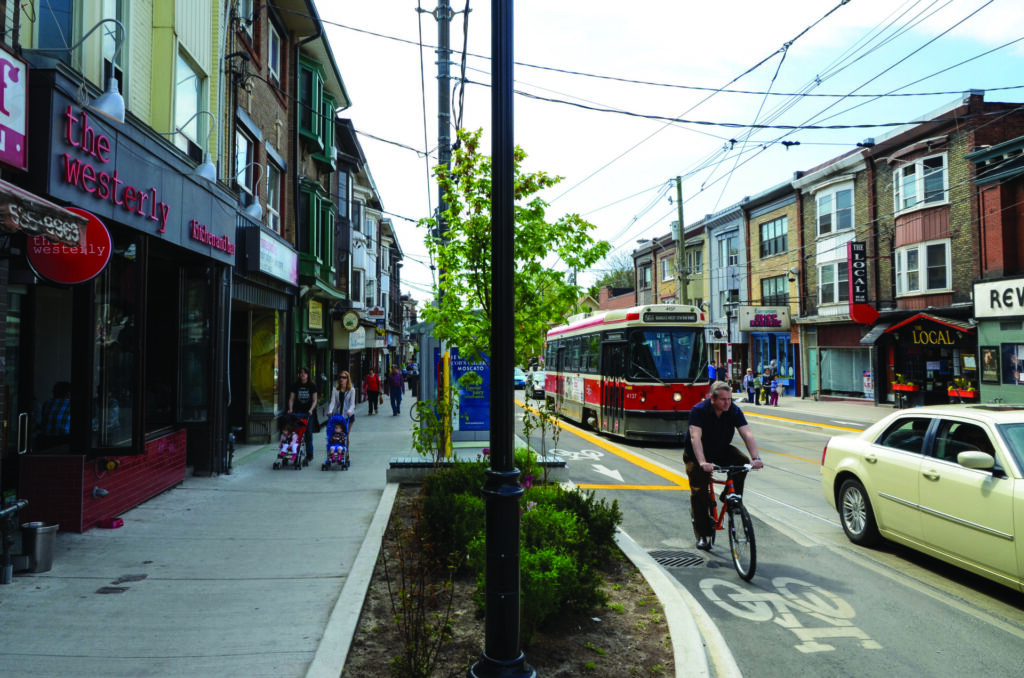
The city first reconstructed Roncesvalles Avenue, which includes a legacy streetcar line. Many bicyclists use the street to access its density of destinations, though there is not width available for dedicated bicycling infrastructure. However, to facilitate safe bicycling movements at stops while providing accessible boarding for transit riders, the city tested a shared boarding/bike lane—the bicycle lane rises to curb level at stops, which bulb out into the parking lane shadow. When the streetcar arrives, bicyclists must yield to boarding or alighting transit passengers. At all other times, bicyclists may cross the bulb without having to cross the streetcar tracks, eliminating a significant hazard.
Key to the success of the Roncesvalles Avenue treatment is a strong culture of compliance, and existing regulations requiring all other road users to yield to transit.
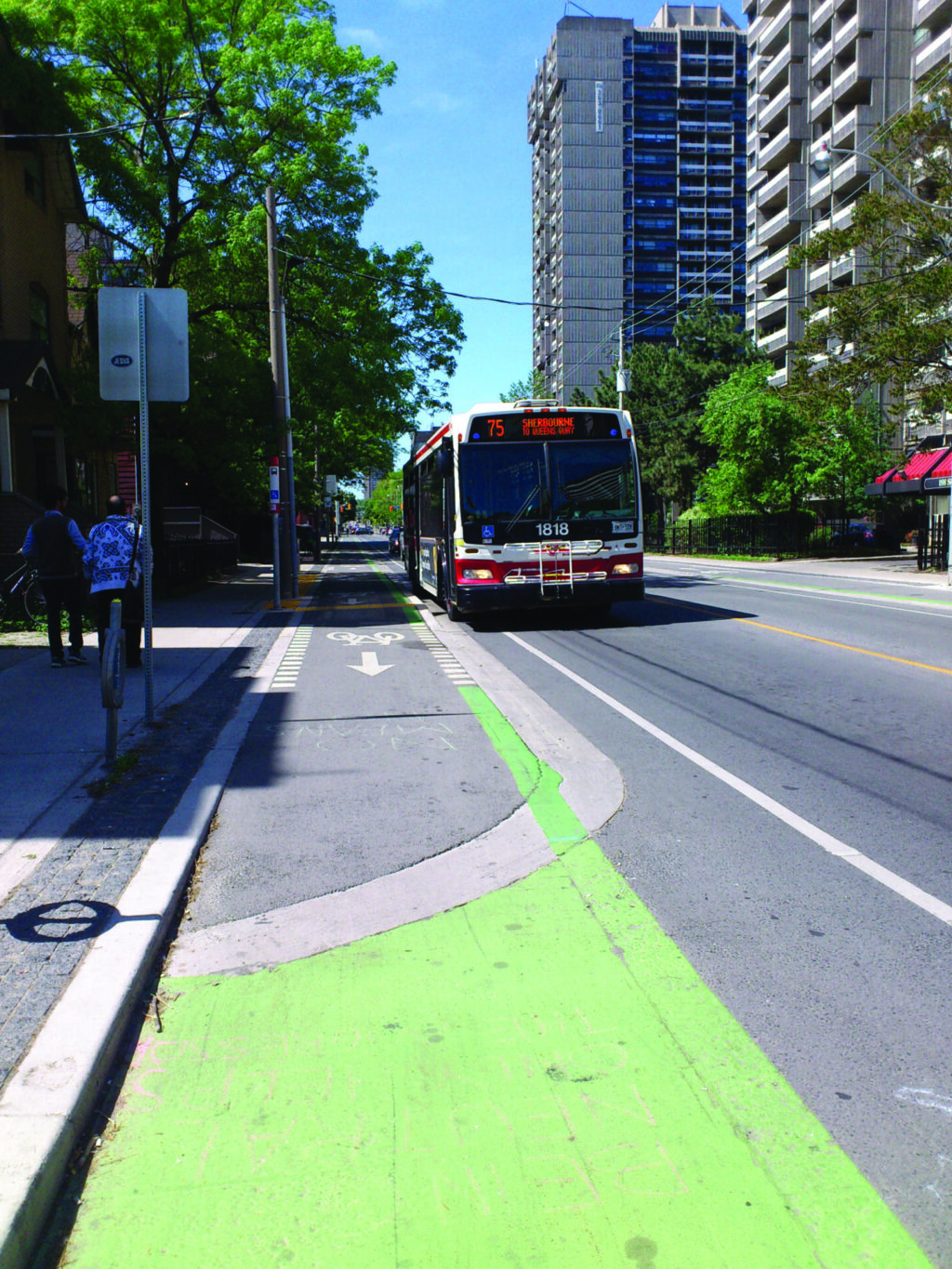
Learning from Roncesvalles, the city applied the treatment to Sherbourne Street, another key but narrow corridor, where a protected bike lane was slated to be installed. Because the constrained right-of-way precluded installation of boarding islands, the raised boarding bike lane was installed at stop locations, allowing transit riders to gain accessible boarding to the bus, while accommodating bicyclists in a high-quality, low-stress facility along the 1.5-mile corridor.
One key lesson from the Roncesvalles Avenue facility was applied to Sherbourne Street—on the boarding lane, a detectable warning strip was applied at two locations on the platform. First, as bikes entered the platform, yellow detectable strip was installed at the top of the ramp to warn bicyclists of the yield expectation. Along the length of the platform at the back edge (between platform and sidewalk), a detectable strip is used to warn pedestrians they are entering a shared facility. When the bus arrives, transit riders have priority; at all other times, bicyclists have priority through the facility. In addition to the grade change, the bike lane also narrows slightly through the platform to slow bicyclists as they move through.
Finally, the city is able to sweep and plow the cycle track all seasons using mini-sweep vehicles.
Transit Street Design Guide
Learn more about transit streets in NACTO’s Transit Street Design Guide.