In January, NACTO published the third edition of Urban Bikeway Design Guide, its first update in a decade. The new edition goes beyond a kit of parts to a more complete how-to manual for designing safe, bikeable, inviting streets. Soon, we’ll make the Urban Bikeway Design Guide available for free on our website. In the meantime, we’re posting excerpts each week here on our blog. Can’t wait until the Guide is on our website? Buy it from Island Press, and use code UBDG3 for 20% off.
Today’s excerpt is from Section 5.1: Maintaining Bikeways.
A bike network is a core component of the transportation system and needs to be accessible year-round. The accumulation of debris, snow, or ice in bikeways poses a significant safety risk and can discourage people from riding bikes. Design and policy decisions that prioritize regular bikeway clearing make it possible for people to access bike networks in all weather conditions.
Maintenance teams should be consulted and involved in the design of bikeways to help ensure that clear, smooth bikeways are available citywide. Designing bikeways that accommodate existing equipment for sweeping and snow clearing helps ensure bikeways are available year-round. In most cities, a 6.5-7.5 ft (2-2.3 m) minimum clear width in the bikeway is necessary. This width also supports All Ages & Abilities users by allowing space for platooning, passing, and riding side-by side.
Formal maintenance agreements with private property owners, institutions, and other third parties can help enhance a city’s ability to keep its bike network clear year-round. Such agreements should always be supplemental to existing maintenance activities and not used to absolve the municipality of bikeway maintenance. Bikeways should be designed to meet city standard specifications in case third parties are unable to renew agreements.
Credit: Seattle Department of Transportation, flickr.com/people/sdot_photos
Sweeping
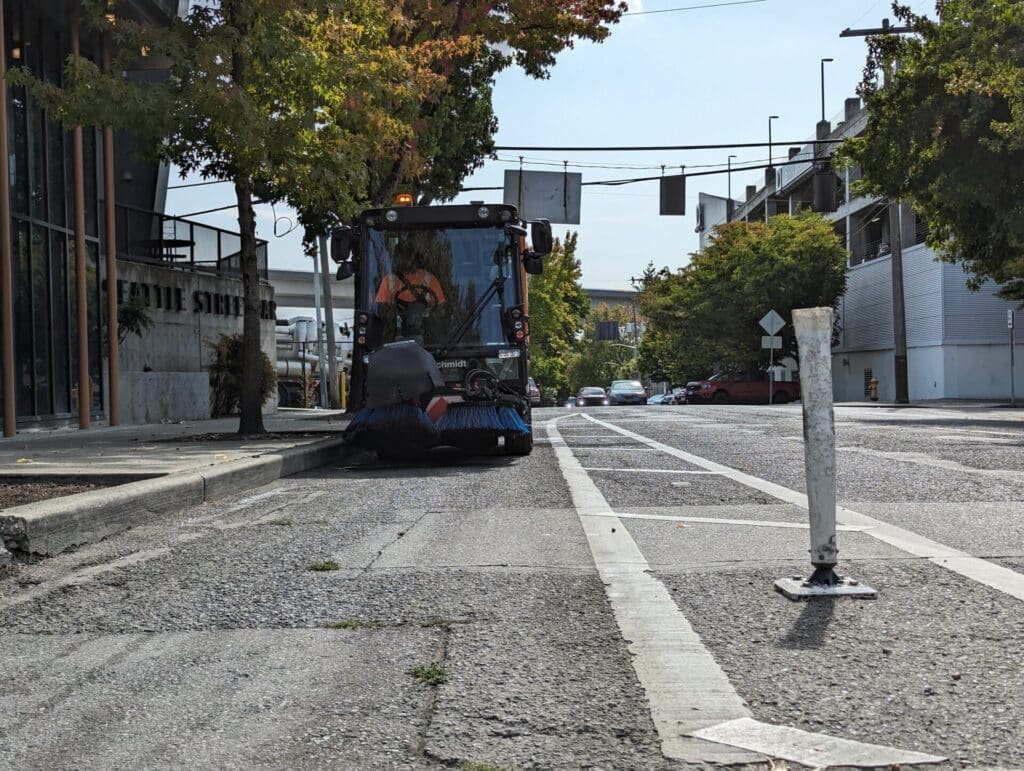
Be sure that maintenance crews can physically sweep the bikeway. Design protected bike lanes so they are wide enough to fit sweeping equipment. Consider the swept-path of equipment; sharp curves can be difficult to maintain with machines and may require manual labor. Purchase smaller vehicles to ensure the ability to clear an expanding network of bikeways.
Raised bikeways may collect less debris than street-level bikeways but will still need periodic sweeping with specialized equipment or clearing by hand. Bike lanes constructed with permeable pavement will also require regular vacuuming to maintain permeability.
Typical practice is to sweep bikeways with the same regularity as the street. Some bikeways will require additional sweeping based on the season, tree canopy, and frequency of litter and debris accumulation. Additional sweeping will be necessary in autumn in locations with deciduous trees. In cold-weather cities, street sweeping typically does not extend through winter; however, debris will continue to accumulate in the bikeway and require periodic sweeping during the winter months. Clear bikeways as soon as possible after major weather events. Be prepared to respond to service requests with more detailed attention, such as removing smaller pieces of debris that are hazardous to people on bikes but traversable by motor vehicles.
Additional coordination with other departments and agencies will be needed when sweeping near sensitive areas, such as encampments or locations where syringes accumulate in the roadway. Proactive outreach during planning and design can help build these relationships.
Selecting and Trimming Vegetation
Schedule regular trimming of vegetation along bikeways to prevent encroachment. Vegetation maintenance can be minimized by selecting species that will not encroach on the bikeway. Consider the growth patterns of grassy plants and weeds when planting near bikeways to minimize growth into the bike lane.
Regularly trim trees with branches that protrude into the bikeway below 8 ft (2.4 m). Avoid trees that produce nuts, fruits, and large seeds that can drop into the bikeway, such as oak, spruce, sweetgum, and pear trees.

Credit: Boston Public Works Department
Winter Weather Maintenance
Be sure that maintenance crews can physically plow the bikeway. Effective snow clearance or removal practices that keep the bikeway surface ice-free and clear of snow allow for year-round bike travel. Bikeways must be included in a city’s annual winter maintenance plan for de-icing, snow clearing and removal.
- De-icing: spreading salt or liquid melter to prevent ice accumulation and snow compaction in the bikeway
- Snow clearing: pushing, blowing, or sweeping snow off the bikeway and onto another part of the street
- Snow removal: loading excess snow into a dump truck for transportation to a snow disposal site
When more than 1 in (2.5 cm) of snow is expected, plan for snow clearing during and after the storm. Salting and sanding, also known as gritting, should precede and accompany snow clearing.
Preventing snow from accumulating in the bikeway during the storm will reduce the need for snow removal afterward. Snow removal is an infrequent but expensive undertaking necessary for many situations in a city, including near curb ramps and through median islands. Bikeways can benefit from snow removal when snowbanks encroach into the bikeway, limiting use.
Designing for Winter Maintenance
Create space for snow windrows. Where possible, design snow storage areas downslope from the bike lane to reduce icing risk during freeze-thaw cycles. The street cross-section will impact how much snow storage will be needed.
Meltwater running over a bikeway can cause icing. In retrofit and reconstruction projects, grade the roadway and bikeway to encourage proper drainage.
Make sure bikeways and adjacent travel or parking lanes are designed to accommodate equipment for snow clearing and removal. Consider bikeway width, turn radii, and tapers. Work with crews to understand what they can and cannot steer around. Modify standard details to accommodate existing vehicles if possible to do so without creating unattainable expectations.
Install vertical objects along bikeways to guide snow clearance during and after storms. Flexible delineators or signs should be installed before and after driveways and intersections to make it easier for plow drivers to identify the bikeway. Signs are especially valuable in these locations as they are much taller than flexible delineators and can be seen even during heavy snowfall. Post object markers or signs for curb regulations on the sign poles. Consider applying a reflective strip to the pole.
Permeable asphalt is less likely to ice over and become slippery than regular asphalt. However, it will require its own maintenance cycle of vacuuming to ensure continued permeability.
Invest in Maintenance Equipment to Meet Community Expectations
Developing and publicizing service level agreements for bikeway maintenance can help the general public understand what to expect. Cities may opt to prioritize specific, connected segments of the bike network for early winter maintenance activities. Priority segments can be added over time as local best practices are solidified.
Invest in growing a fleet of dedicated, bikeway-sized maintenance equipment. This equipment can often be used for other purposes, such as clearing alleys, parking lots, and plazas. Consider partnerships across agencies to share equipment or contracts. For example, a smaller plow that belongs to the parks department may be used by the sanitation department to clear bikeways near parks or the two departments may create work orders off the same shared contract with a snow plowing vendor. At scale, each department may need to procure their own equipment
or contracts.


